



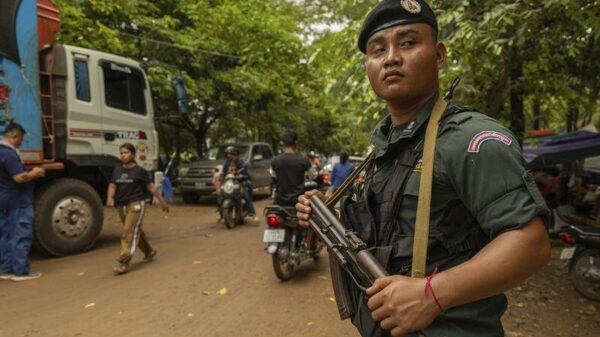





























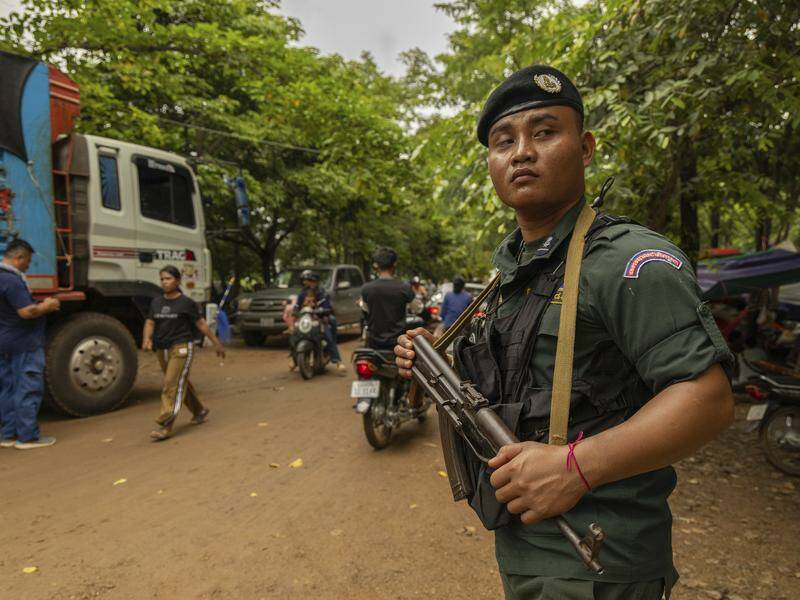
Fighting between Thailand and Cambodia has intensified along their disputed border, with both nations asserting their commitment to defend their sovereignty. The recent clashes, which reignited on Monday, have raised concerns about the viability of a fragile ceasefire that was previously brokered by former US President Donald Trump in July 2023.
Each side has blamed the other for instigating the renewed hostilities, leading to uncertainty over the ceasefire agreement. Cambodia’s former Prime Minister, Hun Sen, stated that his country waited 24 hours to honor the ceasefire and facilitate evacuations before launching counterattacks against Thai forces. In a Facebook post, he emphasized, “Cambodia needs peace, but Cambodia is compelled to counterattack to defend our territory.”
On the Thai side, military officials reported clashes occurring in five border provinces, including a naval operation in Trat Province aimed at expelling Cambodian soldiers. They claimed that Cambodian forces were utilizing artillery, rocket launchers, and drones to target Thai positions. Thai Defence Ministry spokesperson Rear Admiral Surasant Kongsiri expressed the nation’s resolve: “Thailand is determined to defend its sovereignty and territorial integrity, and therefore military measures must be taken as necessary.”
The conflict has resulted in significant casualties. Cambodia’s Defence Ministry accused Thailand of engaging in “brutal and unlawful actions,” reporting that nine civilians have died and 20 others have been seriously injured since the clashes began. In contrast, Thai officials acknowledged the deaths of three soldiers and reported 29 injuries among their ranks. Cambodian Prime Minister Hun Manet, son of Hun Sen, condemned Thailand’s military actions, asserting that they “must not use military force to attack civilian villages under the pretext of reclaiming its sovereignty.”
Both countries have initiated the evacuation of hundreds of thousands of residents from border areas, reflecting the severity of the situation. Tensions have been escalating since November 2022, when Thailand suspended de-escalation measures agreed upon during a summit facilitated by Trump, following an incident where a Thai soldier was injured by a landmine allegedly placed by Cambodia.
The current clashes mark the most intense confrontations since a five-day exchange of rockets and heavy artillery in July 2023, which resulted in at least 48 fatalities and displaced approximately 300,000 people. Trump’s intervention at that time led to a ceasefire agreement, but recent events have threatened to unravel those efforts.
Historically, Thailand and Cambodia have contested their sovereignty along undemarcated segments of their 800 km land border, often ignited by disputes over ancient temples. This long-standing tension has led to numerous armed conflicts, including a deadly artillery exchange in 2011.
As the situation remains volatile, the international community watches closely, hoping for a resolution that can bring lasting peace to the region.