



































A groundbreaking study conducted by researchers from the University of Electro-Communications and RIKEN in Japan reveals how spins influence the crystal structure of solid oxygen under extreme magnetic fields. Published on November 8, 2025, in Physical Review Letters, the findings indicate that at magnetic field strengths exceeding 100 Tesla (T), spins and atomic arrangements can significantly alter, leading to new phases of matter and unusual physical phenomena.
Placing materials in magnetic fields above 100 T generates intriguing behaviors, including a physical phenomenon known as magnetostriction. This effect causes the crystal structure of materials to deform, either stretching or shrinking. Such intense magnetic fields are challenging to maintain, typically lasting only a few microseconds due to the immense stress they place on the generating coils, which often results in their immediate failure.
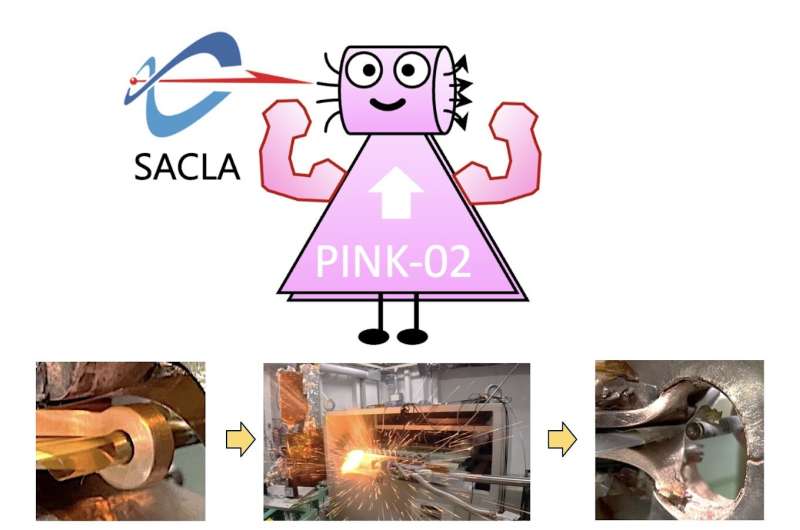
To overcome these limitations, the research team developed a novel portable magnetic field generator known as PINK-02. This innovative device enables the production of magnetic fields around 110 T for brief periods, allowing researchers to investigate the positions of atoms in materials under these conditions.
Capturing Atomic Structures at Extreme Fields
Using PINK-02, the researchers conducted an X-ray experiment on solid oxygen crystals. They employed ultrafast XFEL X-ray pulses to capture the atomic arrangements during the application of the magnetic field. According to Akihiko Ikeda, the lead author of the study, this was the first time such experiments had been conducted at these extreme field strengths, marking a significant advancement in the exploration of materials under ultrahigh magnetic fields.
The results revealed that solid oxygen underwent a substantial magnetostriction, with the crystal being stretched by approximately 1%. This deformation was linked to competing spin interactions and lattice forces within the material under the influence of strong magnetic fields.
Implications for Future Research
The implications of this research extend beyond solid oxygen. The team’s findings suggest that spins play a crucial role in determining the stability of a material’s crystal structure when exposed to extreme magnetic environments. Moving forward, Ikeda and his colleagues aim to explore the crystal structure of solid oxygen’s θ phase by increasing magnetic field strengths to between 120 T and 130 T. They also plan to apply their methods to a broader range of materials, potentially uncovering new insights into condensed matter physics.
Ikeda emphasized the importance of their work, stating, “Our findings demonstrate that spins can affect the stability of a material’s crystal structure. We will continue to investigate how various materials respond to magnetic fields above 100 T.”
This research marks a significant step in understanding the complex interactions between spins and crystal structures, paving the way for future studies in condensed matter physics.
