



































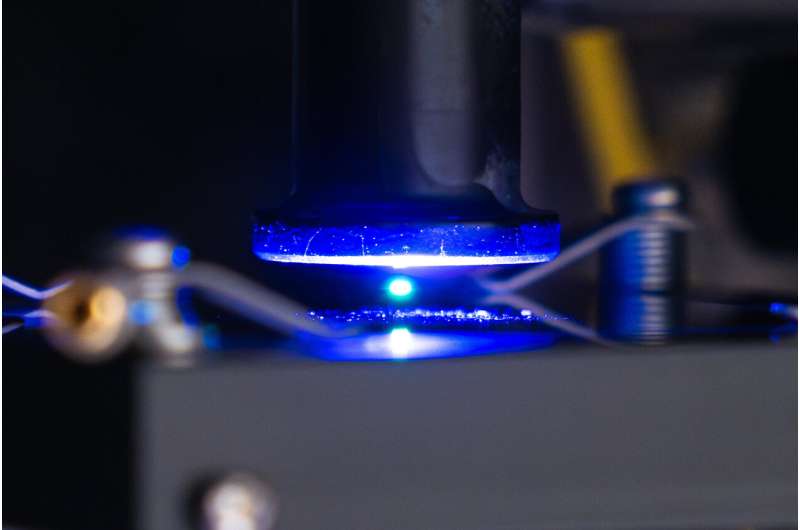
Researchers at the Institute of Science and Technology Austria (ISTA) have achieved a significant breakthrough in the field of acoustic levitation by overcoming a fundamental challenge known as “acoustic collapse.” Their findings, published on December 2, 2025, in the Proceedings of the National Academy of Sciences, demonstrate how electric charge can be used to keep multiple levitated particles separated, opening new avenues for applications in materials science, robotics, and microengineering.
Acoustic levitation, the process of using sound waves to suspend particles in air, has long been effective for single particles. However, when multiple particles are introduced, they tend to clump together due to attractive forces created by sound scattering. Scott Waitukaitis, an assistant professor at ISTA, and his team initially aimed to harness this technique for more fundamental research rather than solely for practical applications.
“While acoustic levitation has been utilized in areas like holography, I believed it could serve broader scientific purposes,” Waitukaitis noted. His research group focused on developing methods to control matter with sound, which led to the discovery of a technique to counteract acoustic collapse.
Introducing Electrostatic Forces
The key to this advancement was the introduction of electric charge to the levitating particles. Sue Shi, a Ph.D. student and lead author of the study, explained that by applying electrostatic repulsion, they were able to maintain separation between particles. “By counteracting sound with electrostatic repulsion, we can keep the particles separated from one another,” Shi stated.
Through their experiments, the team was able to create various configurations of particles, ranging from completely separated arrangements to fully collapsed states and hybrids of both. They also developed simulations to analyze these configurations, balancing sound-scattering and electrostatic forces. This ability to manipulate the interactions among particles represents a major advancement in the field.
Unexpected Discoveries and Future Implications
Alongside their primary findings, the researchers observed intriguing behaviors indicating “non-reciprocal” interactions, which appear to contradict Newton’s third law of motion. Certain particle arrangements exhibited spontaneous rotation, while pairs of particles seemed to chase each other. Although such phenomena had been theoretically predicted, they had not been observed in practice due to the limitations of previous acoustic levitation techniques.
“You can’t study how individual particles interact when you can’t keep them apart,” explained Waitukaitis, emphasizing the significance of their discovery. The introduction of electrostatic forces has provided a stable platform for further investigation into these complex interactions.
The implications of this research extend beyond academic curiosity. The new method paves the way for innovative approaches in manipulating matter suspended in air, which could greatly benefit fields such as materials science and micro-robotics. Shi initially found the unexpected behaviors frustrating, as they interfered with her goal of creating clean crystalline structures. However, exposure to other scientists’ enthusiasm for these anomalies helped her recognize their potential. “The most interesting discoveries often come from the things that don’t go as planned,” she remarked.
As the team continues to explore the ramifications of their findings, their work stands as a testament to the power of scientific inquiry and innovation. The ability to control and manipulate levitated matter has the potential to revolutionize various technological fields, marking a significant leap forward in our understanding of acoustic levitation.
