



































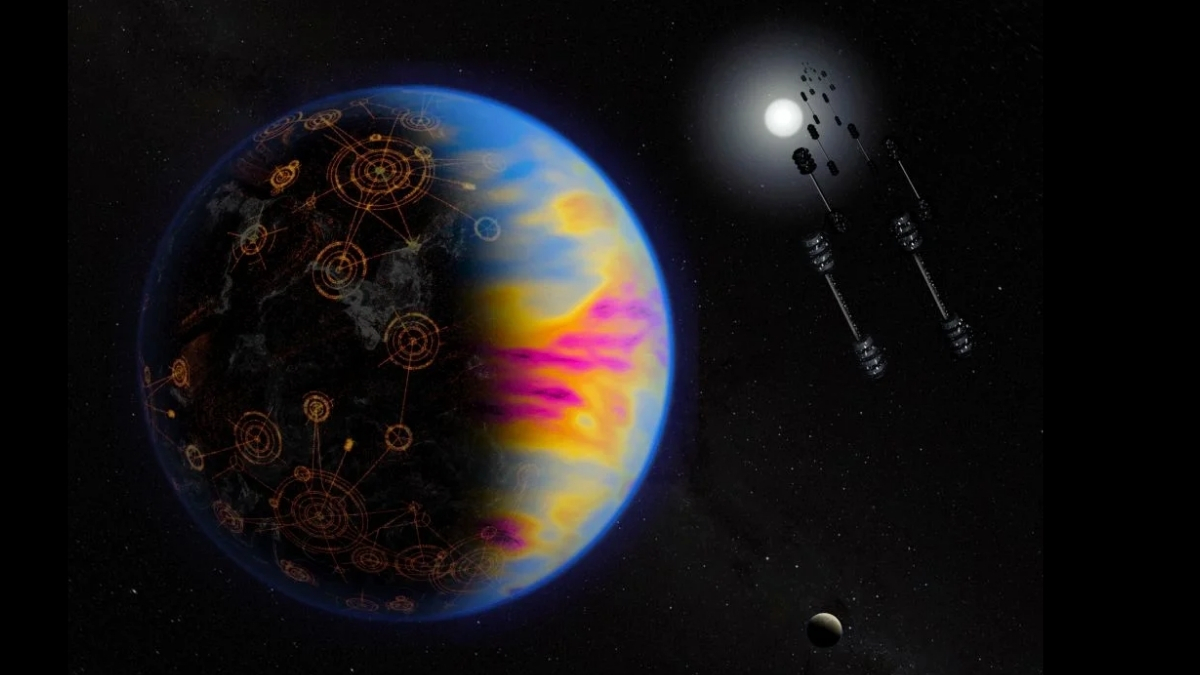
The potential for humanity to make first contact with an extraterrestrial civilization may not align with the dramatic portrayals often seen in science fiction. According to a new research article by David Kipping, a prominent figure in astrophysics and director of the Cool Worlds Lab at Columbia University, the initial detection could be characterized by unusually strong signals, referred to as “loud” technosignatures. This insight is detailed in Kipping’s upcoming paper in the Monthly Notices of the Royal Astronomical Society.
Kipping’s research challenges the conventional narratives of alien contact, which often depict hostile invasions or benevolent beings. Instead, he suggests that the first signs of extraterrestrial intelligence (ETI) may arise from atypical sources, driven by the unique observational biases of our detection methods.
The Atypical Nature of First Contact
Kipping draws parallels between the discovery of exoplanets and the potential for detecting alien civilizations. The first exoplanets identified in the early 1990s orbited pulsars—highly visible cosmic objects due to their precise timing. Currently, fewer than ten of the over 6,000 exoplanets cataloged in the NASA Exoplanet Archive are found around pulsars, underscoring that initial discoveries are not representative of broader categories.
Kipping elaborates on this idea through the concept he terms the Eschatian Hypothesis. He posits that the first confirmed detection of an extraterrestrial civilization is likely to be an “unusually loud” signal, possibly arising from a civilization in a precarious or declining state. This perspective echoes the religious concept of eschatology, which pertains to end-times and existential crises.
The implications of this hypothesis are significant. Kipping suggests that if humanity’s first encounter with an alien civilization were to occur, it might manifest as a clear, loud signal indicative of a civilization grappling with its own challenges.
Searching for Anomalous Signals
The Wow! signal, detected in 1977, serves as a historical example of what such a signal might look like. Kipping speculates whether this mysterious transmission could have been a distress call from a civilization facing its own end. He emphasizes the importance of broadening the scope of our search strategies.
To optimize the chances of detecting these atypical signals, Kipping advocates for wide-field, high-cadence surveys that focus on transient phenomena. Modern observatories, such as the Vera Rubin Observatory and the Sloan Digital Sky Survey, are increasingly monitoring the night sky for changes. These facilities are ideally positioned to identify unusual signals that may not conform to known astrophysical phenomena.
Kipping argues that prioritizing searches for broad, anomalous transients—rather than narrowly defined technosignatures—could lead to groundbreaking discoveries. This approach encourages the exploration of signals that exhibit unexpected luminosities or behaviors, potentially revealing the first signs of extraterrestrial intelligence.
In conclusion, Kipping’s research shifts the narrative surrounding first contact with alien civilizations from fantastical scenarios to a more grounded understanding. The likelihood that humanity’s initial encounter will be characterized by a loud, atypical signal challenges the dramatic expectations often portrayed in popular culture. As astronomical technology continues to advance, the search for these signals could pave the way for a new era of understanding our place in the cosmos.
