



































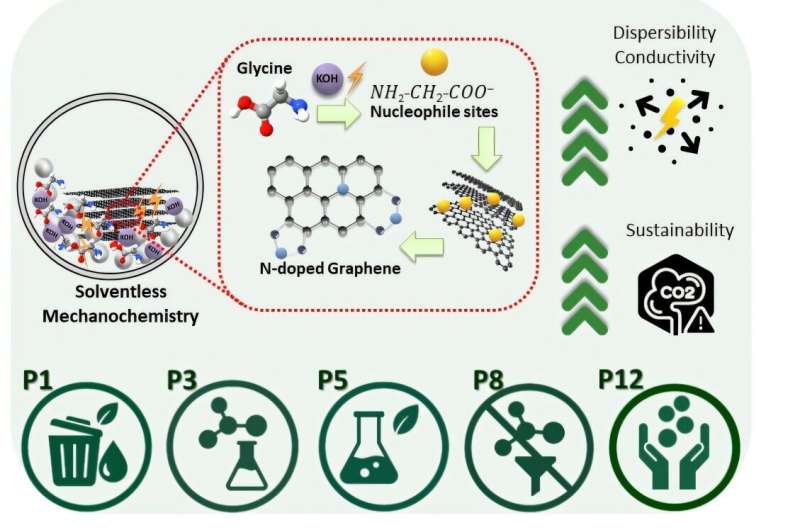
Graphene, often hailed as a revolutionary material due to its unique properties, faces significant hurdles in practical applications. Despite years of research, many technologies utilizing graphene remain confined to laboratory settings. A recent study led by Chamalki Madhusha and colleagues at Monash University presents a promising alternative for creating functionalized graphene materials through sustainable methods.
The challenge with traditional graphene is its poor solubility in common solvents. This limitation necessitates complex functionalization processes, which often involve toxic chemicals, high temperatures, and substantial waste generation. The new research, published in ACS Sustainable Chemistry & Engineering on December 25, 2025, explores a solvent-free method for producing nitrogen-doped graphene nanoplatelets (N-GNPs) using a bio-derived mechanochemical approach.
Rethinking Graphene Functionalization
Graphene’s remarkable properties make it suitable for various advanced applications, including smart coatings and conductive composites. However, these applications typically require significant chemical modifications to enhance graphene’s dispersibility and performance. One common technique is nitrogen doping, which improves the electronic structure and interactions with solvents or polymer matrices. Unfortunately, conventional methods often employ harmful nitrogen precursors and involve energy-intensive purification steps, including high-temperature post-annealing.
Madhusha’s team turned to mechanochemistry, a technique that harnesses mechanical forces to drive chemical reactions without solvents. By employing a ball-milling process, they directly functionalized graphite with amino acids as a nitrogen source under ambient conditions. This innovative approach resulted in N-GNPs produced without harsh solvents or toxic reagents, maintaining high electrical conductivity and good dispersibility.
Measuring Sustainability in Material Production
The research team did not merely evaluate the performance of the N-GNPs; they also assessed the sustainability of their production method. Employing both qualitative and quantitative metrics, they measured waste generation and energy consumption. The process achieved a material yield of approximately 80%, a significant achievement for solid-state synthesis. More importantly, the methodology exhibited a lower E-factor, a green chemistry metric that quantifies waste produced per unit of product.
By eliminating solvents and high-temperature steps, the overall energy consumption was reduced, demonstrating that sustainable practices can be integrated into advanced materials production without sacrificing quality. This research indicates that greener process designs can substantially influence the sustainability of material manufacturing.
The incorporation of nitrogen atoms into the graphene lattice enhances properties such as electrical conductivity and chemical reactivity, making N-GNPs excellent candidates for a range of applications. Their potential as nanofillers in composite systems was highlighted, where they significantly improve electrical, thermal, and mechanical properties.
This new method aligns with green chemistry principles, advocating for environmentally friendly practices in materials design. Rather than compromising functionality for sustainability, this research exemplifies how innovative design choices can lead to both advanced materials and lower environmental impact.
Looking forward, Madhusha’s work opens avenues for developing repairable coatings, recyclable composites, and longer-lasting structural materials. The compatibility of N-GNPs with vitrimers—polymers that combine the durability of thermosets with the recyclability of thermoplastics—illustrates the multifunctional benefits of this approach. These advancements could pave the way for materials that meet both performance and sustainability standards.
Overall, this research underscores the importance of rethinking traditional manufacturing processes for advanced materials. As industries in electronics, aerospace, energy storage, and smart coatings increasingly prioritize environmental responsibility, adopting green methods like mechanochemistry will be essential. Future studies will explore adapting this synthesis approach to other dopants and scaling it for broader applications.
As demand for innovative functional materials continues to rise, the focus on sustainable synthesis strategies will shape the future of material science. The work of Madhusha and her team is a significant step toward aligning nanomaterials with sustainability goals, ensuring that advancements in technology do not come at the expense of the environment.
