



































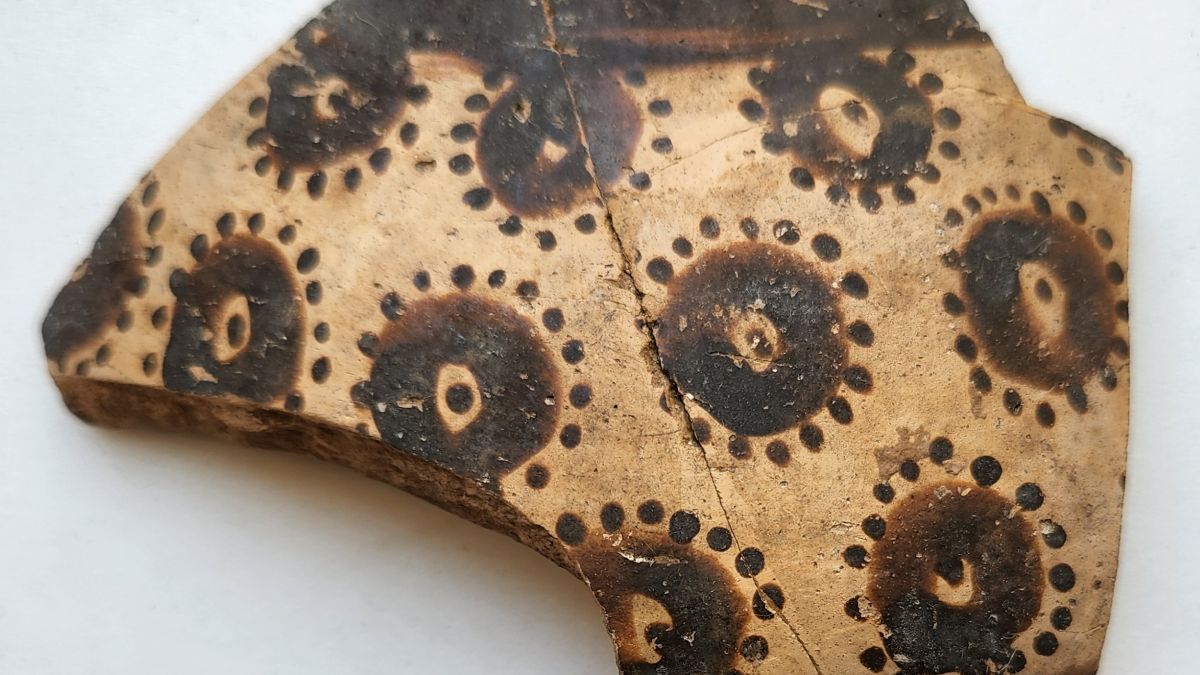
BREAKING: Exciting new findings reveal that the world’s oldest known botanical art, originating from the Halafian culture of northern Mesopotamia around 6000 BCE, illustrates early mathematical thinking. This groundbreaking study, led by researchers Yosef Garfinkel and Sarah Krulwich from the Hebrew University of Jerusalem, highlights how seemingly simple motifs on ancient pottery indicate a profound cultural shift.
The decorated pottery not only showcases an early appreciation for the beauty of plants but also reveals a sophisticated understanding of mathematical concepts. The study emphasizes that while written numerical symbols did not appear until thousands of years later, the floral designs exhibit a remarkable grasp of symmetry and numerical sequences.
According to Garfinkel and Krulwich, “These vessels represent the first moment in history when people chose to portray the botanical world as a subject worthy of artistic attention.” Their analysis, published in the Journal of World Prehistory, meticulously catalogs plant motifs from 29 archaeological sites, providing compelling evidence of early cognitive development in art and mathematics.
The researchers argue that the plants depicted—flowers, seedlings, and towering trees—are not related to agriculture but reflect an aesthetic appreciation for plant beauty. This artistic expression likely arose from an early awareness of mathematical patterns, influencing daily life practices such as sharing harvests and allocating communal fields.
A striking discovery involves the geometric sequences found in the flower motifs, with many bowls featuring petals in arrangements of 4, 8, 16, 32, and even 64. “These patterns show that mathematical thinking began long before writing,” Krulwich states, underscoring the importance of visualizing divisions and sequences through art.
These findings challenge the long-held assumption that early humans lacked advanced cognitive abilities. Instead, they indicate that the ability to recognize and replicate mathematical patterns was integral to their cultural expression.
As the research continues to attract attention, it raises intriguing questions about the cognitive developments of ancient societies and how these early artistic endeavors laid the groundwork for future mathematical reasoning.
Stay tuned for further updates on this fascinating revelation that bridges art, mathematics, and our understanding of human history.
