



































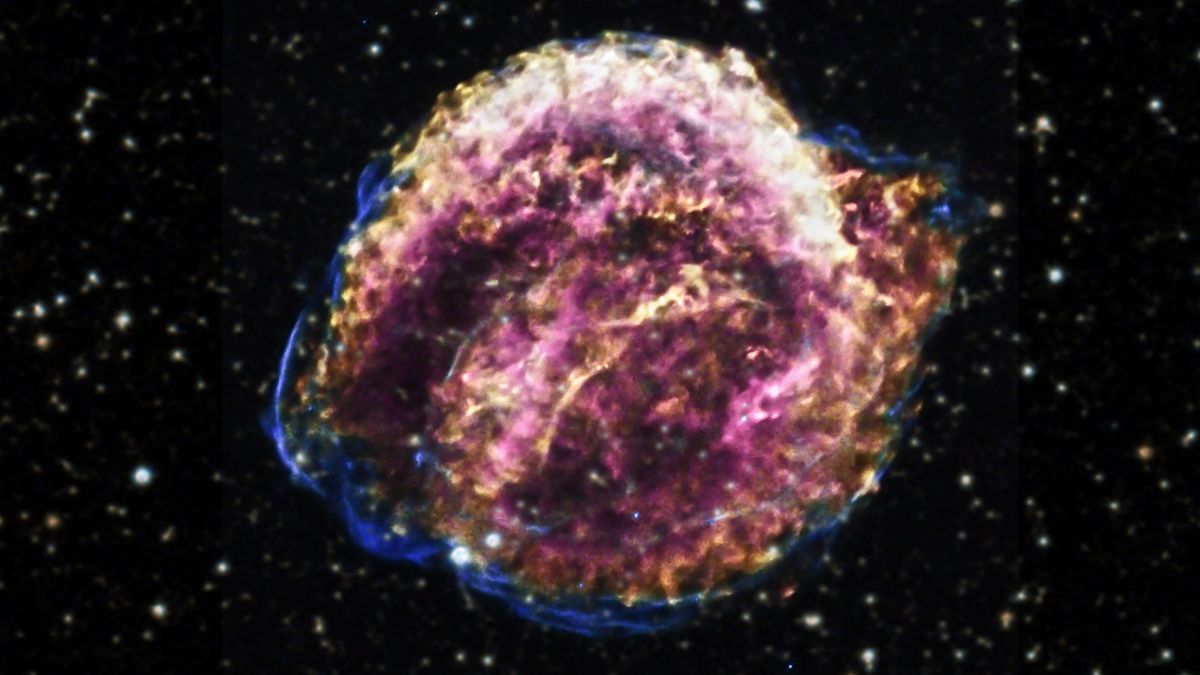
A new video from NASA offers a visual journey through the remarkable evolution of Kepler’s Supernova, also known as SN 1604. This supernova, first observed in 1604, marks a pivotal moment in our understanding of cosmic events. The video compiles 25 years of data, showcasing the remnants of this stellar explosion as it continues to expand at extraordinary speeds.
The presentation of this video occurred during the 247th Meeting of the American Astronomical Society, where astronomers Jessye Gassel from George Mason University and Brian Williams from NASA’s Goddard Space Flight Center revealed their findings. Kepler’s Supernova is particularly significant due to its well-documented timeline and its proximity of approximately 20,000 light-years from Earth, allowing for detailed observation.
Kepler’s Supernova is classified as a Type Ia supernova, resulting from a white dwarf star in a binary system accumulating mass until it reaches a critical point of instability, leading to a catastrophic explosion. These events are crucial for several reasons. They provide a reliable method for measuring cosmic distances due to their consistent peak brightness, and they are also essential for the synthesis of heavy elements in the universe.
“The elements produced by supernova explosions are critical for the formation of new stars and planets,” Williams noted. “Understanding their dynamics is essential for deciphering our cosmic history.” Kepler’s Supernova serves as an invaluable laboratory for astronomers seeking to understand these processes.
Over the decades, astronomers have closely monitored the expanding remnant of the supernova. A previous study conducted in 2020 revealed that certain knots within the expanding debris are moving at velocities reaching up to 8,700 kilometers per second (approximately 5,400 miles per second). The new video presents a series of snapshots taken in 2000, 2004, 2006, 2014, and 2025, illustrating the significant changes within the supernova remnant.
The researchers aim to publish further findings that will focus on measuring the motion of the ejecta. Their analysis builds upon a 2022 study that mapped the speeds of shock fronts in various locations, revealing other regions of the shock moving between 6,170 kilometers per second and 1,790 kilometers per second, which is approximately 2 percent and 0.5 percent of the speed of light, respectively.
While these speeds are impressive, the expanding front encounters surrounding gas and dust, which will slow its momentum considerably. Ultimately, the debris from the supernova will dissipate over thousands of years, making our current observations a fleeting glimpse into cosmic history.
“The narrative of Kepler’s Supernova is just beginning to unfold,” Gassel remarked. “It’s extraordinary to witness the remains of this shattered star interacting with material ejected into space.”
This ongoing observation not only enriches our understanding of supernovae but also highlights the dynamic nature of the universe. The continuous expansion of Kepler’s Supernova serves as a reminder of the powerful forces at play in our cosmos, captivating both scientists and enthusiasts alike.
