



































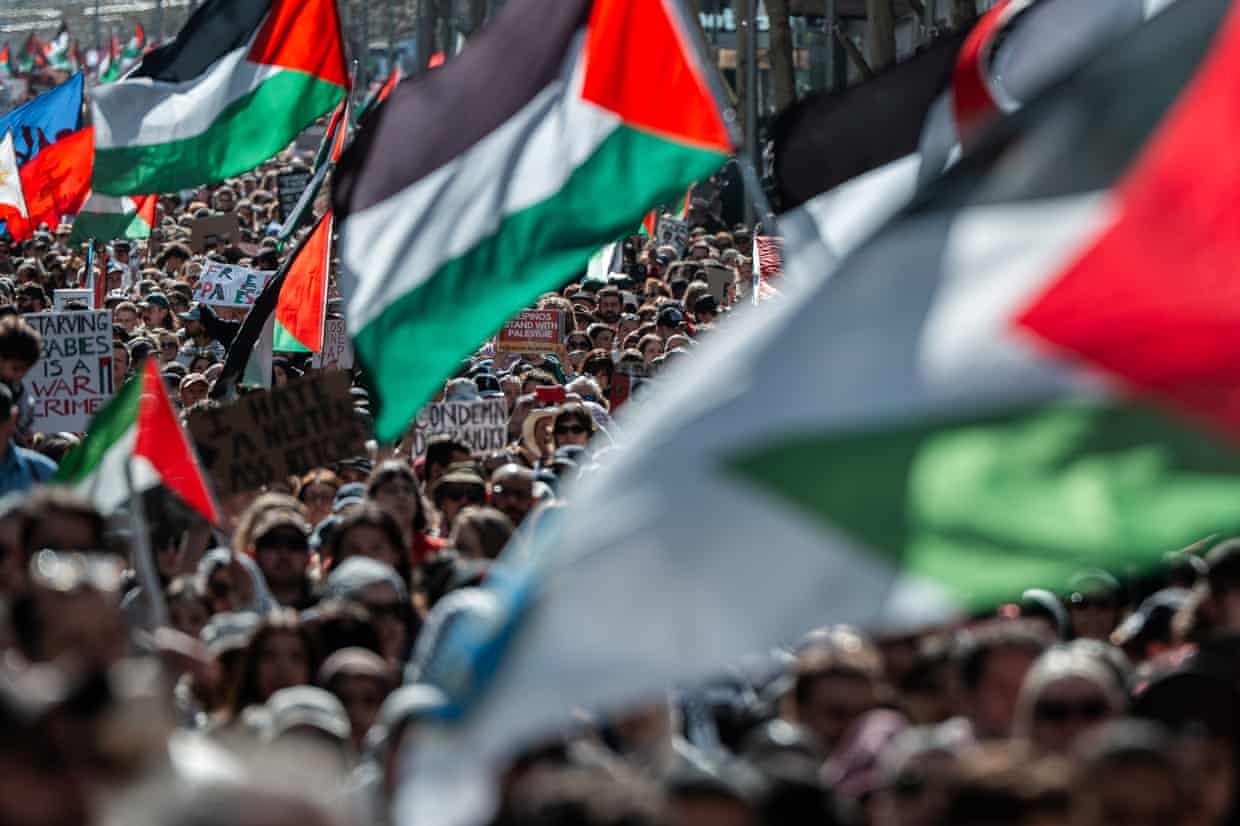
The New South Wales (NSW) government is exploring the possibility of adopting laws similar to those in the United Kingdom that could ban the controversial protest slogan “globalise the intifada.” This inquiry comes as the Australian federal government prepares to debate a bill addressing hate speech, especially following violent incidents, including the recent attack in Bondi.
The inquiry, which sought public input until October 16, 2023, has closed submissions and will not hold public hearings. It is expected to deliver its report to the government led by Premier Chris Minns by the end of the month. While the inquiry is meant to evaluate hate speech laws broadly, it has been specifically tasked with examining the implications of banning the term “globalise the intifada,” an Arabic word meaning uprising.
The term is often linked to the Palestinian uprisings against Israel in 1987 and 2000, events that were marked by significant violence, leading many within the Jewish community to associate the term with terrorism and indiscriminate violence.
UK Legal Framework and Its Implications
In the UK, police forces, including the Metropolitan Police and Greater Manchester Police, have stated they would take action against individuals chanting “globalise the intifada” or displaying related placards. According to the UK’s Crown Prosecution Service, the context surrounding such phrases has shifted since recent attacks, prompting a more aggressive response from law enforcement.
Rather than an outright ban, UK authorities have utilized existing laws, such as the Public Order Act, to arrest individuals under allegations of racially aggravated public order offences. Since a change in legislation in July 2023, it has also become a criminal offence to show support for the UK group Palestine Action, designated as a terrorist organization. This action has drawn criticism from human rights groups like Amnesty International, which argue that it infringes upon fundamental rights to free expression.
In recent months, over 2,100 arrests have been made related to support for Palestine Action, with a significant number of those arrested being older adults. The law carries a maximum penalty of six months in prison for those found guilty of showing support for the group.
Challenges of Implementing Similar Laws in NSW
Experts have raised concerns about the feasibility of implementing similar laws in NSW, primarily due to Australia’s constitutional framework, which protects political communication. Anne Twomey, a professor of constitutional law at the University of Sydney, noted that the UK lacks the constitutional protections present in Australia, making any proposed bans more susceptible to legal challenges.
Conversely, Luke McNamara, a professor at the University of NSW, suggested that existing public order offences could be more effective than a blanket ban. He pointed to the newly established offence for inciting racial hatred under the NSW Crimes Act as a potential tool for law enforcement, arguing that it allows for context-specific decisions by the police.
Recent statistics reveal that only two charges have been filed under this new provision since its introduction in August 2023. In a notable case, a woman was arrested for wearing a jacket with the phrase “globalise the intifada” at a protest in Sydney but was subsequently released without charge.
The opposition has voiced skepticism about the government’s approach. Damien Tudehope, the shadow attorney general, described the inquiry as “very rushed,” expressing doubts regarding the government’s ability to enforce broad bans on slogans without facing constitutional challenges. He pointed out that the UK has shifted away from outright bans, opting instead for public order laws.
The inquiry’s chair, Edmond Atalla, has expressed support for banning the slogan and emphasized the urgency of the issue, stating that the government aims to address it promptly when Parliament reconvenes in February.
The debate has garnered varied responses from different community organizations. The Jewish Council of Australia supports a ban on the slogan, citing its historical associations with violence. In contrast, groups such as the Sydney Palestine Action Group have condemned the inquiry, warning against adopting what they describe as “repressive models” from the UK.
Critics of the proposed ban argue that restrictions on slogans could stifle political expression and lead to heightened tensions during protests. Dr. Vince Hurley, a criminology lecturer, cautioned that adopting such bans could result in an escalation of police responses reminiscent of those seen in the UK.
As the inquiry progresses, the implications of banning specific slogans will likely continue to provoke discussions about the balance between public order and freedom of expression in Australia.
