



































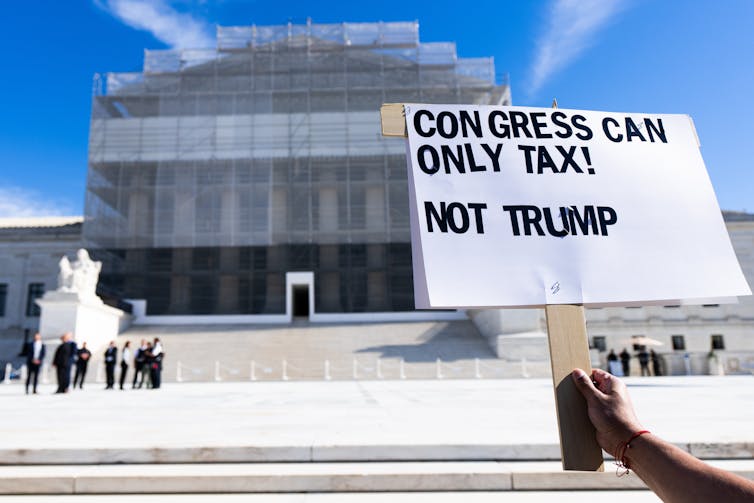
The U.S. Supreme Court is poised to rule on the constitutionality of tariffs imposed by former President Donald Trump. The decision, expected in the coming days, will address whether these trade barriers align with U.S. law, but it will not evaluate their economic wisdom. As the debate unfolds, economists express concerns that Trump’s tariffs may undermine what is termed “economic democracy,” a principle focused on inclusive decision-making that reflects the interests of all stakeholders.
At the heart of the issue is the interpretation of the International Emergency Economic Powers Act of 1977. This law grants the president authority to act in response to “any unusual and extraordinary threat.” In April 2025, Trump leveraged this act to apply tariffs on goods from nearly every country, a move that critics argue lacks the necessary checks and balances typically provided by Congress.
The framers of the U.S. Constitution intended for tariff decisions to be made by Congress, the branch closest to the electorate. This structure ensures that taxes and tariffs are subject to public scrutiny and debate, allowing voters to express their approval or discontent through elections. While the executive branch has been granted temporary tariff powers in emergencies, Trump’s expansive use of these powers raises significant constitutional questions.
Economic Concerns
Several issues arise from the Supreme Court’s consideration of Trump’s tariffs that could impact economic democracy. One major concern is the concentration of power in the executive branch. Tariff decisions made solely by the president bypass the legislative process, which traditionally allows competing interests to be debated publicly. This lack of transparency can lead to policies that serve personal or political agendas rather than the broader public interest.
The uncertainty surrounding tariffs imposed through the International Emergency Economic Powers Act also poses risks. Unlike tariffs debated and voted on by Congress, those enacted under Trump’s administration have been frequently altered. While some supporters argue that this unpredictability strengthens the U.S.’s bargaining position globally, many economists caution that it threatens efforts to revitalize American industries. Stable import market access is crucial for both domestic and foreign investments, and the fluctuating nature of these tariffs discourages long-term planning.
In the first year following the implementation of Trump’s tariffs, evidence emerged indicating a decrease in hiring and capital investment in the manufacturing sector. This trend highlights the potential long-term economic ramifications of tariff instability.
Additionally, bypassing Congress raises accountability issues. Tariffs can effectively act as a hidden tax, as the additional costs imposed on imported goods ultimately fall on consumers and can reduce profit margins for importing companies. Estimates suggest that Trump’s approach could generate over $2 trillion in additional government revenue over a decade. Yet, this revenue is primarily extracted from U.S. consumers rather than foreign entities, effectively functioning as a domestic tax.
Political Favoritism and Corruption Risks
Finally, the ability to impose and modify tariffs unilaterally raises the potential for political favoritism. Economists refer to this phenomenon as “rent seeking,” where businesses seek to gain advantages through influence rather than competitive practices. Under Trump’s tariff regime, certain industries have received preferential treatment, leading to allegations of unfairness. Notably, major U.S. electronics companies have been granted exemptions for specific products, while smaller firms lack the same lobbying power.
The implications extend beyond domestic businesses, potentially affecting international relations. Tariffs enacted under the International Emergency Economic Powers Act can discriminate between countries, allowing for trade agreements that prioritize bilateral arrangements over broader U.S. interests. Reports indicate that some foreign governments have even offered personal gifts to Trump in exchange for favorable trade terms, raising ethical concerns about the conduct of international trade.
The challenges posed by Trump’s tariff policies echo the historical context in which the U.S. founders established a system of checks and balances. Concerns about unchecked power were central to the framers’ efforts to maintain democratic legitimacy in economic policy. As the Supreme Court prepares to make its ruling, the stakes remain high, with potential implications for both the economy and the democratic process in the United States.
