



































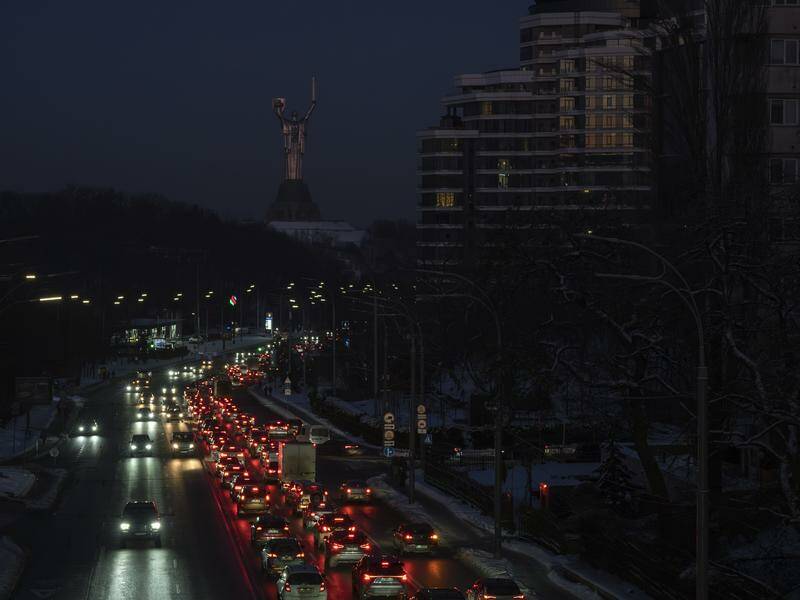
A Russian air attack has left over one million residents in Kyiv without power, disrupting electrical substations that support Ukraine’s nuclear facilities. The assault, which occurred on March 15, 2024, is part of a broader winter campaign by Moscow aimed at crippling Ukraine’s energy infrastructure while intensifying military operations on the frontlines.
The strikes, targeting various regions across Ukraine, resulted in four fatalities—three in the southeastern city of Zaporizhzhia and one in the surrounding areas of the capital. This latest attack marks the second instance this month that Russian forces have targeted Kyiv. As temperatures plummeted to minus 13 degrees Celsius overnight, emergency services worked tirelessly to restore power and heat to affected areas.
In a nightly video address, President Volodymyr Zelenskiy reported that more than one million households in the capital remain without electricity and over 4,000 apartment buildings lack heating. “We need an action and decision plan for stabilizing services by tomorrow,” he stated, emphasizing the urgency of the situation. Deputy Prime Minister Oleksiy Kuleba announced the deployment of 68 repair brigades in Kyiv, while over 1,400 emergency stations have been established to help residents stay warm and charge their devices.
The International Atomic Energy Agency (IAEA) confirmed that the attack affected several critical substations necessary for nuclear safety. Ukraine relies on nuclear power for more than half of its electricity supply, and the Chernobyl plant lost all off-site power during the assault, although it has since been reconnected. Ukrainian officials had recently warned that Russian forces would deliberately target nuclear facilities, raising concerns about potential disasters.
“While Russian officials speak about the ‘importance’ of power lines, their forces deliberately strike substations, directly endangering nuclear safety,” said Foreign Minister Andrii Sybiha. The grid operator Ukrenergo reported that the attack involved over 330 drones and nearly three dozen missiles, aiming to cripple both power generation and distribution systems. In the northern region of Chernihiv, authorities indicated that 87 percent of the population is currently without electricity.
Russia claimed its strikes were aimed at military-industrial, energy, and transport targets to support its armed forces. These attacks follow a recent round of peace talks involving U.S. and Ukrainian officials, as diplomatic efforts to end the ongoing conflict appear to be met with little enthusiasm from Moscow.
During the World Economic Forum meetings in Switzerland, representatives for U.S. President Donald Trump and Russian President Vladimir Putin characterized their discussions about a potential peace deal as “very positive” and “constructive.” In light of the recent violence, Zelenskiy urged the U.S. to increase pressure on Moscow, asserting that it has “not yet had the strength” to halt Russian aggression.
Zelenskiy requested tougher sanctions on Moscow to limit its military production capabilities, noting that some of the missiles launched on Tuesday were manufactured this year. He expressed his willingness to attend the World Economic Forum if the U.S. was ready to finalize documents related to security guarantees for Ukraine and a post-war prosperity plan.
As the situation in Kyiv worsens, residents are compelled to find creative ways to stay warm. Many have resorted to heating bricks or setting up makeshift tents indoors to endure the cold. The ongoing conflict continues to take a toll on the civilian population as Ukraine grapples with both military and humanitarian challenges.
