



































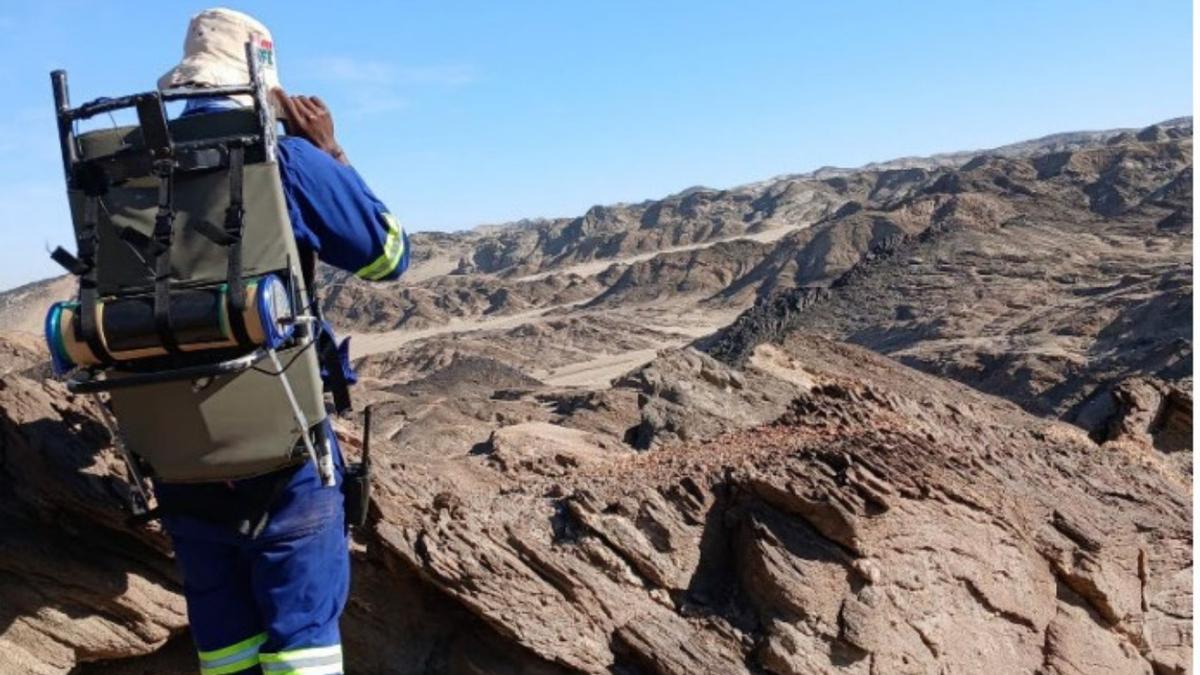
Noronex Limited has announced the commencement of its inaugural drilling campaign at the Etango North uranium project, situated approximately 32 kilometers east-northeast of Swakopmund, Namibia. This significant milestone follows a year of strategic preparation, during which the company leveraged modern exploration techniques to stack geological evidence in its favor before initiating the reverse circulation (RC) drilling program.
The Etango North project is strategically located within a region known for its rich uranium deposits. It lies on a geological line of strike connecting Bannerman Energy’s Etango project, which holds an estimated 207 million pounds of contained uranium oxide, to the operational Rossing and Husab uranium mines, located around 36 kilometers northeast of Etango. The Rossing project, one of the largest open-pit uranium mines globally, has produced over 140,000 tonnes of yellowcake since its inception in 1976. The Husab mine, also significant in the uranium sector, boasts over 300,000 tonnes of uranium oxide and is projected to continue production until 2044, accounting for 6 percent of global uranium output as of 2019.
Noronex is entering this competitive landscape with a fresh perspective and promising geological findings. Last year’s ground spectrometry survey revealed multiple uranium-thorium anomalies and suggested the presence of alaskite-hosted mineralization within Noronex’s tenure. Recently, the company employed a remotely sensed geological interpretation to enhance its understanding of the geological framework, allowing it to identify structures likely to host uranium-bearing alaskites. A follow-up field examination validated these findings, highlighting favorable contacts between the Khan, Chuos, and Arandis formations, along with domal structural closures that may serve as traps for uranium-bearing alaskite sheets, akin to those found in neighboring deposits.
As the RC drilling approaches, Noronex is set to explore the third dimension of its mineralization model. Up to this point, the narrative has been developed primarily from surface and near-surface datasets. The initial drilling program aims to target multiple priority anomalies, including the strongest uranium and thorium signals identified in the 2025 survey. Alaskite bodies mapped during field traverses and zones of shallow cover suggest that mineralization may extend beyond surface indications. Additionally, the drilling will investigate potential extensions of anomalous historical results near the company’s license boundary, where previous findings reported uranium values exceeding 100 parts per million of uranium oxide.
Management at Noronex expresses optimism regarding the potential for a significant greenfields discovery. As drilling gets underway, the company will soon determine whether its AI-assisted modeling and geophysical interpretations have successfully pinpointed the region’s next commercial uranium site. The Etango North project operates as a joint venture with a local vendor, providing Noronex the opportunity to earn up to an 80 percent interest, which could significantly amplify exploration success if the drilling yields favorable results.
While uranium remains the focal point, Noronex is also advancing its copper portfolio across Namibia and Botswana, positioning itself for opportunities across multiple commodities that are regaining attention on a global scale. As drilling begins at Etango North, the industry watches closely to see if this region, known for its world-class uranium deposits, conceals a new chapter of resource discovery beneath the surface.
