



































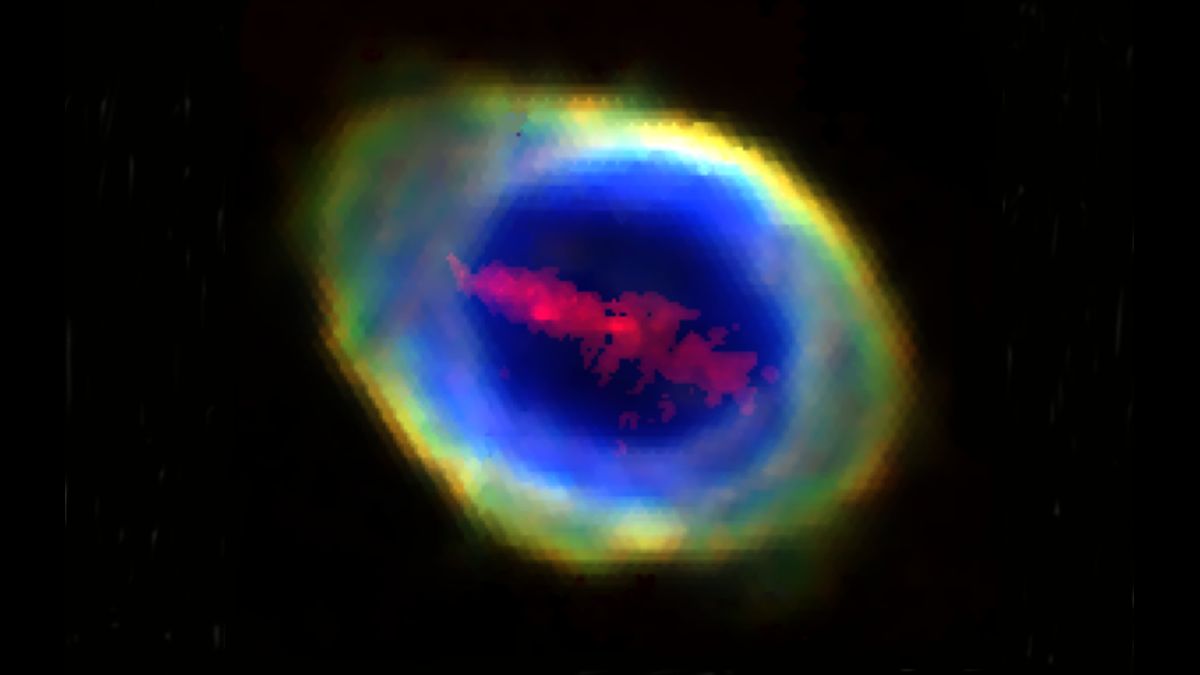
Astronomers have uncovered an unusual structure at the heart of the iconic Ring Nebula, located approximately 2,570 light-years from Earth. A giant, linear cloud of glowing, ionized iron atoms has been detected, a phenomenon never before observed in a nebula. The discovery, led by Roger Wesson of Cardiff University, raises intriguing questions about the formation and composition of this enigmatic feature.
The Ring Nebula, catalogued by French astronomer Charles Messier in 1779, is a planetary nebula formed from the remnants of dying stars. These stellar remnants typically produce spherical structures as they shed their outer layers, leaving behind a white dwarf at their core. Astronomers have extensively studied the Ring Nebula, expecting little more than the familiar patterns in this well-trodden celestial landscape.
The observations were made using the William Herschel Telescope, equipped with the new WHT Enhanced Area Velocity Explorer (WEAVE) instrument. This advanced technology allows researchers to capture vast fields of view in a single observation, yielding detailed spectroscopic data. Wesson noted, “Even though the Ring Nebula has been studied using many different telescopes and instruments, WEAVE has allowed us to observe it in a new way, providing so much more detail than before.”
The newly identified iron cloud stands out as a straight, bar-like formation, distinct from typical emissions in the nebula. Prior observations utilized slit spectroscopy, which only captures narrow slices of the object being studied. This technique can overlook features unless perfectly aligned, explaining why the iron cloud remained unnoticed for so long.
Further examination indicates that the white dwarf at the center of the Ring Nebula does not appear to be the source of the iron. The bar’s motion suggests it is moving uniformly away from Earth, contradicting the expected patterns of material ejected in jets from a star. The emission lines indicate that the entire structure is receding, rather than exhibiting the dual motion typical of jets.
One of the most striking aspects of this iron cloud is its sheer mass—approximately 14% of Earth’s mass, or more than the mass of Mars. Iron in nebulae is usually bound within dust, not present as naked, ionized atoms. The unique composition of this cloud poses further questions regarding its origins.
Researchers speculate that the iron could have emerged from a significant amount of dust being destroyed, a scenario supported by data from the James Webb Space Telescope (JWST). Observations show dust on either side of the iron cloud, yet no evidence exists to suggest the necessary conditions for iron release are present within the nebula. To ionize the iron, extremely high temperatures or powerful shocks are required—conditions seemingly absent in the tranquil center of the Ring Nebula.
Another theory proposes that the iron could be the remnants of a planet that was torn apart, yet this explanation also faces scrutiny. The debris from such an event would not likely form a neat, straight structure, and would include other elements that have not been detected in the observations.
The iron cloud’s three-dimensional shape remains unclear; it may extend beyond the line of sight, a factor complicating the analysis. As Wesson concluded, “It would be very surprising if the iron bar in the Ring is unique. So hopefully, as we observe and analyze more nebulae created in the same way, we will discover more examples of this phenomenon, which will help us to understand where the iron comes from.”
The findings have been published in the Monthly Notices of the Royal Astronomical Society, and they highlight the ongoing mystery that continues to captivate astronomers in their quest to understand the complexities of our universe.
