



































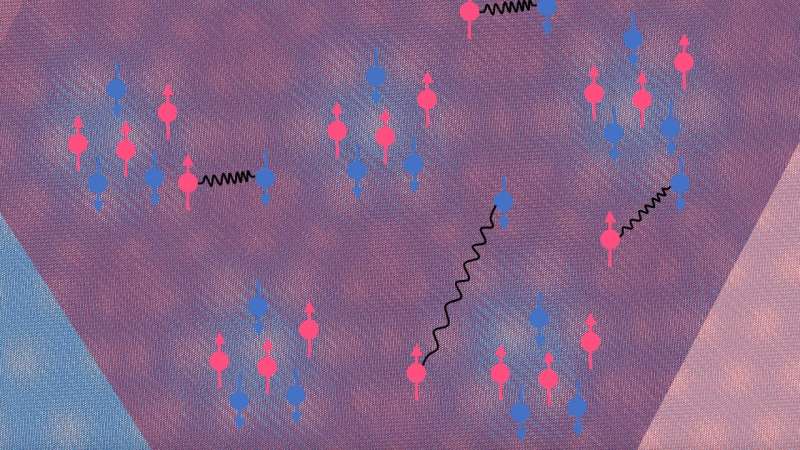
Researchers at Ecole Polytechnique Fédérale de Lausanne, Freie Universität Berlin, and other institutions have made significant strides in the study of superconductivity, revealing strong correlations within a supermoiré lattice structure. Their findings, published in Nature Physics on February 15, 2026, suggest new pathways for the development of advanced quantum materials.
The team focused on a twisted trilayer graphene system, where two or more graphene layers are stacked at small twist angles relative to each other, creating a distinct moiré pattern. This configuration influences electron movement, leading to strongly correlated states, including superconductivity. Senior author Mitali Banerjee explained that their initial goal was to create a device with identical twist angles. However, unexpected results led to the discovery of a unique phase diagram that set this research apart from traditional magic-angle twisted trilayer graphene.
Unexpected Findings in Electrical Measurements
During the research, Zekang Zhou, a student involved in the project, identified an asymmetry in the electric displacement field. This finding indicated that the device behaved differently when subjected to electric fields in opposing directions. As a result, a resistive state emerged in various regions of the material, prompting the team to further investigate this intriguing phenomenon.
Banerjee noted, “The rich phase diagram inspired us to pursue this system. The project developed in a direction we had not originally anticipated.” Their continued exploration revealed multiple interesting states and transitions within the supermoiré lattice, indicating a powerful new approach to engineering quantum phases in graphene-based systems.
The primary aim of the study was to determine if strong superconductivity could manifest in a twisted trilayer graphene system exhibiting broken mirror symmetry. To achieve this, the researchers conducted a series of low-temperature electrical transport measurements, tuning two key parameters: carrier density through gate voltage and displacement field by applying electric fields across the layers. This allowed for a comprehensive mapping of the system’s full phase diagram.
Robust Superconductivity in Unique Conditions
The researchers observed a dramatic drop in electrical resistance, nearing zero, signaling the emergence of superconducting states. Banerjee stated, “To verify that this zero-resistance state corresponds to superconductivity, we performed standard characterization measurements.” Their tests indicated that as temperature increased, the superconducting state diminished, alongside strong nonlinear transport behavior.
Interestingly, the superconducting states were uniquely suppressed by magnetic fields, despite the lack of mirror symmetry in the device. Banerjee elaborated, “We performed further experimental characterizations to elucidate the system’s behavior and identified the presence of a supermoiré lattice through the Brown-Zak oscillations.” These oscillations occur when electrons synchronize with a repeating lattice structure under a magnetic field, confirming the formation of a supermoiré lattice.
The findings illustrate that strong superconductivity persists even with broken symmetry, highlighting the potential of this novel lattice structure for future applications in quantum technologies.
Banerjee emphasized the implications of their research: “Numerous quantum phases, including superconductivity and the fractional quantum anomalous Hall effect, have been observed in twisted systems. Our findings demonstrate that the interference between distinct moiré lattices constitutes a new degree of freedom.” This discovery may pave the way for designing materials with unprecedented electronic properties.
Looking ahead, Banerjee and her team plan further studies focusing on systems in which moiré quasicrystals arise alongside supermoiré lattices. Their objective is to uncover the precise conditions necessary for stabilizing a supermoiré lattice within a multidimensional parameter space. “We will also investigate the microscopic origin of superconductivity in our system,” she added, noting the need to understand why robust superconductivity persists under conditions far from the magic angle.
The research conducted by Banerjee, Zhou, and their colleagues represents a significant advancement in the field of quantum materials, potentially influencing the development of next-generation quantum devices and technologies.
