



































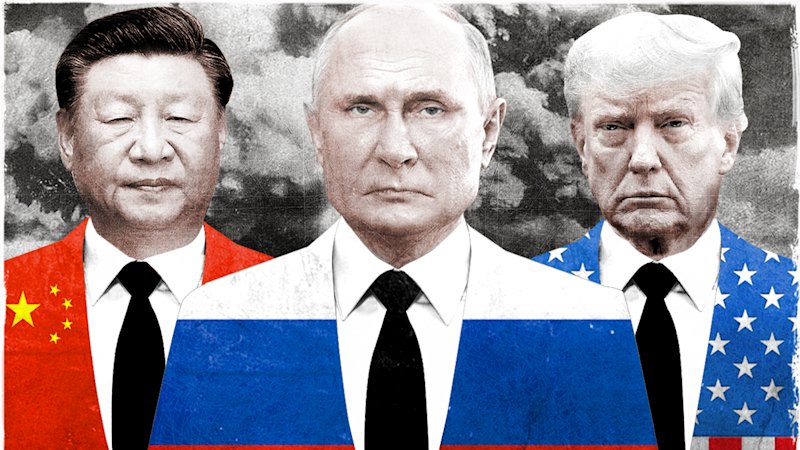
February 24, 2026 marks the fifth anniversary of Russia’s invasion of Ukraine, an event that has reshaped global dynamics and highlighted the brutal realities of power politics. The Pentagon had predicted a swift Russian victory, forecasting that Ukraine could be defeated in just three days. Instead, the conflict has evolved into a prolonged struggle, raising critical questions about national survival, alliances, and the nature of power itself.
The ongoing war has illustrated that a nation’s endurance is often tied to its willpower rather than merely its military capabilities. Initially, the United States maintained a dominant global military stance, with allies relying on American support. However, this dynamic shifted significantly after Barack Obama allowed Vladimir Putin to annex parts of Ukraine in 2014, a decision that emboldened not only Putin but also other authoritarian leaders, including Xi Jinping of China and Kim Jong-un of North Korea.
Under Joe Biden, the U.S. momentarily renewed its commitment to NATO and supported Ukraine, but this effort has waned since the return of Donald Trump. Trump’s administration has seen a withdrawal of U.S. support for Ukraine, effectively allowing Russia and China to pursue their ambitions without restraint.
The implications of this shift are significant. The borders of Europe are now contested daily on the battlefield in Ukraine, while Xi Jinping’s China continues to assert military pressure in the South China Sea. Reports indicate that Chinese naval forces have circumnavigated Australia, further demonstrating Beijing’s expanding influence.
Despite being ranked as the world’s second-largest military power before the invasion, Russia’s initial expectations of a quick victory were thwarted by Ukraine’s unyielding resolve. According to Global Firepower, Ukraine was ranked a distant 25th in military capability. Yet, what has emerged as a defining factor in the conflict has been the morale and determination of the Ukrainian people.
Russian academic Vladislav L. Inozemtsev notes that the morale of both armies and the leadership capabilities of their commanders have been pivotal. He argues that “the most important factor today is the morale of both armies and the capabilities of their commanders to lead their troops.” This sentiment harkens back to Napoleon, who famously stated that “the moral is to the physical as three is to one.”
In Ukraine, the willingness of civilians to volunteer, alongside the government’s eventual move to conscription, has bolstered its defenses. In stark contrast, Russian soldiers have often been constrained by a lack of will to fight, with reports of “blocking troops” positioned to prevent retreats.
The conflict has also revealed the essential relationship between a nation’s military and its society. An army reflects the values and motivations of its people. Volodymyr Zelensky, Ukraine’s president, has galvanized his nation from the start, famously stating, “I need ammunition, not a ride,” when offered an escape. This contrasts sharply with Putin’s hidden leadership style, which has often been characterized by contradictory narratives.
While morale is crucial, material resources remain vital. Phillips P. O’Brien, a strategist and professor at the University of St Andrews, emphasizes the importance of economic and technological strength. He asserts, “For a state to have power, it must have economic/technological strength.” This has implications for nations like Australia, which has heavily relied on the U.S. for military hardware.
Australia’s recent attempts to produce its own missiles and diversify its defense partnerships, such as with Japan, represent a shift towards greater self-reliance, albeit while maintaining strong ties with the U.S.
Another significant lesson from Ukraine is the importance of alliances. Ukraine’s survival owes much to its European partners, while Russia’s capabilities have been propped up by Chinese support. Australia has recognized this necessity as it seeks to strengthen relationships with nations like Japan and Indonesia.
Durability has also emerged as a critical factor in Ukraine’s struggle. The conflict has become a long and grueling marathon, with the support of the entire nation, not just its military, being crucial for sustained resistance. The Albanese government has acknowledged this need for a comprehensive national resilience strategy, aligning its defense posture accordingly.
Finally, one of the most pressing lessons from Ukraine’s experience is the necessity of vigilance against potential aggressors. Ukraine believed Putin’s claims of no intention to attack, which proved to be a critical miscalculation. Nations must heed the strategic narratives of their adversaries rather than accepting reassurances that downplay threats.
As the conflict in Ukraine continues to unfold, the lessons learned will resonate far beyond its borders, shaping the global landscape for years to come.
