



































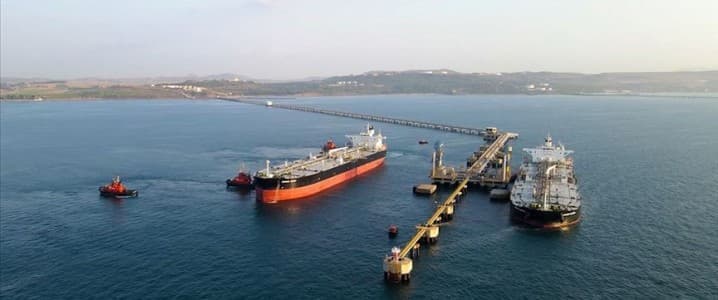
An oil tanker has successfully unloaded crude oil from the Kurdistan Region of Iraq (KRI) at a U.S. port, marking the first such import since the Iraq-Turkey Pipeline (ITP) reopened approximately two months ago. This resumption signifies not only a renewed interest in Iraqi Kurdish oil but also a strategic response to recent geopolitical tensions, particularly following a rocket attack on the Khor Mor gas field.
The Khor Mor incident, a significant escalation in violence, comes after a series of drone strikes in July that disrupted oil production in the region, reducing output by approximately 150,000 barrels per day. While the attack did not directly impact oil exports, it caused major power outages in the Sulaymaniyah region, as the gas field is crucial for local energy generation. Senior security sources suggest the attack likely stems from Iranian influence, aimed at undermining KRI’s energy independence and reinforcing the Tehran-Baghdad relationship.
Geopolitical Context and Energy Independence
Iran’s alleged involvement points to broader regional dynamics, particularly the challenge posed by Iraqi Kurdistan’s potential to become less dependent on Iranian gas imports, which currently meet about 40% of Iraq’s energy needs. The U.S. aims to counteract Iranian influence by promoting energy independence in the KRI. In this context, the recent oil imports from Iraqi Kurdistan symbolize a commitment from the U.S. and its allies to remain actively engaged in the region.
The ongoing investment in Iraq’s gas sector has drawn interest from several Western companies, looking to harness the vast natural gas resources that have historically been flared or left untapped. According to the International Energy Agency (IEA), Iraq’s proven natural gas reserves stand at approximately 3.5 trillion cubic metres, ranking it 12th globally. However, the potential for growth is significant, with the IEA estimating recoverable resources could reach as high as 8.0 trillion cubic metres, including a substantial portion of non-associated gas.
Recent developments showcase a renewed focus on the KRI’s energy resources. British energy giant Shell has initiated projects aimed at converting associated gas from southern oilfields into usable fuel, while France’s TotalEnergies launched a comprehensive US$27 billion deal that encompasses gas production and export initiatives.
Challenges and Future Prospects
Despite these advances, challenges remain. The KRI lacks a fully developed gas infrastructure, which historically has deterred investment. Key fields, such as Miran and Bina Bawi, hold significant reserves but remain stranded due to inadequate export infrastructure. This situation is compounded by Iranian efforts to disrupt Western investments through proxy militias, a tactic that has escalated recently, as evidenced by the drone attacks on oil facilities.
The U.S. and its allies view the KRI as critical to their strategy in the region, aiming to sever ties between Iraq and companies linked to Iran, Russia, and China. Additionally, the KRI serves as a strategic base for surveillance operations against Iranian activities.
In this context, the U.S. resumption of oil imports from the KRI is not merely an economic transaction but a clear signal of intent. It underscores a commitment to bolster the KRI’s energy capabilities while countering Iranian influence. As one senior source from the U.S. Treasury Department remarked, “This [the recent oil shipment from Iraq to the U.S.] is just part of the whole which says, ‘we’re here again now, and this time we’re not going away.’”
The implications of these developments extend beyond energy markets, impacting regional stability and the balance of power in the Middle East, as foreign investments continue to flow into the KRI’s energy sector. As the U.S. solidifies its presence, it seeks to ensure that the KRI becomes a vital player in the global energy landscape, free from external manipulation.
