



































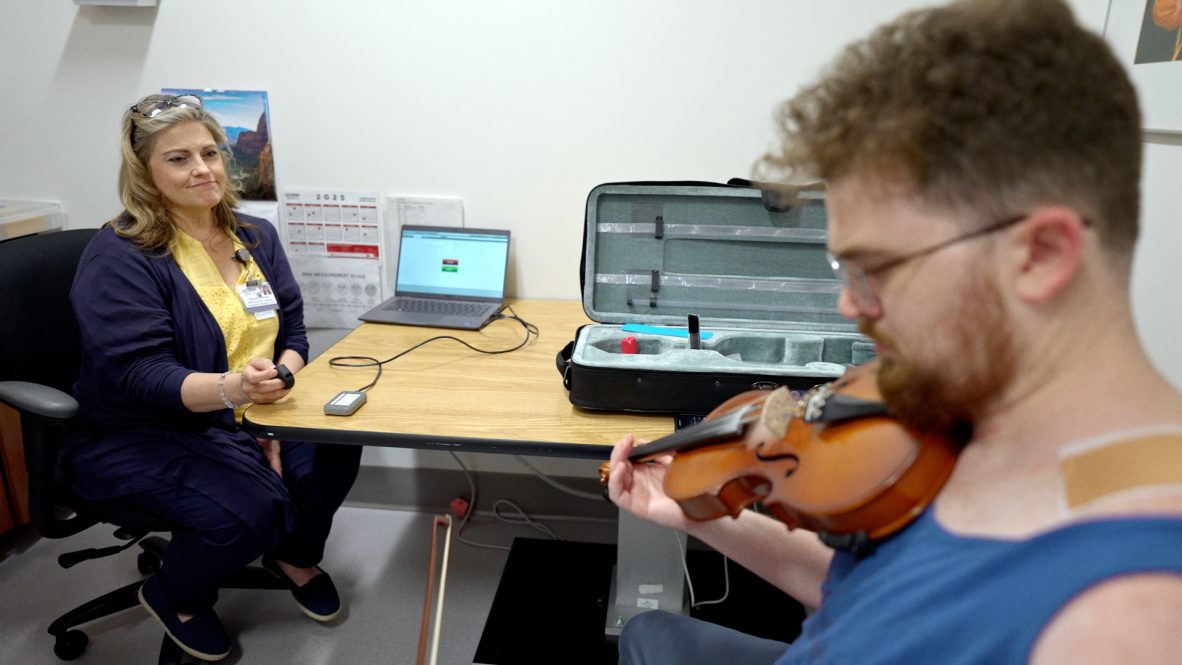
A life-altering stroke left renowned musician Peter Skaar paralyzed and struggling to hold his cello bow. Once celebrated for his performances at Carnegie Hall, Skaar faced a daunting recovery journey after the incident. Fortunately, thanks to an innovative therapy developed at UConn Health, he is now regaining his ability to play and reconnect with his passion for music.
Skaar, whose career took him to prestigious venues, found himself dealing with the harsh realities of stroke rehabilitation. Initially unable to perform even the simplest tasks, he needed a revolutionary approach to therapy to reclaim his former life. The treatment he received focuses on retraining the brain and muscles, emphasizing neuroplasticity—the brain’s ability to adapt and change.
At UConn Health, a team of dedicated health professionals developed a program tailored to Skaar’s unique needs. Using advanced techniques, they combined physical therapy with cognitive exercises designed to stimulate the brain’s recovery. This approach has shown promising results, not only for Skaar but also for other stroke victims seeking to regain their independence.
The therapy’s success lies in its innovative use of technology. Patients engage with interactive exercises that encourage movement and mental engagement, helping to rebuild neural pathways that may have been damaged during the stroke. Skaar’s progress has been remarkable; he has regained significant control over his hand movements, allowing him to once again hold his cello bow and practice.
Dr. John Smith, a neurologist at UConn Health, emphasized the importance of early intervention in stroke recovery. “Our program is designed to be both comprehensive and personalized,” he stated. “By focusing on each patient’s specific challenges, we can foster a more effective recovery process.”
Skaar’s journey is not just about personal triumph; it highlights the broader implications of innovative therapies in stroke rehabilitation. As awareness grows regarding the importance of tailored rehabilitation programs, more patients are likely to benefit from similar advancements.
With ongoing support from UConn Health and his family, Skaar plans to return to the stage. He has expressed gratitude for the care he received, stating, “It feels incredible to be playing music again. It’s as if I have my life back.” His story serves as an inspiring testament to the power of modern medicine and the human spirit.
As the field of stroke therapy continues to evolve, Skaar remains an advocate for those affected by similar challenges. He hopes to raise awareness about the importance of innovative treatments and the need for ongoing research. “There’s hope for everyone,” he affirmed, encouraging others to seek out the help they need.
The commitment of health professionals at UConn Health is paving the way for future breakthroughs in rehabilitation. Their work exemplifies how innovative approaches can transform lives, turning setbacks into opportunities for recovery and renewal. Skaar’s journey illustrates that with the right support and advancements in medical science, recovery is not just possible—it can lead to a revival of one’s passions.
