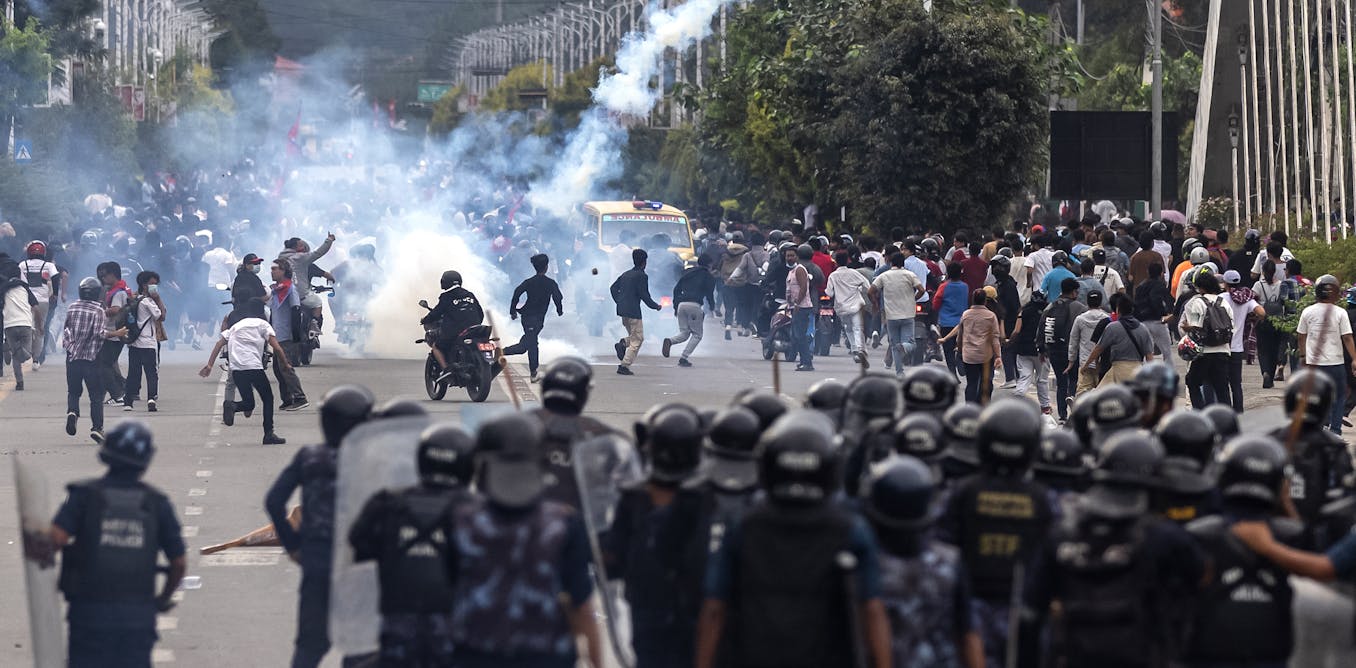
Days of unrest in Nepal culminated in the removal of Prime Minister K.P. Sharma Oli, following protests triggered by the government’s decision to ban social media platforms. On September 8, 2025, riot police clashed with demonstrators in Kathmandu, resulting in at least 50 fatalities and widespread property damage. While the appointment of a new interim leader on September 12 quieted the streets, the protests have left behind a trail of destruction, including burned government buildings and financial losses estimated in the billions of dollars.
The unrest began when the government imposed a ban on 26 social media platforms on September 4, citing concerns over misinformation and the need for greater accountability. However, this move ignited anger among Nepal’s youth, who rely heavily on these platforms for communication, education, and economic opportunities. As of January 2025, nearly half of Nepal’s population, approximating 15 million users, engaged with platforms like Facebook and Instagram, making the ban a significant point of contention.
Government Regulations and Civil Liberties Concerns
The government had previously introduced regulations requiring social media companies to register locally and cooperate with criminal investigations. Critics, including rights groups, have argued that these measures threaten freedom of expression and press liberties. The decision to block platforms was met with backlash from various sectors, particularly small business owners who utilize social media for marketing.
Ncell, Nepal’s second-largest telecommunications provider, warned that implementing a blanket ban on all platforms would be technically challenging and detrimental to businesses, especially with the festive season approaching. Additionally, students who depend on these platforms for online classes expressed concerns over their educational accessibility.
The ban became a flashpoint for civil discontent. Prior to the protests, young Nepalis had utilized social media to highlight issues of inequality and privilege, particularly through trending hashtags like #NepoKids. This campaign illustrated the stark contrast between the affluent lifestyles of the elite and the struggles faced by the wider population, igniting further outrage.
The Role of Social Media in Mobilizing Protest
Social media has been instrumental in shaping the current protest movement, serving both as a platform for information dissemination and as a tool for mobilization. Viral content showcasing the opulent lifestyles of politicians contrasted sharply with the hardships faced by ordinary citizens. For instance, a video of a provincial minister’s son flaunting luxury goods drew significant attention and criticism, underscoring perceptions of corruption and privilege.
This environment of discontent was exacerbated by broader economic challenges. As of 2024, Nepal faced an overall unemployment rate of 11%, with youth unemployment significantly higher at 21%. Many young people struggle to find stable employment, often relegated to informal jobs that offer little security.
Corruption remains a pervasive issue, with Nepal ranking 107th out of 180 countries on Transparency International’s Corruption Perceptions Index. Approximately 84% of the population views government corruption as a major problem, which has fostered a climate of distrust towards the political elite.
Together, these economic and political pressures have created a fertile ground for social mobilization. The #NepoKids movement, which emerged from frustrations over entrenched inequality, found its voice in the digital sphere. When the government attempted to stifle this expression through a social media ban, it ultimately backfired, galvanizing youth protests instead.
The aftermath of these protests highlights the critical role of social media in contemporary Nepalese society. As the new interim government seeks to stabilize the country, the events of the past weeks serve as a stark reminder of the power of digital platforms in shaping political discourse and mobilizing collective action.