



































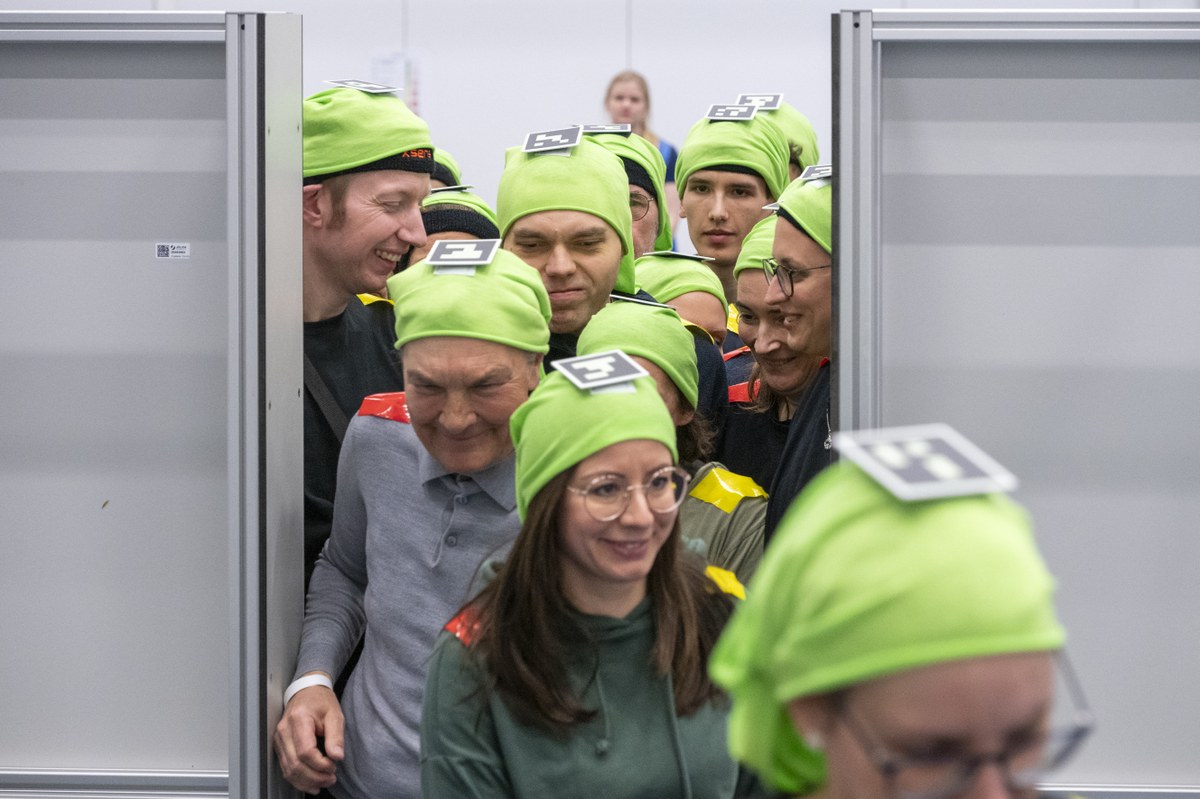
Researchers at Forschungszentrum Jülich and the German Sport University Cologne are conducting a significant study to understand how age and exhaustion affect movement and safety in crowded environments. This investigation comes as crowds increasingly gather in confined spaces, such as train stations and concert venues, where the risk of accidents can escalate rapidly.
Understanding Movement in Crowded Spaces
The research team aims to uncover how different age groups respond to the challenges of limited space. Young individuals tend to navigate swiftly and change direction quickly, while older adults often take more cautious approaches, searching for support before moving. As Dr. Maik Boltes from the Institute of Civil Security Research (IAS-7) at Forschungszentrum Jülich notes, “People differ not only in height or gender, but also in how quickly they react, maintain their balance, or respond to sudden crowding.”
This dynamic can lead to dangerous situations where quick evasive actions become difficult, resulting in minor stumbles or, in severe cases, life-threatening falls. Furthermore, the degree of exhaustion plays a critical role; emergency service reports suggest that accidents are more prevalent at the end of large events compared to the start.
Investigating Key Factors in Crowd Dynamics
The LostInCrowds project, which commenced in early 2025, seeks to explore the relationship between age, exhaustion, and safety in crowded situations. According to Carina Wings, a researcher involved in the project, “The focus is on how crowd dynamics affect the individual movement behaviour of each person—and which factors are therefore decisive for potential safety risks.”
Following initial experiments, the research team will recreate critical scenarios to assess joint loads and movement stability. Katharina Borgmann, project manager at the Institute of Biomechanics and Orthopaedics, emphasized the importance of biomechanics in understanding how injuries occur in specific movement and stress situations. “We want to use this knowledge to better map individual injury risks in dense crowds and integrate them into existing models,” she said.
The implications of this research are significant, potentially influencing evacuation strategies, safety protocols for large gatherings, and the planning of transport infrastructure. “Our goal is to use the knowledge we have gained to further develop our pedestrian models in order to specifically improve safety in crowds and at large events,” added Maik Boltes.
Experimental Findings from January Trials
Between January 17 and 21, 2026, approximately 60 participants of varying ages took part in controlled experiments at the German Sport University Cologne. The researchers aimed to observe how individuals adapt their movement when faced with competitive and shrinking spaces. Participants were instructed to navigate through a simulated crowd with heightened motivation, while their movements were meticulously recorded by ceiling-mounted cameras.
Some individuals were equipped with 3D motion sensors and heart rate monitors, providing researchers with valuable insights into their physical responses during the trials. The study also took into account individual characteristics such as body size and fitness level to create a comprehensive overview of crowd dynamics.
As this research progresses, the findings will contribute essential knowledge towards enhancing safety measures in crowded environments, ultimately aiming to mitigate risks associated with age and exhaustion in these challenging situations.
