



































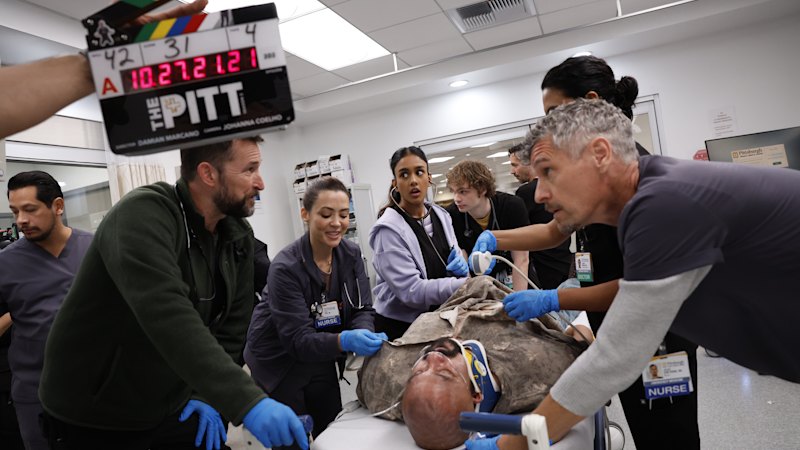
‘The Pitt’, a groundbreaking medical drama starring Noah Wyle, is set to launch its highly anticipated second season on January 9, 2024. The series has garnered significant attention for its unique approach to storytelling, flipping traditional medical drama conventions on their head. Instead of focusing solely on the medical staff, ‘The Pitt’ turns the camera to capture the perspective of the patients, creating an immersive and almost documentary-like experience.
Reinventing the Medical Drama
Wyle, who also serves as an executive producer for the series, emphasizes the dramatic shift in style. He notes, “The biggest difference, stylistically, is everything.” The production employs over 200 individual lights situated in the hospital ceiling, which are remotely controlled to adjust brightness and temperature in real-time. This innovative lighting setup allows actors to move freely without the constraints of traditional filmmaking tools.
“It’s intentionally sloppy,” Wyle explains, describing the show’s aesthetic. “You want it to be grounded in the perspective of a voyeur, analogous to being in the back seat of a squad car on a ride-along.” This immersive technique places viewers in the heart of the action, compelling them to engage with the harrowing and often chaotic world of emergency medicine.
Authenticity and Realism
Filmed primarily on the Warner Bros lot in Los Angeles, ‘The Pitt’ features a massive linear set that incorporates various hospital environments. For authenticity, exterior shots are filmed in Pittsburgh, Pennsylvania, including scenes at the Allegheny General Hospital. The series is praised for its stark realism, depicting bloody surgeries and severe injuries with a level of detail that is rarely seen in Hollywood productions.
Each episode of the series covers a single hour of real time, presenting a continuous emergency department shift that lasts for 15 episodes. This unique format adds a layer of urgency and intensity, as characters navigate the complexities of modern healthcare, including overcrowding and staff burnout. Wyle reflects on the challenges of filming, recalling a particularly grueling moment from the show’s first season where “blood was everywhere.”
Behind the scenes, the production team utilizes complex diagrams to coordinate the intricate filming process. A secondary unit captures the journey of background patients, ensuring that their experiences mirror the reality of hospital life. The realism extends to the extras, many of whom have prior experience in medical settings, enhancing the authenticity of the performances.
Wyle’s long association with Warner Bros adds a personal touch to his involvement in ‘The Pitt’. He has worked with the studio for over three decades, starting with his role on the iconic series ‘ER’. Reflecting on his career, Wyle expresses a sense of nostalgia for the traditional Hollywood landscape, stating, “I’m such a romantic and such a sentimentalist that I can’t help feel like I’m watching something that I really love kind of go away.”
The Future of Television
The landscape of television is changing rapidly, especially as streaming platforms like Netflix make significant moves within the industry. Warner Bros is currently the target of a US$82.7 billion takeover bid by the streaming giant. Wyle acknowledges this monumental shift, saying, “We’re witnessing the end of a significant era.” He notes that the film industry is no longer centralized in Hollywood and that international content is gaining prominence.
As ‘The Pitt’ prepares for its second season, Wyle feels a mix of pressure and excitement. He emphasizes the importance of remaining true to the original intent of the show, rather than trying to outdo its initial success. “We do feel a pressure, but the pressure is really to be as authentic and honest to the intention of the first season as we can be,” he explains.
‘The Pitt’ is set to return on HBO Max, promising to deliver another gripping season filled with raw emotion and unflinching realism. As viewers gear up for the new episodes, they can expect a series that not only entertains but also challenges perceptions of the medical drama genre.
