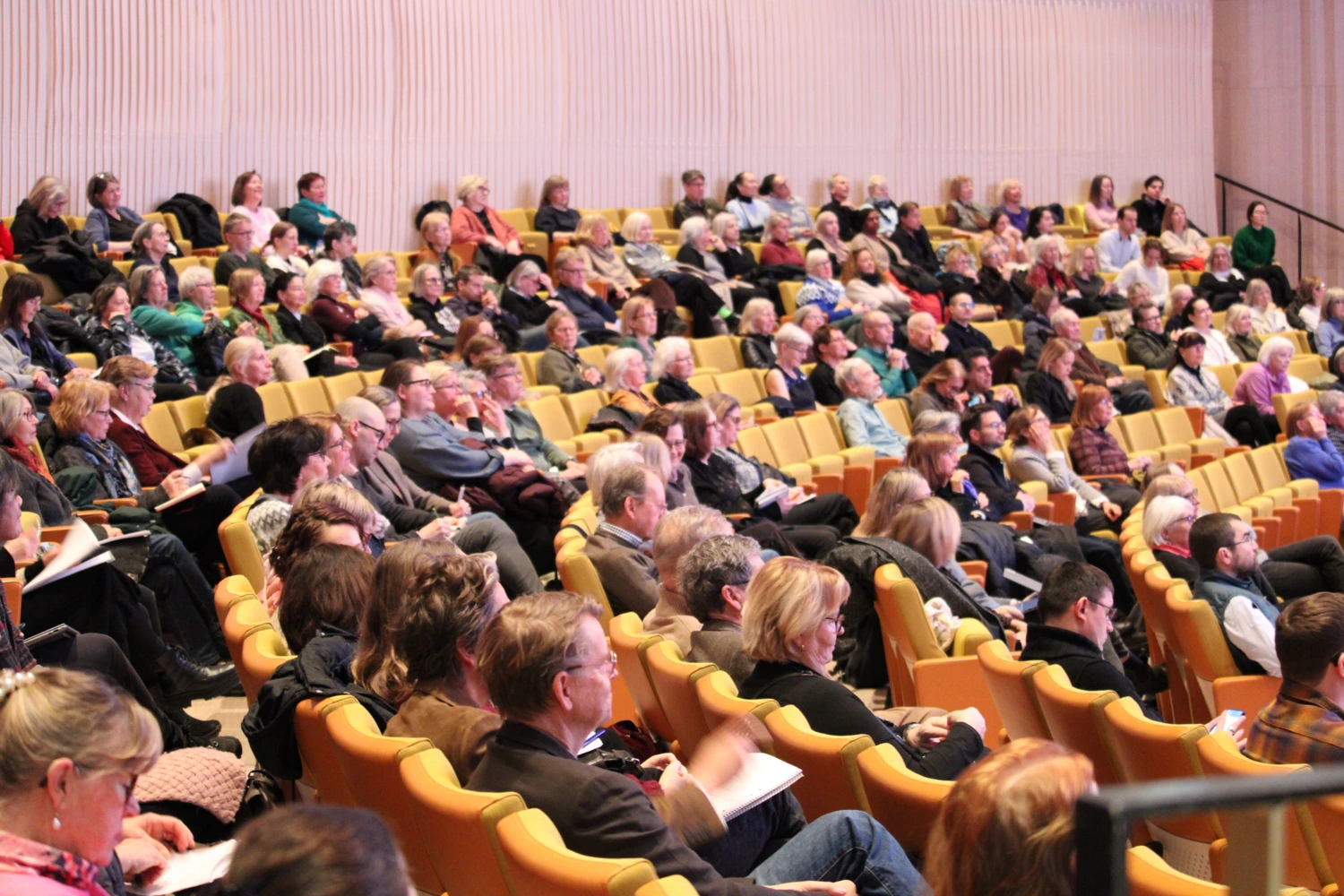
The Aging Research Center (ARC) celebrated its 25th anniversary by hosting a dedicated forum on aging research, supported by a grant from Forte. On February 5, 2024, the event titled “Forum for Aging Research – What have we achieved and where are we heading?” took place at Aula Medica in Sweden. This gathering brought together researchers from across the country to share insights and discoveries regarding the complexities of aging.
The forum was structured around three key themes, beginning in the morning with “Older adults’ health today – successes and challenges.” After a networking lunch, the discussions continued with “Healthy aging – an individual and care perspective” and concluded with “The interaction between people and their environment.” The session was moderated by Jens Berggren, head of the cognitive unit at Ersta Hospital, who facilitated a dynamic program.
The first speaker, Carin Lennartsson, senior lecturer at NVS and Director of ARC, addressed the impact of demographic changes, equality, and the challenges facing Sweden’s welfare system. Currently, six percent of Sweden’s population is over the age of 80, with projections indicating that by 2060, one in ten Swedes will reach this age. Notably, formal care services have been halved, while informal family support has risen significantly.
Via video link, Ingmar Skoog, senior professor at the University of Gothenburg, discussed the evolving perceptions of aging in his lecture titled “Is 70 the new 50?”. He highlighted that today’s 70-year-olds often enjoy improved health, increased activity levels, and greater societal engagement compared to past generations. He also detailed the four life stages commonly recognized today: childhood, adulthood, retirement, and the “fourth age,” when individuals can no longer live independently.
Exploring the biological aspects of aging, Sara Hägg, senior lecturer at MEB, emphasized that advanced age is a significant risk factor for many diseases. She indicated that multimorbidity, where a 95-year-old typically has five concurrent illnesses, is a pressing concern. Hägg clarified that biological age can be assessed on multiple levels—cellular, molecular, clinical, and functional—and that there is no singular method for its measurement.
The forum also featured a presentation on person-centred care by Joakim Öhlén, a professor of nursing at the University of Gothenburg. This approach, introduced at the Sahlgrenska Academy in 2010, aims to enhance patient autonomy and address the fragmented nature of healthcare services, tailoring care to individual needs based on patient narratives.
Following the lunch break, Erika Jonsson Laukka, docent at NVS and Head of ARC division, presented her findings on cognitive aging. She noted that Sweden’s early establishment of longitudinal studies has created a wealth of databases that continue to benefit researchers. Jonsson Laukka outlined various risk and protective factors associated with achieving healthy cognitive aging.
In a discussion on sensory health, Maria Larsson, a professor of perception and psychophysics at Stockholm University, focused on the aging sense of smell. She explained its critical role as a warning system and in the experience of taste and memory. Larsson highlighted research indicating that impaired olfactory function can increase the risk of depression among older adults.
Addressing the challenges of multimorbidity, Amaia Calderon‐Larrañaga, senior researcher at ARC/NVS, urged for a paradigm shift in healthcare to treat patients holistically rather than focusing on individual diseases. She pointed out that polypharmacy, or the use of multiple medications, poses significant risks to patient safety and sustainability, highlighting the urgent need for systemic changes.
The topic of loneliness was presented by Lena Dahlberg, a professor of social work at Dalarna University. Drawing from 25 years of research, she defined loneliness as a feeling arising from a perceived gap between desired and actual social connections. Dahlberg noted that older adults often do not perceive themselves as lonely as significantly as those around them might assume.
Finally, Jan C. Semenza, a researcher at Umeå University, discussed “The impact of climate change on the older population.” He explored how factors such as temperature, social isolation, and vulnerability intersect, emphasizing the need for early warning systems. Semenza argued that the dangers of climate change extend beyond extreme weather, affecting older adults in profound ways.
Each thematic session concluded with a panel discussion, allowing participants to engage directly with the speakers. The forum provided a rich opportunity for collaboration and knowledge exchange, illuminating the multifaceted nature of aging and the collective responsibility to support older adults effectively.