



































A newly discovered galaxy cluster, named SPT2349-56, has astonished astronomers by revealing gas temperatures far exceeding prior predictions, occurring just 1.4 billion years after the Big Bang. This finding challenges our understanding of galaxy evolution and the processes that govern the early Universe.
The cluster, first identified in 2010 through observations from the South Pole Telescope in Antarctica, has shown characteristics that defy conventional astrophysical models. Dazhi Zhou, a doctoral student in astrophysics at the University of British Columbia, expressed initial skepticism about the findings, stating, “We didn’t expect to see such a hot cluster atmosphere so early in cosmic history.” After extensive verification, researchers confirmed that the gas within SPT2349-56 is at least five times hotter than previously estimated, reaching temperatures of over 10 million Kelvin.
Unprecedented Observations Unveiling Early Universe Secrets
Follow-up observations published in 2018 indicated that SPT2349-56 comprises more than 30 galaxies that are forming stars at a staggering rate—approximately 1,000 times faster than the Milky Way. This rapid star formation, coupled with the cluster’s trajectory towards a potential collision, positions it as a significant subject for understanding galaxy dynamics during a crucial epoch in cosmic history.
An international team, led by Zhou, utilized the ultra-sensitive Atacama Large Millimeter/submillimeter Array (ALMA) to analyze the cosmic microwave background (CMB). They aimed to detect a distortion known as the Sunyaev-Zeldovich signal, which occurs when hot electrons within the cluster interact with CMB photons. The smooth nature of the CMB allows these distortions, or “shadows,” to be measured and analyzed.
The gravitational forces within a galaxy cluster create a region where gravity intensifies, drawing galaxies and gas closer together. This process compresses the intracluster medium, resulting in increased energy and, consequently, higher temperatures. The discovery of SPT2349-56 highlights the extreme conditions present in early galaxy clusters, contributing to a deeper understanding of the Universe’s evolution.
Challenging Existing Models of Galaxy Cluster Evolution
The findings from ALMA not only confirmed the existence of the Sunyaev-Zeldovich signal but also revealed a powerful thermal signature from the hot electrons. While researchers anticipated the presence of a warm intracluster medium, the recorded temperatures greatly surpassed their expectations. Existing models suggest that gravity alone should not be capable of generating such high temperatures within a short timeframe.
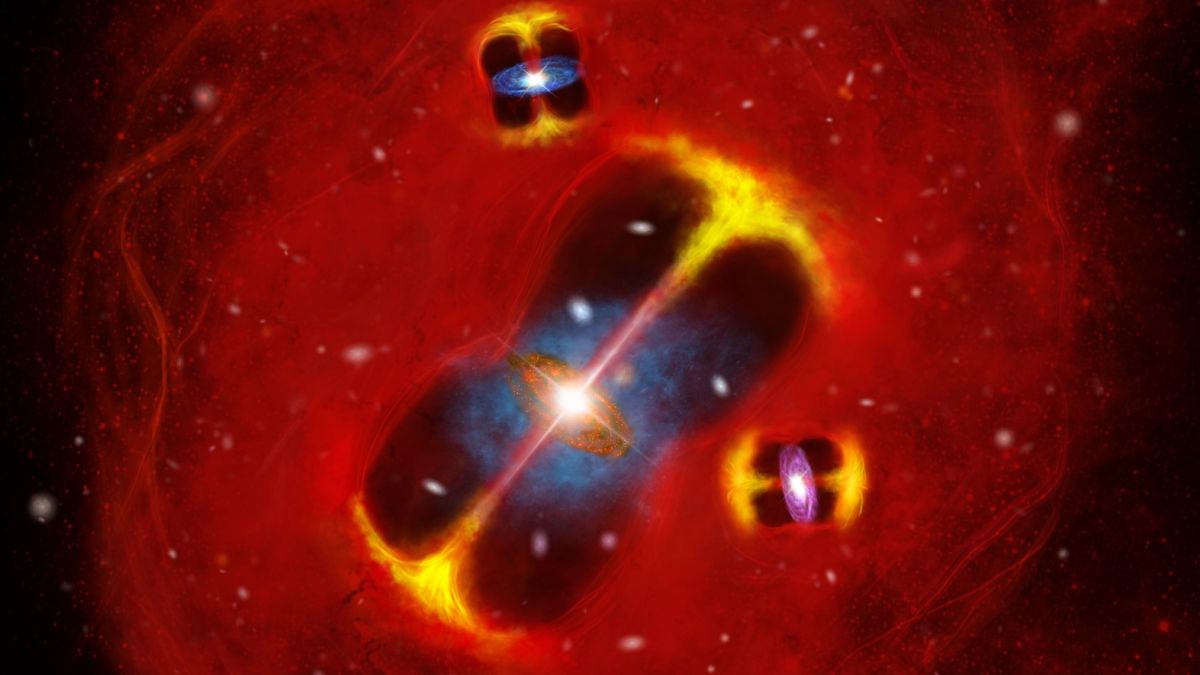
The research team suspects that powerful jets from at least three supermassive black holes within SPT2349-56 may be injecting additional energy into the cluster. Scott Chapman, an astrophysicist at Dalhousie University, explained, “This tells us that something in the early Universe, likely three recently discovered supermassive black holes in the cluster, were already pumping huge amounts of energy into the surroundings and shaping the young cluster, much earlier and more strongly than we thought.”
These insights suggest that the current theoretical framework for galaxy cluster evolution is incomplete. Zhou emphasized the need to understand how intense star formation, active black holes, and the overheated atmosphere interact, stating, “We want to figure out how these elements influence each other and what it reveals about the formation of present-day galaxy clusters.”
The research has been published in the journal Nature, marking a significant step forward in our understanding of the early Universe and the complex dynamics that shape galaxy clusters.
