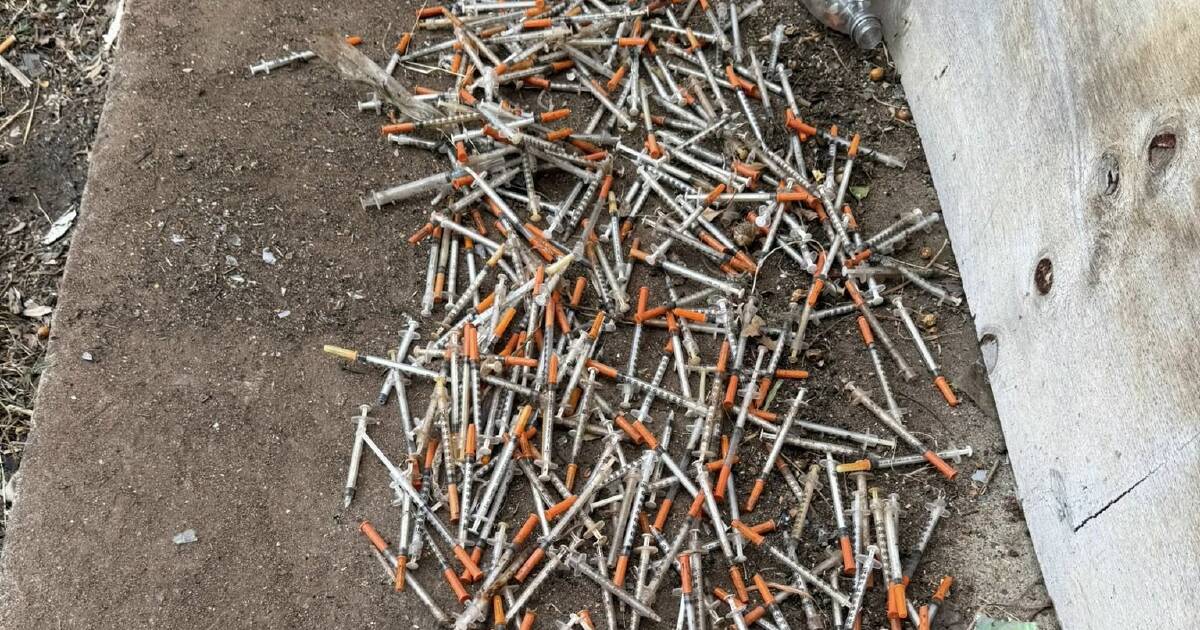
The city of Dubbo is grappling with a significant health risk as residents encounter an increasing number of discarded syringes. Craig Rose, owner of Dubbo Yard Maintenance, estimates that his company collects between 5,000 and 10,000 syringes annually. His concerns are amplified by a personal experience involving a family member who spent six months undergoing blood tests after a needle-related incident at a beach in Newcastle.
When Mr. Rose established his business in 2023, discarded needles were not a common sight. However, he now finds syringes in numerous public spaces, including schools and playgrounds. “Just recently, I was spraying weeds when I spotted a black box, which prompted a search for needles,” he explained. Regular calls for needle pickups come from childcare centres, and one client contracts his team for biweekly checks due to safety concerns.
The Daily Liberal reported that syringes have been found in various locations, including Victoria Park and Redbank Reserve, with notable incidents in February 2026. During a recent cleanup of a fire-damaged property, Mr. Rose’s team discovered over 150 needles, many lacking protective caps. This alarming situation poses serious challenges for their operations.
“It’s mentally confronting,” Mr. Rose stated. “New team members must be warned to stay vigilant for needles. We find them among children’s toys and in bedrooms.” He recounted an instance where hundreds of syringes and caps were located within a small area of a property, raising concerns about additional needles that may have been lost in the fire.
The implications of this health risk extend beyond the immediate danger. “When quoting for a job, you might estimate a couple of hundred dollars for weeding a garden,” Mr. Rose noted. “But the presence of syringes adds a dangerous aspect, necessitating personal protective equipment, which incurs extra costs.”
While his team takes pride in preparing land for affordable housing, Mr. Rose emphasizes that dealing with discarded needles was not part of his original business plan. He advocates for stronger measures to prevent improper needle disposal, suggesting that implementing a system of barcodes or serial numbers on syringes could hold users accountable. “If they choose to use drugs, that’s their decision, but it shouldn’t affect the lives of others,” he remarked.
The Dubbo Regional Council reported four syringe-related incidents from January 1 to March 1, 2026, compared to five in the same period the previous year. Whenever a report is received, trained staff or contractors are dispatched for safe removal. Craig Arms, the council director, emphasized that “disposed sharps are a constant issue in some locations, particularly along the riverbank.” The council prioritizes these incidents and provides sharps bins in key public areas, including parts of the Macquarie Riverbank and local parks.
A representative from the Western NSW Local Health District stated that reducing the risks associated with discarded needles is a “shared responsibility.” The NSW Needle and Syringe Program (NSP) aims to minimize the transmission of bloodborne viruses by offering sterile injecting equipment and educating users on safe disposal practices.
The NSP operates through three facilities in Dubbo: Dubbo Hospital, Dubbo Sexual Health, and Dubbo Primary and Community Health. Community members are encouraged to report any encounters with syringes by contacting the NSW Needle Clean-Up Hotline at 1800 633 353, which coordinates prompt clean-up efforts.
As Dubbo continues to face this pressing health issue, the collaboration between local businesses, health authorities, and the community will be essential in tackling the growing problem of needle disposal.