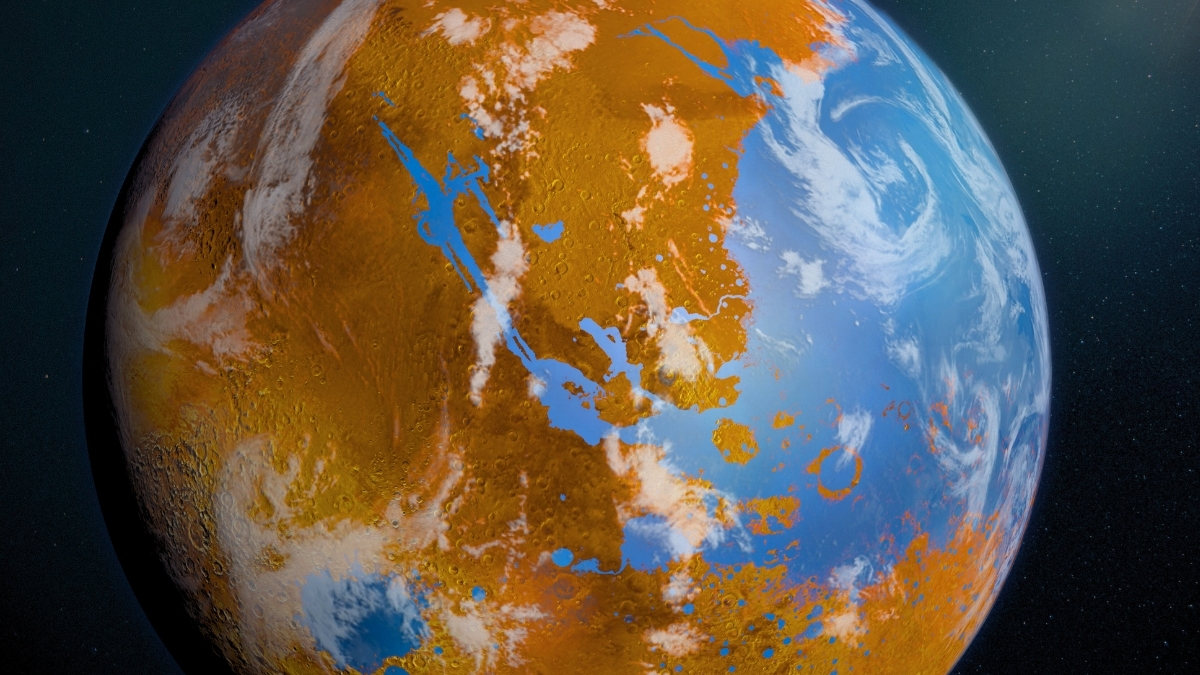
Scientists have made significant progress in understanding the mysterious disappearance of water on Mars. A new study has revealed that dust storms on the planet play a crucial role in pushing water into the atmosphere, where it is subsequently destroyed by ultraviolet (UV) radiation. This finding challenges previous assumptions about the planet’s hydrological history and suggests that water loss may occur year-round, rather than being restricted to specific seasons.
Research conducted by a team utilizing data from at least six different instruments across three spacecraft, including the Perseverance and Curiosity rovers, as well as the Mars Reconnaissance Orbiter and ExoMars, indicates that Mars was once a wet world. Estimates suggest there could have been enough water to cover the planet’s surface to a depth of several hundred meters. The scientists employed a technique known as the deuterium/hydrogen (D/H) ratio to arrive at these conclusions. This method measures the ratio of deuterium, a heavier isotope of hydrogen, in water molecules.
As the lighter hydrogen atoms are blown away into space, the D/H ratio increases, which has been measured to be 5-8 times higher on Mars than on Earth. This suggests that a significant amount of water has been lost over time, leading to the dry conditions observed today.
Impact of Dust Storms on Water Loss
Mars experiences distinct seasons due to its axial tilt, similar to Earth. However, its elliptical orbit results in pronounced seasonal variations, particularly between northern and southern summers. Previous research suggested that the water loss process was primarily active during the warmer southern summer months.
The recent study has challenged this notion by focusing on a specific event known as a “rocket storm” that occurred during the northern summer of Mars year 37 (corresponding to the 2022-2023 timeframe on Earth). This storm, documented by the Emirates Mars Mission and other spacecraft, triggered significant moisture loss in a manner comparable to that observed during southern summers. The storm’s intensity pushed water vapor higher into the atmosphere, where it became more vulnerable to destruction from UV radiation.
Typically, during southern summer dust storms, dust particles warm the air in the mid-atmosphere, preventing the formation of water ice clouds that would normally trap water. With the rise in temperature from these storms, water can be pushed even higher, exposing it to harsher conditions that lead to its breakdown.
Implications for Mars’ Climate History
The findings indicate that the process of water loss is not limited to specific seasons. Researchers suggest that in Mars’s distant past, the planet may have had a more pronounced axial tilt, which could have facilitated similar storm activity during northern summers. Such a scenario may provide insight into the substantial discrepancies between current estimates of Martian water reserves and those of its wetter past.
This new understanding of Mars’s climate history could reshape our knowledge of the planet’s evolution and its potential to support life. As scientists continue to analyze data from ongoing missions, the importance of these findings cannot be overstated.
This article originally appeared in Universe Today.