



































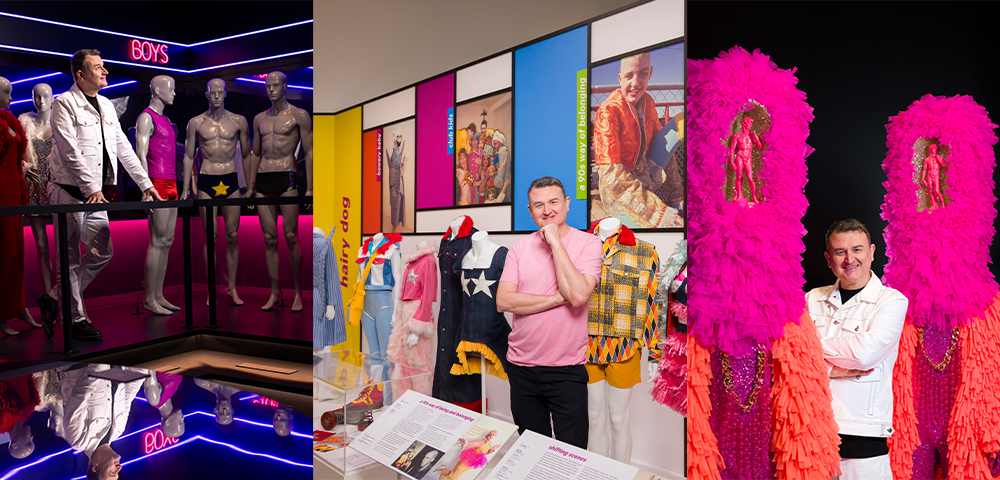
The Queensland Museum has launched a groundbreaking exhibition titled Make a Scene: Fashioning Queer Identity and Club Culture in the 90s, marking the first significant exploration of LGBTQ+ social history in its 165-year existence. Curator Chris Salter designed the exhibition to celebrate the vibrant queer culture that emerged in Queensland during a transformative five-year period from 1989 to 1994, following the decriminalisation of homosexuality in the state.
Rather than attempting to cover the entirety of queer history, the exhibition hones in on a pivotal moment that coincides with the 35th anniversary of this landmark legislative change. Salter emphasizes that Make a Scene is both a historical account and a reflection of a vibrant cultural moment. “I was very aware that it was the first LGBTQ+ social history exhibition ever presented by Queensland Museum,” he stated.
Salter’s focus is not merely on political milestones but on how identity and self-expression flourished during this time. The exhibition showcases how various political, social, cultural, and economic factors influenced the fashion and expression of young queer individuals. As someone who came of age in Brisbane’s queer scene in the early 1990s, Salter has a personal connection to the material on display.
A significant highlight of the exhibition is the archive of Mark Wilson, a teenage designer who founded the influential Brisbane label Hairy Dog. Wilson began his career at 16 and tragically passed away at 19 in December 1993. Salter recalls, “I was a wearer of Hairy Dog, and I really remember the ripple that went through the scene at his passing.” Wilson’s contributions are featured prominently, representing a unique expression of the global club kid movement that took root in Brisbane, a city characterized by its conservative backdrop.
The exhibition is a collaborative effort, with Salter working closely with approximately 175 individuals to bring it to fruition. “While it started with the journey of one, it really was made manifest and made possible by all of those other people who contributed,” he noted. The emotional connections forged during the development process have added a rich layer of authenticity to the exhibition.
Visitors to Make a Scene are greeted by a recreated 90s dance floor, complete with clubwear and archival objects that anchor local history within the broader queer cultural landscape. Iconic pop culture references, including costumes from Kylie Minogue and Priscilla, further enrich the experience. Salter points out that the exhibition does not just look into the past but also casts a vision towards the future, hinting at contemporary developments in queer fashion.
The exhibition features commissioned works by local designers and even showcases Darren Hayes‘ outfit from his Mardi Gras performance, seamlessly connecting past and present narratives. Salter expresses that Make a Scene is not just an end point for queer history in Queensland. “Queer history is Queensland history. I hope that this is just the beginning,” he said.
The exhibition is designed to establish the Queensland Museum as a lasting home for queer culture, memory, and meaning. Make a Scene: Fashioning Queer Identity and Club Culture in the 90s is open to the public until July 19, 2026, providing an opportunity for visitors to engage with a significant yet often overlooked aspect of Queensland’s social history.
