



































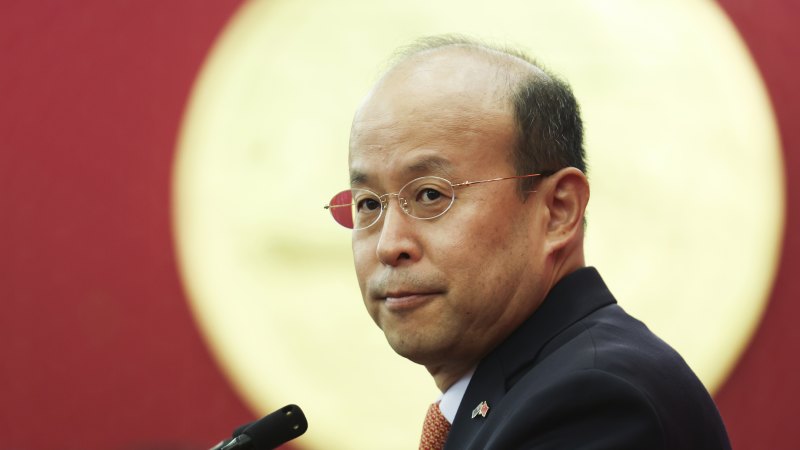
China’s ambassador to Australia, Xiao Qian, has called on the Albanese government to reconsider its restrictions on international student visas from China. This appeal marks a significant moment in the ongoing discussion surrounding the international student sector, which plays a vital role in Australia’s economy. Speaking at a Universities Australia conference, Qian emphasized that increasing short-term visa opportunities could strengthen the bilateral relationship between the two nations.
In his remarks, Qian stated, “I hope that the Australian federal government would consider providing more visa facilitation for Chinese students and scholars on short-term exchange programs to Australia, and offer policy support for the free flow of people between our two countries.” He stressed the importance of facilitating the movement of young academics and researchers, particularly as the number of Chinese international students approaches pre-pandemic levels.
Despite the positive outlook, Qian voiced concerns regarding Australia’s ongoing restrictions on research cooperation in critical fields, including advanced technology. He noted that uncertainty surrounding visa policies continues to pose challenges to the relationship. Currently, Chinese students represent approximately 22 percent of Australia’s $53 billion international education industry, which is the country’s fourth-largest export commodity.
Former Home Affairs Secretary Michael Pezzullo raised caution during another session at the conference, highlighting the risks associated with Australia’s reliance on Chinese students. “China has a vociferous appetite and … we just have to face the fact that any relationship with Chinese scholars and Chinese institutions is going to have sitting behind it the Chinese state,” he stated. Pezzullo underlined the importance of acknowledging the stringent controls that the Chinese government maintains over various aspects of society.
Concerns about foreign interference were echoed by Rachel Noble, a former director-general of the Australian Signals Directorate, who described the threat as “unprecedented.” In light of these risks, the Albanese government has previously warned university leaders to reduce overreliance on students from China and India. Although legislation to cap the intake of international students did not pass in 2024, the government has shifted its focus to managing student numbers through the visa system, implementing a slower processing pace for applications once a university reaches 80 percent of its student allocation for the year.
Despite these challenges, demand for Australian degrees remains robust in China. A report from the Department of Education released in December highlighted a strong outlook for the next seven to eight years. Each year, over 700,000 mainland Chinese students study abroad, with the number of high school graduates expected to peak at approximately 17.8 million by 2032. The report also indicated that the costs associated with obtaining an Australian education can exceed $750,000 for certain degrees, underlining the prestige that an Australian qualification holds among Chinese students.
The briefing noted that while Australia is likely to remain a preferred destination for Chinese students, competition from other Asian nations is intensifying. Factors such as governmental relations can influence student decisions significantly. If diplomatic ties between Australia and China deteriorate, the flow of students may decrease. Conversely, stable or improving relations could lead to increased interest from Chinese students. The report suggested that Australian universities with campuses in Southeast Asia may benefit, although they will face heightened competition as more Chinese institutions expand their presence in the region.
Julian Hill, the Federal Assistant Minister for International Education, is scheduled to address the summit on Thursday. His insights could shed further light on the government’s strategy regarding international student policies and engagement with China.
As Australia navigates the complexities of its relationship with China, the balance between economic interests and national security continues to be a critical consideration.
