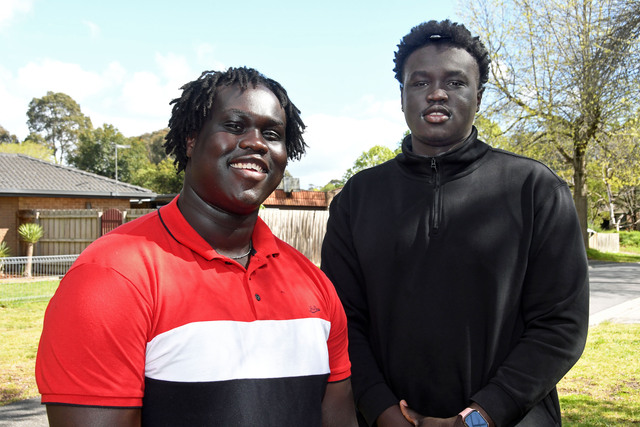
Retired gang members Mar and Moses Riek are on a mission to transform their past struggles into a force for good. Fleeing the civil war in Sudan, the Riek family arrived in Australia in 2005. Their journey, marked by adversity and resilience, illustrates the path from street life to community empowerment.
In an interview with Gazette journalist Afraa Kori, the brothers shared their experiences and insights on breaking free from the cycle of gang involvement. Mar stated, “I see my testimony as a blueprint and a pathway out of the streets and trouble.”
The Riek brothers faced immense challenges during their upbringing. Initially settling in Sydney, they later moved to Pakenham following their parents’ separation. Raised in a single-parent household, they struggled with identity and stability. Both brothers showed promise in sports, particularly basketball, with Moses earning a spot in the NBL Combine before an injury curtailed his aspirations. Mar also pursued basketball, but both brothers found themselves drawn into a life of crime.
Mar’s descent began with petty theft and escalated quickly. By the age of 13, he formed a gang comprised of Sudanese youth in South East Melbourne, navigating rivalries rooted in tribal and geographic divisions. “We competed over status, respect, women, and power,” he recalled. However, he recognized the destructive nature of this lifestyle and left the gang shortly after joining. “Thank the good lord I never was imprisoned or faced court for any of my actions in my past, I always escaped death and prison,” Mar reflected.
Moses’ journey mirrored his brother’s but with more dire consequences. After his basketball dreams were shattered due to injury, he disengaged from education and family, gravitating toward crime. His activities escalated until a home invasion in 2020 led to a four-and-a-half-year prison sentence. The deaths of two friends served as a painful wake-up call for both brothers. Mar acknowledged that the violence and gang culture offered no real future. “The streets is dead,” he expressed, emphasizing the lack of generational wealth and community development.
While incarcerated, Moses experienced a significant transformation. He engaged in rehabilitation programs, which led to his reclassification to minimum security. There, he began to rebuild his identity and sought education in civil construction, even pursuing a military preparation course. Both brothers found purpose through their experiences, channeling their past into mentorship and community initiatives.
Today, Mar leads music programs at Next Generation Unite, while the brothers co-founded 1038 The Collective, a record label aimed at empowering young creatives in Pakenham. Mar advocates for community development, financial literacy, and self-improvement, all rooted in a strong faith. Moses, recently released from prison, collaborates with various government organizations and is a member of the South Sudanese Expert Working Group within the Department of Justice. He mentors youth involved in the justice system, helping them access support services and opportunities.
“I’m learning to be a professional, navigating corporate spaces, and even working with the government,” Moses noted. He emphasizes the importance of his testimony as a guide for young people seeking to escape gang life. “I want young people to know they can reach out to me, talk to me, and I can connect them with support,” he added.
Both brothers underline the need to show young people that alternatives to gang life exist. Mar stresses the importance of staying true to one’s morals and thinking long-term. “I hope it empowers others to pick themselves and their futures first,” he stated. Moses encourages resilience, saying, “Don’t give up on your dreams. The streets may have taken some paths from me, but they didn’t take my purpose.”
Their mission is not just personal; it is a commitment to challenge the generational cycle of gang involvement. Through 1038 The Collective and their community work, the Riek brothers aspire to demonstrate that even those who have walked dark paths can emerge as leaders and role models. They aim to leave a lasting impact by mentoring youth and creating opportunities for a brighter future.