



































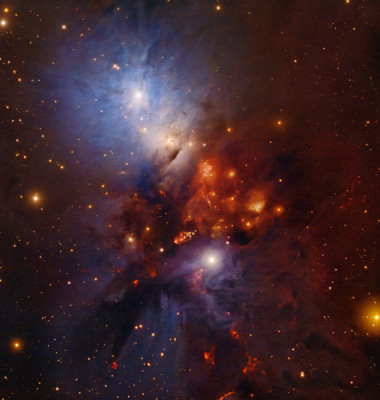
Astronomers have unveiled the most detailed images of a jet produced by a young star, marking a significant milestone in astrophysics. This groundbreaking research, published in Nature Astronomy on March 15, 2024, confirms a theoretical model that has remained untested for nearly three decades. The findings reveal intricate, ring-like structures that chronicle decades of explosive activity during the star’s formative years.
Utilizing the Atacama Large Millimeter/submillimeter Array (ALMA), one of the world’s leading astronomical facilities, an international team of researchers focused on a fast-moving jet originating from SVS 13, a binary star system located approximately 1,000 light-years from Earth. The high-resolution images captured by ALMA display over 400 nested molecular rings, each one representing the aftermath of energetic outbursts that occurred as the star began to develop.
Gary Fuller, a Professor of Astrophysics at the University of Manchester and co-author of the study, emphasized the significance of these observations. He stated, “ALMA has provided a level of precision we’ve never been able to achieve before. These images give us a completely new way of reading a young star’s history. Each group of rings is effectively a time-stamp of a past eruption, offering vital insights into how young stars grow and how their developing planetary systems are shaped.”
Understanding the Formation of Stars
Stars like the Sun emerge from the dense clouds of gas and dust found in the cosmos. During their initial stages, they experience powerful outbursts that not only heat but also disturb the surrounding material. Concurrently, they launch rapid, collimated jets of gas that play a critical role in regulating their matter accumulation and influencing the evolution of the surrounding disc, where future planetary systems will form.
The research team made a remarkable discovery in their analysis of the jet from SVS 13. They identified how its shape and speed evolved over time as it traversed through its environment. By employing a technique described as “cosmic tomography,” they reconstructed the jet’s three-dimensional structure with unprecedented clarity. Notably, the youngest ring they observed corresponds to a bright outburst recorded from the SVS 13 system in the early 1990s. This correlation represents the first direct link between a specific energetic event in a forming star and a change in the speed of its jet.
A Collaborative Effort Across Borders
This extensive project brought together astronomers from 16 institutions across eight countries, showcasing the global collaboration in the field of astrophysics. The initiative was led by the Institute of Astrophysics of Andalusia (IAA-CSIC) in Spain and builds upon previous work from the US National Science Foundation’s Very Large Array (VLA), which first detected the jets from SVS 13.
ALMA operates under the auspices of the Joint ALMA Observatory, which is managed by the European Southern Observatory (ESO), the National Radio Astronomy Observatory (AUI/NRAO), and the National Astronomical Observatory of Japan (NAOJ). The UK ALMA Regional Centre Node, which supports UK astronomers in their use of the ALMA observatory, is backed by the UK Science and Technology Facilities Council (STFC).
This research represents a significant advancement in our understanding of stellar formation and the dynamics of young stars. By providing a clear historical context of how stars interact with their environments, these findings pave the way for future explorations into the birth and evolution of celestial bodies.
