



































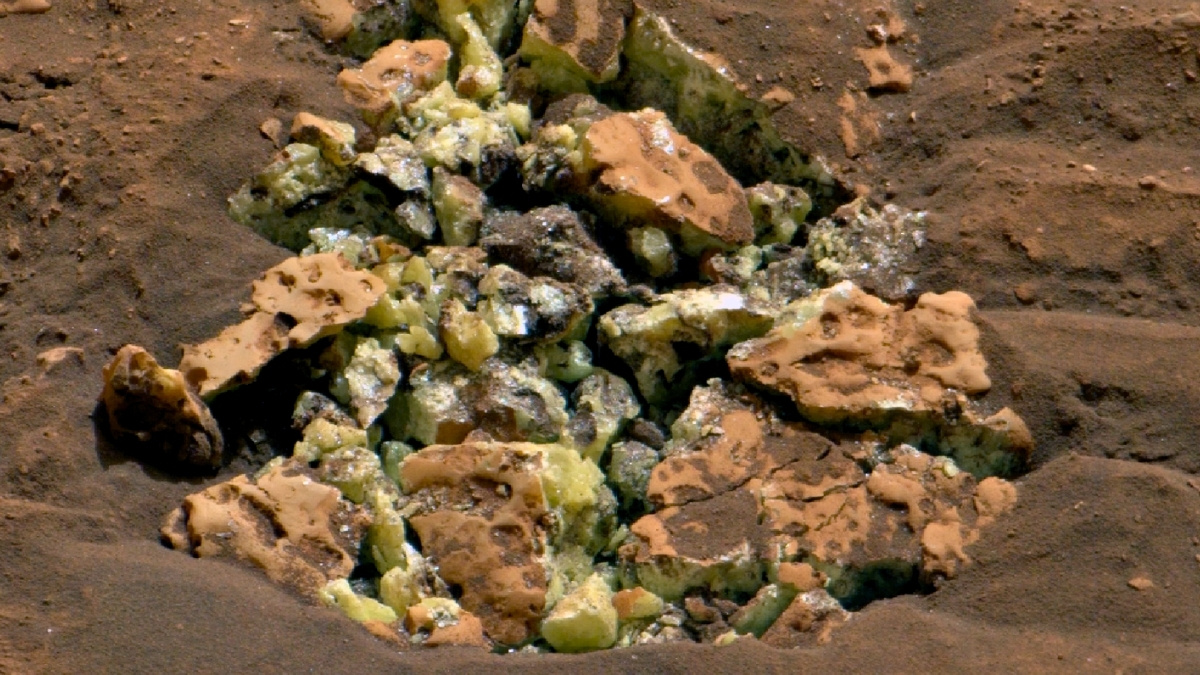
A recent discovery on Mars has revealed unexpected yellow crystals of elemental sulfur, following an accidental cracking of a rock by NASA’s Curiosity rover. While exploring the Gediz Vallis Channel in May 2023, the rover’s weight caused the rock to break open, unveiling the pure elemental sulfur, also referred to as brimstone. This marks the first time such a mineral has been found on the red planet, despite sulfates being relatively common.
The Gediz Vallis Channel is an area of significant geological interest, previously thought to hold only sulfate minerals formed from sulfur compounds mixed with other minerals in water. The discovery of pure sulfur suggests that elemental sulfur may be more prevalent in this region than previously understood. “Finding a field of stones made of pure sulfur is like finding an oasis in the desert,” stated Ashwin Vasavada, project scientist for Curiosity at NASA’s Jet Propulsion Laboratory, in a statement released in July 2024. “It shouldn’t be there, so now we have to explain it.”
Understanding the implications of this finding requires further research. Sulfate minerals can provide crucial insights into the history of water on Mars and the planet’s geological weathering processes. In contrast, pure sulfur forms under specific conditions that have not been observed in the region where Curiosity made its discovery. This raises questions about the geological history of Mars and suggests that there may be significant elements yet to be uncovered.
Sulfur is an essential element for life, typically existing in sulfate form. It plays a crucial role in forming amino acids necessary for protein synthesis. Although the presence of sulfates on Mars is already established, the discovery of pure sulfur adds a new layer of complexity to our understanding of the planet’s potential for habitability. While definitive evidence of life on Mars remains elusive, researchers continue to find elements that could support life, including chemistry conducive to biological processes, water, and conditions that may have been habitable in the past.
Curiosity’s journey is crucial for expanding our knowledge of the Martian surface. The rover’s instruments were able to analyze and identify the sulfur-rich rocks, but if it had not fortuitously cracked one open, this discovery might have taken much longer to achieve. The next phase of research will involve modeling Mars’s geological evolution to understand how this sulfur came to be present.
The Gediz Vallis Channel itself is a remnant of an ancient waterway, its rocks bearing the marks of rivers that flowed billions of years ago. As Curiosity continues to traverse this fascinating landscape, it remains on the lookout for further surprises hidden among the Martian rocks.
In addition to Curiosity, NASA’s Perseverance rover is also exploring Mars, recently achieving a milestone in planetary exploration. On June 19, 2024, it completed the longest recorded drive of any robot vehicle on the Martian surface, covering a distance of 411 meters in one trip. This achievement highlights the advancements in robotic exploration and the ongoing quest for knowledge about Mars.
The discoveries made by these rovers underscore humanity’s enduring spirit of inquiry and the desire to understand our place in the cosmos. As scientists analyze the implications of the sulfur find and continue their explorations, the quest for answers about Mars’s past and potential for life is far from over.
