



































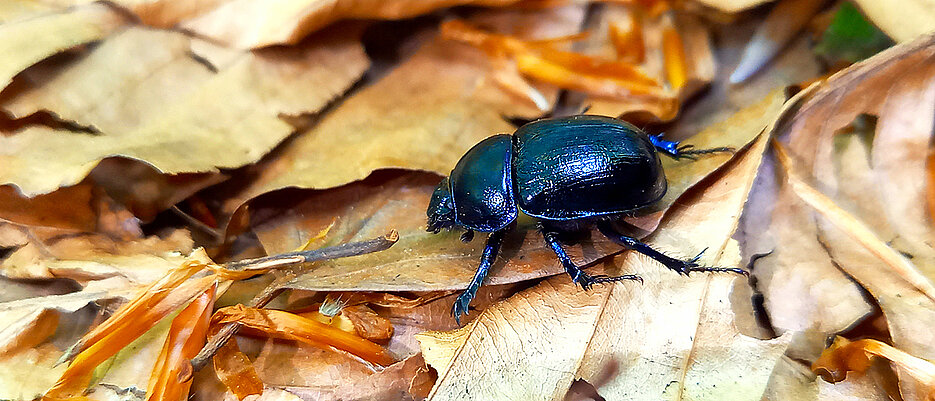
Research from the University of Würzburg has revealed that efforts to enhance biodiversity in forests may inadvertently harm dung beetle populations. The study underscores how rising temperatures are exacerbating the situation. Rather than flourishing in newly created canopy openings designed to mimic the conditions of natural forests, dung beetles are experiencing significant declines in these areas.
The initiative to create greater structural diversity in Europe’s commercial forests aims to counteract species loss. This strategy involves deliberately opening up forest canopies and enriching deadwood to provide habitats for various plants and animals. In a major forestry experiment across Germany, researchers from Julius-Maximilians-Universität Würzburg examined the impact of these changes on dung beetles, comparing conventional dense forests with those featuring enhanced structural diversity.
Over a span of the study, a total of 234 areas across eleven forest regions in Germany were scrutinized, including the Bavarian Forest National Park and forests surrounding Lübeck. The findings were unexpected: “The diversity of dung beetles did not increase in the more structurally diverse forests. In the newly created canopy openings, it even declined significantly,” stated Johanna Asch, a doctoral student at the university and lead author of the study.
The study highlights that dung beetles, crucial to forest ecosystems, do not benefit from structural diversity in the same way other species might. Instead, the survival of these beetles is closely tied to the microclimate of their forest environments. Dung beetles, often overlooked, serve essential ecological roles, acting as “health police” by removing animal feces and preventing the spread of parasites. They also work as “nutrient recyclers,” reintroducing nutrients into the soil by breaking down dung.
The most prevalent species in the study, the forest dung beetle Anoplotrupes stercorosus, was found to be particularly vulnerable. This species, which represents over 90 percent of the dung beetle biomass in many regions, is negatively impacted by climate changes linked to forest management practices. The research indicates that closed, dense forests provide a buffer against extreme temperatures, whereas canopy openings can lead to increased temperatures and drier conditions.
The implications of this study are significant, particularly in the context of climate change. The researchers found that when beetles from cooler regions were excluded from dung, the decomposition rate dropped by an alarming 77 to 91 percent. This data underscores the vital importance of dung beetles in maintaining healthy ecosystems.
As temperatures continue to rise, the survival of dung beetle populations becomes increasingly precarious. The researchers emphasize that while promoting structural diversity in forests remains a valid goal, it is equally important to maintain large, closed forest areas that provide cooler conditions. “Even if the goal of greater structural diversity remains valid, it is essential to maintain sufficiently large, closed, and thus cooler forest stands at the same time,” Asch noted.
With ongoing climate change, the forest dung beetle may retreat to cooler regions, potentially creating a functional gap in ecosystems. Future research will need to explore whether warmer climate species from Mediterranean areas can migrate to fill this void.
This study, published in the Journal of Applied Ecology on February 15, 2026, illustrates the complexities of ecosystem management. It emphasizes that a one-size-fits-all approach is inadequate to preserve the intricate relationships among species. Understanding the specific needs of different species, like dung beetles, is crucial for effective biodiversity conservation.
