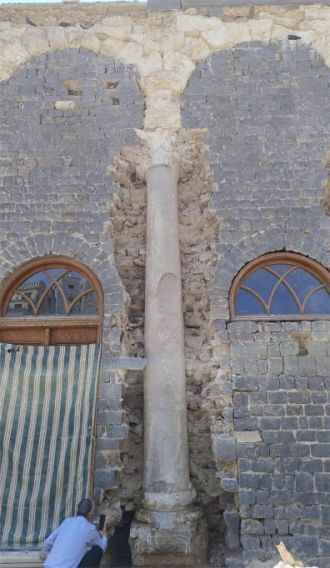
A Greek inscription recently uncovered at the Great Mosque of Homs in Syria has reignited discussions regarding the historical location of the Temple of the Sun, associated with the Roman Emperor Elagabalus. This discovery, made during restoration work, has prompted scholars to reevaluate the mosque’s origin and its connection to ancient religious practices.
The Great Mosque, notable for its oval layout, stands atop a site rich in history. Once known as Emesa, Homs remains a significant cultural center within its province. The inscription was found beneath a column during restoration efforts in the mosque, which is linked to the 12th-century Zengid ruler Nur ad-Din. Initially believed to have been constructed on the remains of a church dedicated to St. John the Baptist, the mosque has been a focal point of religious significance for centuries.
In a recent study published in the archaeology journal Shedet, Dr. Maamoun Saleh Abdulkarim, an archaeological expert from the University of Sharjah, posits that this inscription may offer crucial insights into the mosque’s historical layers. His research aims to clarify whether the Great Mosque was built directly over the Temple of Elagabalus, a question that has perplexed historians for decades.
“This inscription provides new evidence in a long-standing debate,” Dr. Abdulkarim remarked. He highlighted the importance of understanding the site’s transformation from a pagan temple to a Christian church and finally to a mosque. The inscription, he argues, could establish a continuity of worship practices at this historically significant location.
Investigating Religious Layers
For many years, scholars have attempted to trace the origins of the Great Mosque, examining various forms of historical evidence. The newly discovered inscription, however, adds a fresh perspective to the discussion. Dr. Abdulkarim’s analysis suggests that if the inscription indeed bears solar cult symbolism, it may indicate a direct link between the ancient pagan sanctuary and the subsequent religious structures.
He noted, “Such evidence would significantly strengthen the argument that religious transformation in Emesa occurred through architectural layering and reinterpretation rather than a complete break.” This continuity reflects a broader narrative of religious coexistence in Emesa, showcasing the evolution of faith from paganism to Christianity and eventually to Islam.
The study meticulously outlines Emesa’s religious landscape through three pivotal phases: paganism, Christianity, and Islam. It serves as a case study of cultural resilience and the layered identities that have emerged within Middle Eastern archaeology. Dr. Abdulkarim elaborated, “The evolution of religious life in Emesa during Roman and early Byzantine times illustrates how the city’s religious landscape changed, reflecting broader social and political dynamics.”
Revealing the Inscription
The granite inscription, measuring 1×1 meter, is situated at the base of a mosque column and features a symmetrical design, typical of formal dedication texts. Archaeologist Teriz Lyoun, head of the Excavation Department in Homs, described its discovery during excavations in 2016. The inscription was fully revealed by May 2016, following years of unrest in Syria, and the first translation was published by historian Abdulhadi Al-Najjar on social media.
The text of the inscription embodies a heroic tone, likening a ruler to natural forces as he triumphs over enemies. Dr. Abdulkarim noted that the Greek language exhibited grammatical irregularities, reflecting the linguistic dynamics of the region during the Roman period, where Aramaic was more commonly spoken.
This inscription reinforces the hypothesis that the Great Mosque may indeed lie atop the Temple of the Sun. Dr. Abdulkarim stated, “Every inscription from the Roman era that is uncovered here will enhance our understanding of this site’s history.”
The transition from a pagan temple to a Christian church and ultimately to a mosque illustrates the complex interplay between faiths in Emesa. Dr. Abdulkarim emphasized that the city’s identity was deeply intertwined with its pagan roots, particularly through the worship of Elagabalus, the local solar deity.
The findings contribute to a broader understanding of religious transformation in the region. As Emesa evolved, the coexistence of pagan and Christian practices persisted for generations, similar to the modern-day interactions between Islam and Christianity in Syria.
Dr. Abdulkarim concludes, “The transformation of Emesa was not a rupture; it was a negotiation between old beliefs and emerging faith. This historical site continues to reflect the layers of identity, power dynamics, and cultural resilience that define its rich heritage.” The Great Mosque of Homs remains a testament to the enduring significance of religious practice and identity across centuries.