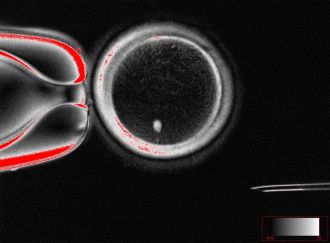
Recent research published in Nature Communications reveals a groundbreaking advancement in reproductive science: human skin cells can be transformed into fertilizable eggs. This proof-of-concept study, conducted by a team at Oregon Health & Science University, showcases the potential of cell reprogramming to address infertility, a condition affecting millions globally.
Infertility often arises from issues related to the gametes—the oocyte (egg) or sperm—necessary for creating a zygote. Traditional methods such as in vitro fertilization (IVF) can sometimes yield limited success. The study introduces an alternative approach known as somatic cell nuclear transfer (SCNT), a technique where the nucleus from a somatic cell is transferred into an egg cell that has had its nucleus removed. This process aims to create a functional oocyte.
A significant challenge in SCNT is that the cells produced possess two complete sets of chromosomes, resulting in embryos with an extra set, which can lead to complications. The researchers developed a method termed mitomeiosis to address this issue, mimicking natural cell division by discarding one set of chromosomes. In their experiments, the team successfully generated 82 functional oocytes, which were subsequently fertilized in the laboratory. Approximately 9% of these fertilized eggs developed to the blastocyst stage after six days.
Despite the potential, the study acknowledges several limitations. The majority of embryos did not progress beyond fertilization, and chromosomal abnormalities were present in the blastocysts. Nevertheless, the findings suggest that generating functional gametes from skin cells could be feasible in humans, laying the groundwork for future research in this area.
Scientific Insights and Implications
The research provides insights into the complex molecular processes that govern chromosome segregation during egg development. Prof. Roger Sturmey, a Professor of Reproductive Medicine at the University of Hull, UK, emphasized the significance of this study, stating, “This offers a new understanding of the intricate molecular processes that control the segregation of chromosomes in the egg, during the stages immediately before the egg is fertilized.”
He pointed out that while the science is promising, the low success rates reported indicate that clinical applications remain a distant prospect. He highlighted the need for ongoing public dialogue regarding advancements in reproductive research to ensure governance and accountability.
Prof. Ying Cheong, from the University of Southampton, described the study as an exciting proof of concept, noting, “Clinicians are seeing more and more people who cannot use their own eggs, often because of age or medical conditions.” She expressed optimism that such research could eventually transform the understanding of infertility and miscarriage, potentially leading to the creation of egg or sperm-like cells for those without options.
Prof. Richard Anderson, Elsie Inglis Professor of Clinical Reproductive Science at the University of Edinburgh, added that the ability to generate new eggs could significantly impact women who have lost their eggs due to various health reasons, including cancer treatment. He acknowledged the safety concerns that would need to be addressed but considered this study a step toward helping many women conceive genetically linked children.
Future Directions in Reproductive Science
While the study demonstrates the feasibility of generating eggs from skin cells, further research is essential to ensure the safety and efficacy of the technique before it can be used in clinical settings. The next steps will likely focus on refining the process and addressing the limitations encountered with embryonic development.
With ongoing advancements in reproductive technology, the potential to assist individuals facing infertility could reshape the landscape of reproductive health. As researchers continue to explore innovative methods such as mitomeiosis, the hope remains that these scientific breakthroughs will one day provide new solutions for those desiring to start families.