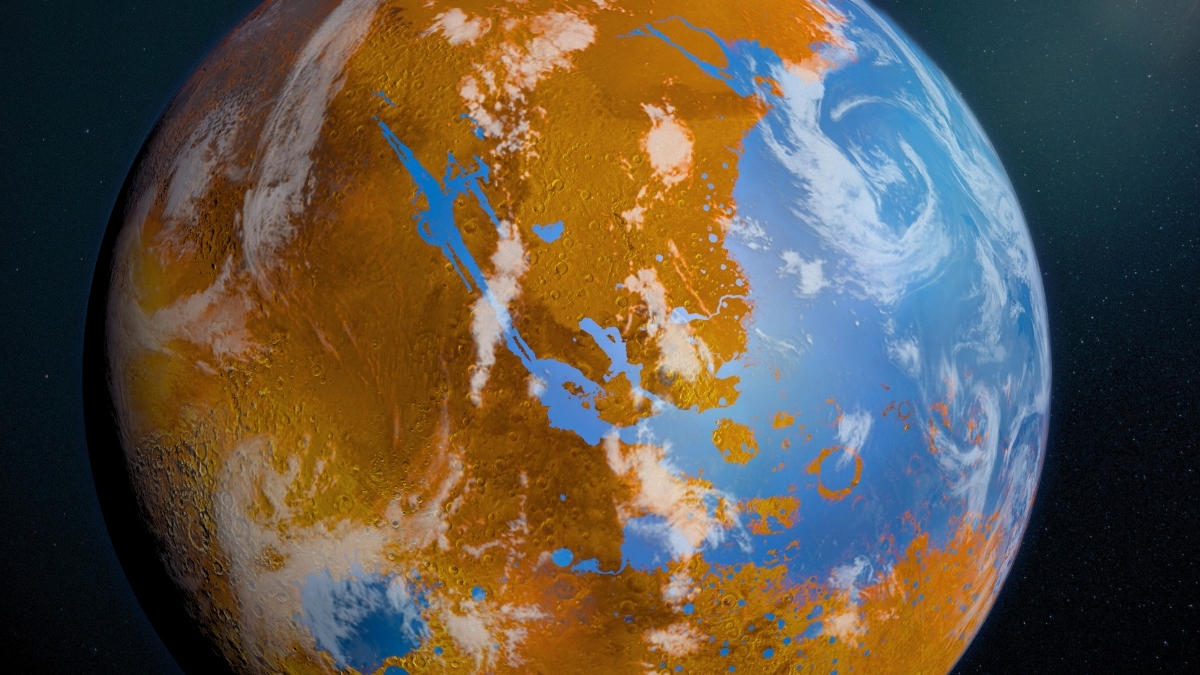
Understanding the fate of water on Mars has puzzled scientists for decades. Recent research presents new findings that suggest a phenomenon known as “rocket storms” may contribute to the loss of water from the Martian atmosphere. This study utilizes data collected from multiple instruments across three spacecraft, including the Perseverance and Curiosity rovers, alongside orbiters such as the Mars Reconnaissance Orbiter and ExoMars.
Mars was once a wet world, supported by evidence indicating it had a robust hydrodynamic cycle. Current estimates suggest that the Red Planet had enough water to potentially cover much of its surface to a depth of hundreds of meters. To estimate the water’s previous abundance, scientists analyze the deuterium/hydrogen (D/H) ratio. The presence of deuterium, a heavier isotope of hydrogen, provides clues about water loss over time.
As lighter hydrogen atoms are more likely to escape into space, the ratio of deuterium to hydrogen increases in Martian water. Measurements show that this ratio on Mars is 5-8 times higher than that of Earth, indicating significant water loss. Estimations derived from these ratios reflect a time when Mars could have been coated with ice.
Reassessing Water Loss Mechanisms
Historically, scientists believed that water loss occurred primarily during the warmer southern summer months, when temperatures rise significantly. Mars features an axial tilt similar to Earth, leading to seasonal changes. However, the recent findings challenge this assumption.
The study highlights a particularly powerful storm that occurred during the northern summer of Mars year 37 (corresponding to 2022-2023 on Earth). Data from the Emirates Mars Mission (EMM) and other missions revealed that this storm triggered a process where water was pushed into the upper atmosphere, where it is susceptible to destruction from ultraviolet radiation.
Traditionally, dust storms during southern summers were thought to be the primary drivers of moisture loss. The new research indicates that similar processes may happen year-round, not limited to specific seasonal events. Dust particles, when lifted into the atmosphere, can raise temperatures by approximately 15°C, preventing the formation of ice clouds that would normally trap water.
Implications for Martian Climate History
The implications of these findings are significant. They suggest that Mars may have experienced more consistent and intensified water loss throughout its history than previously assumed. Researchers speculate that in the past, Mars might have had an even greater axial tilt, which could have led to more extreme northern summers and increased storm activity, creating additional pathways for water to escape.
This comprehensive understanding of Martian water loss not only sheds light on the planet’s climate history but also raises intriguing questions about its potential to support life. The continuous examination of Mars’ atmospheric dynamics remains crucial as scientists work to unravel the mysteries of the Red Planet.
These findings are detailed in a paper published in a peer-reviewed journal and further contribute to the ongoing exploration of Mars. As researchers gather more data, they hope to refine their models and better understand the complex climate history of our neighboring planet.