



































Researchers at the Joint Quantum Institute (JQI) have made a surprising discovery regarding the interactions of quantum particles, revealing unexpected behaviors that challenge existing theories. Their findings, published on January 1, 2026, in the journal Science, indicate that quantum particles may behave differently than previously thought, particularly when it comes to the relationships between fermions and bosons.
The study, led by JQI Fellow Mohammad Hafezi, aimed to explore how varying the ratio of fermionic to bosonic particles in a material could alter their interactions. Initially, the team anticipated that fermions would avoid each other and the bosons, leading to crowding that would restrict the movement of bosons. Contrary to these expectations, the researchers observed that bosons began to move rapidly when fermions were introduced to block their pathways.
Daniel Suárez-Forero, a former JQI postdoctoral researcher now at the University of Maryland, Baltimore County, recalled their initial disbelief at the results: “We thought the experiment was done wrong.” However, after thorough verification, they realized they had uncovered a new way for quantum particles to interact.
Unpacking Quantum Relationships
The researchers focused on the interactions between electrons and quasiparticles known as holes. Holes occur when an electron is absent from an atom, creating a positively charged vacancy that can move and carry energy. When an electron pairs with a hole, they form an exciton, a structure typically considered “monogamous” due to their strong binding.
Previous assumptions held that excitons would remain stable, with their electron partners acting as fixed companions. Nevertheless, the experiment revealed that in crowded conditions, holes began to behave differently, leading to what the team described as “non-monogamous hole diffusion.” This unexpected behavior allowed excitons to travel further and faster than anticipated.
Experimental Design and Findings
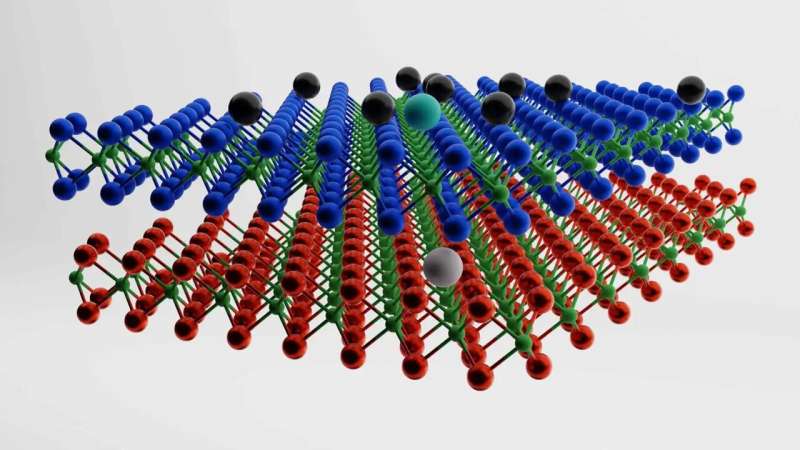
To conduct their experiments, the researchers engineered a material by layering two thin substances with precise alignment. This structure created a favorable environment for excitons, enabling them to persist longer while maintaining order within the material. The arrangement resembled a restaurant with intimate tables, where electrons and excitons needed designated spots and could not share.
As the team manipulated the electron density within the material by adjusting electrical voltages, they found that excitons’ mobility significantly increased when the electron population reached a tipping point. The results showed that rather than being hindered by the dense presence of electrons, the excitons adapted to the conditions, leading to accelerated movement.
Pranshoo Upadhyay, the lead author of the study, emphasized the significance of these findings, stating, “No one wanted to believe it… We replicated the results in different settings and they remained consistent.” The research was successfully repeated across various samples, solidifying their conclusions.
The implications of this research extend beyond theoretical understanding. By controlling the mobility of excitons through electrical adjustments, the team envisions potential applications in advanced technologies such as solar panels and electronic devices. Hafezi expressed enthusiasm about the prospects: “Understanding this dramatic increase in the exciton mobility offers an opportunity for developing novel electronic and optical devices with enhanced capabilities.”
As this research unfolds, it contributes valuable insights into the fundamental interactions of quantum particles, paving the way for future advancements in quantum technology.
