



































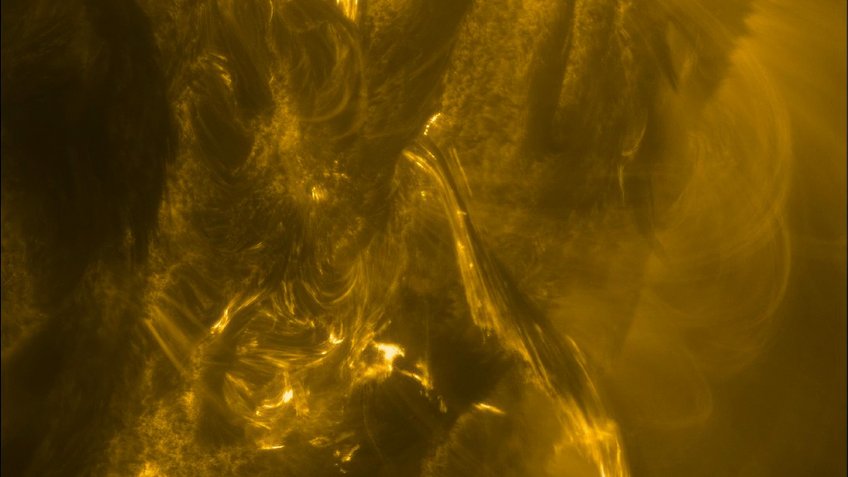
A significant solar event unfolded on September 30, 2024, when the European Space Agency’s (ESA) Solar Orbiter successfully captured an M7.7-class solar flare. This eruption, which hurled radiation and particles into space, was observed with unprecedented detail, thanks to Solar Orbiter’s proximity to the Sun. On that day, the spacecraft was approximately 45 million kilometers from the solar surface, the closest point in its elliptical orbit.
The timing of the observation was fortuitous. Solar Orbiter had positioned itself perfectly to monitor the eruption occurring at the solar limb, allowing scientists to capture critical events leading up to the flare. According to Lakshmi Pradeep Chitta, a scientist at the Max Planck Institute for Solar System Research (MPS), “It was extremely fortunate that Solar Orbiter, the most powerful solar observatory in space, was looking at the flare at exactly the right time and from exactly the right angle.”
Understanding Solar Flares
Although the M7.7-class flare was not among the most powerful solar events, it was still a remarkable occurrence. Such flares are relatively rare, even during periods of heightened solar activity. The implications of solar flares can be significant, leading to disruptions in radio communications and potential impacts on satellites and power supplies. Sami K. Solanki, MPS Director, emphasized the importance of understanding these solar phenomena, stating, “It is therefore important to understand exactly what causes such events on the Sun.”
Research indicates that changes in the Sun’s magnetic field architecture provide the energy necessary for these eruptions. Twisted magnetic field lines store energy, which is released when they break open and reassemble—a process known as reconnection. The exact mechanics of this process remain a mystery, but recent findings suggest that smaller reconnection events can trigger larger flares, akin to an avalanche.
Unprecedented Observations
In a detailed study published in the journal Astronomy & Astrophysics, researchers led by MPS described how Solar Orbiter’s instruments, including the Extreme Ultraviolet Imager (EUI), observed the solar flare in real-time on the evening of September 30. The EUI captured images with high spatial resolution of approximately 210 kilometers and a rapid sequence rate of two seconds. This level of detail is comparable to a form of “solar sports photography,” revealing movements and changes in the solar atmosphere that were previously undetectable.
Around 40 minutes prior to the flare, EUI images displayed a dark plasma loop extending into the corona, the Sun’s outer atmosphere. This relatively cool plasma structure, suspended by twisted magnetic field lines, stored energy much like a coiled spring. At approximately 23:47 UTC, a discharge occurred, causing the plasma arc to rise and explode, accelerating charged particles to speeds nearing 50 percent of the speed of light.
The moments leading up to the eruption were particularly intriguing for researchers. Adjacent to the dark plasma loop, bright plasma streams captured within the magnetic field began to destabilize about 30 minutes before the flare. Initial reconnection processes resulted in the formation and destabilization of new plasma strands, triggering an avalanche of reconnection events that led to the major eruption.
Pradeep noted, “These minutes before the flare are extremely important and Solar Orbiter gave us a window right into the foot of the flare where this avalanche process began.” The study revealed that not all energy from the flare was released into space; some was transferred to surrounding plasma, resulting in high-speed plasma blobs raining down.
Miho Janvier, ESA’s Solar Orbiter co-Project Scientist, highlighted the significance of these findings: “Solar Orbiter’s observations unveil the central engine of a flare and emphasise the crucial role of an avalanche-like magnetic energy release mechanism at work.” She added that understanding whether this mechanism occurs in all solar flares or on other flaring stars remains an intriguing prospect.
The successful capture of this solar flare underscores the capabilities of Solar Orbiter and the importance of continued solar research, which may provide insights not only into our Sun but also into the behavior of other stars across the universe.
