



































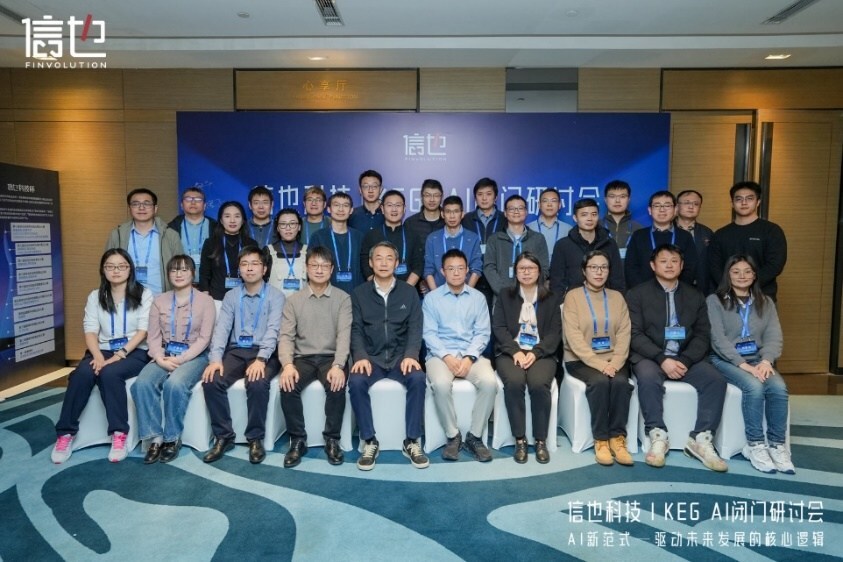
FinVolution Group, a leading credit technology company, hosted a closed-door technology forum on December 18, 2025, in Shanghai. The event, titled “New AI Paradigms: The Core Logic Driving Future Development,” gathered over 20 prominent scholars in the field of artificial intelligence. The forum aimed to explore the evolution of AI technologies beyond standalone tools, focusing on their systemic capabilities and impact on fintech business models.
Scholars from esteemed institutions such as Tsinghua University, Fudan University, Beijing Jiaotong University, and Beijing Normal University contributed valuable insights regarding the application of large models across various industries. Key discussions revolved around the importance of industry-academia collaboration and interdisciplinary innovation, covering advanced topics like AI detection, data mining, and knowledge graphs.
Professor Jie Tang from Tsinghua University provided a forward-thinking perspective that integrated cutting-edge research with historical technological advancements. He outlined potential development trajectories and key trends that may shape the future of artificial intelligence at a macro level.
During the forum, Yuxiang Wang, Chief Operating Officer and Chief Technology Officer of FinVolution, presented the company’s latest AI initiatives. He emphasized that the essence of the new AI paradigm lies in deeply integrating technology with core business logic. This integration necessitates a systematic reconstruction of underlying architectures, rather than merely adding model capabilities.
Wang introduced FinVolution’s AI development framework, which consists of a centralized model layer, resource layer, and application layer built on the company’s hardware infrastructure. By combining commercial large models with proprietary models, FinVolution has created a business-oriented agent platform. This platform enables AI to actively engage in essential functions such as risk management, customer service, and operations.
The company’s multilingual intelligent assistant, Blu, is currently operational in nine countries and manages over five million interactions daily. This deployment exemplifies how AI can empower business operations at scale. “In an era where large AI models are transforming every industry, fintech companies should not view AI merely as an efficiency tool,” Wang stated. “Instead, AI applications need to evolve from discriminative to generative, and from isolated decision-making to end-to-end perception and decision systems.”
At the forum, FinVolution announced the official launch of research for its upcoming white paper, titled “Intelligent Leadership Goes Global: The Evolution of AI in Fintech.” This document will detail the company’s experiences with international expansion and summarize practical approaches for integrating AI into core business operations across various markets and regulatory environments. It will particularly focus on the application of multimodal large models in areas such as cross-border customer acquisition, risk identification, and operational decision-making.
Lei Chen, Vice President of FinVolution, remarked that the white paper represents a culmination of the company’s global experience and offers replicable methodologies. “By grounding our analysis in real international business scenarios, we aim to clarify how AI can be applied, how far it can go, and where its boundaries lie,” he said. “This will provide the industry with a reference that balances innovation and compliance.”
The forum marked a significant step in facilitating dialogue between academia and industry leaders, setting the stage for future advancements in AI that could reshape the fintech landscape.
