



































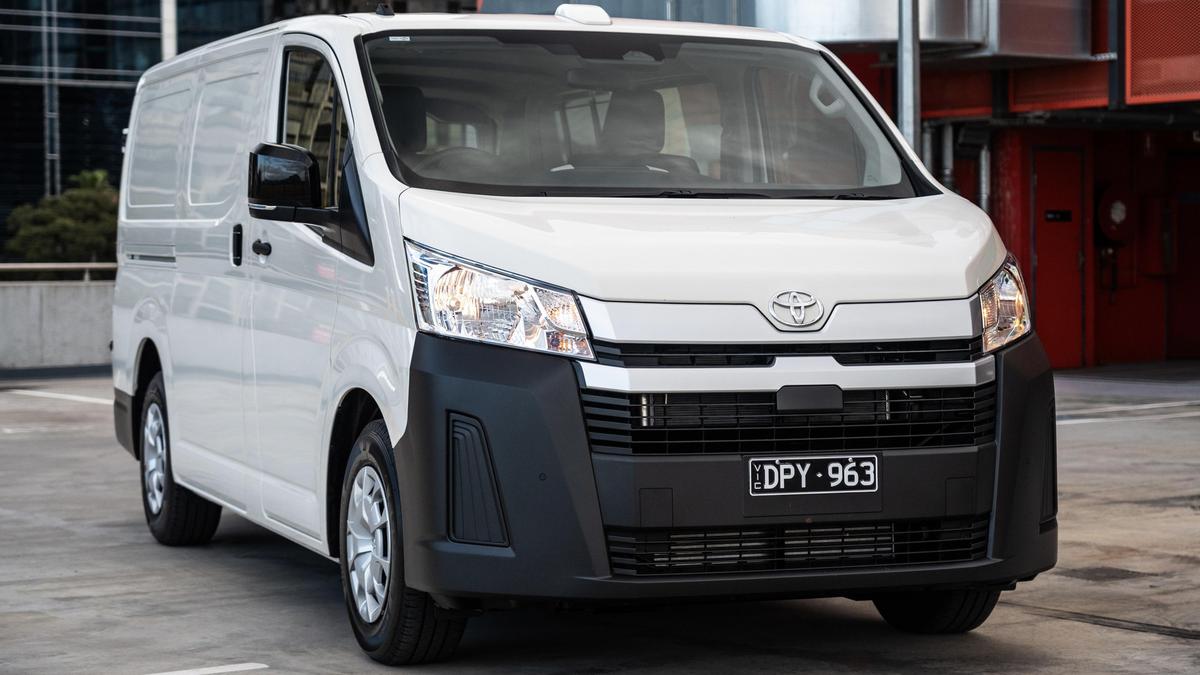
The Toyota HiAce remains the leading choice in Australia’s commercial van sector, having surpassed 10,000 sales in 2023. This figure starkly contrasts with the 3,500 units sold by the second-place Ford Transit Custom, underscoring the HiAce’s enduring popularity. Even as new competitors enter the market, the HiAce continues to stand strong, backed by its reputation and recent updates aimed at keeping pace with modern demands.
In a bid to enhance its appeal, Toyota has introduced several updates to the HiAce for 2026. Significant changes include a new digital instrument cluster, adaptive cruise control, and standard wireless connectivity for both Apple CarPlay and Android Auto. Notably, a window has been added to the passenger-side sliding door, improving visibility and convenience. Despite these updates, many elements of the sixth-generation HiAce, which debuted in mid-2019, remain unchanged, including its rear-wheel-drive layout and the 2.8-litre turbo-diesel engine that has become a hallmark of the model.
For buyers considering the HiAce, pricing begins at $54,630 for the basic barn-door variant, reflecting an increase of approximately $3,000 compared to previous models. The HiAce’s two main competitors, the Ford Transit Custom and the Hyundai Staria Load, start at $57,590 and $46,990, respectively. The Volkswagen Transporter is priced from $58,590, while the LDV Deliver 7 can be had for around $48,411 drive-away.
Interior Features and Storage Capacity
Inside the HiAce, the cabin offers a practical and comfortable environment, now enhanced by the new technology. While the infotainment system retains a somewhat outdated aesthetic, the inclusion of wireless smartphone mirroring has been positively received. Users have reported a seamless experience with Apple CarPlay, although some may find the initial setup slightly cumbersome compared to wired connections.
The new 7.0-inch digital instrument display replaces the previous analogue setup, providing a more modern interface. While customization options remain limited, the display effectively conveys a range of information through intuitive controls located on the steering wheel. Although the HiAce lacks in some comfort features, such as inboard armrests, it compensates with ample storage solutions, including five cupholders and a spacious glove compartment.
Cargo capacity is a standout feature, with a total volume of 6.2 cubic metres. The interior is left mostly bare, allowing for easy customization without concern for damaging upholstery. Six heavy-duty tie-down points enhance cargo security, while barn doors facilitate easy loading and unloading. The full-height sliding doors on both sides of the van ensure accessibility for various loading situations.
Performance and Driving Experience
Under the hood, the HiAce is powered by Toyota’s renowned 2.8-litre turbo-diesel engine, paired with a six-speed automatic transmission. This combination delivers 450Nm of torque, making it well-suited for both freeway commuting and urban driving. However, real-world fuel consumption figures have been reported as higher than Toyota’s official claims, particularly under commercial usage conditions.
The driving experience remains largely unchanged, with the HiAce offering a spacious cargo area that can amplify noise levels while on the road. Although the absence of a standard bulkhead can impact insulation, visibility from the driver’s seat is improved due to the addition of a window in the passenger-side sliding door. The van’s short bonnet provides good visibility, although it can make parking challenging.
The HiAce is equipped with adaptive cruise control and modern steering technologies that improve its handling on longer trips. However, it still lacks some refinement compared to newer competitors, which may offer better insulation and comfort features.
Safety is another area where the HiAce excels, boasting a five-star rating from the Australasian New Car Assessment Program (ANCAP), based on testing conducted in March 2025. Standard safety features include advanced collision avoidance systems, contributing to its reputation as a reliable work vehicle.
The Toyota HiAce is backed by a five-year, unlimited-kilometre warranty, with servicing intervals set at every six months or 10,000 kilometres. While this is shorter compared to some rivals like the Volkswagen Transporter and Ford Transit Custom, which offer longer service intervals, the HiAce’s reliability continues to attract business owners and couriers alike.
In conclusion, while the Toyota HiAce remains a popular and dependable choice for commercial use, it faces increasing competition from more modern alternatives. With its combination of practicality, performance, and minor technological enhancements, it still meets the needs of many businesses. However, potential buyers may want to consider newer options that offer a more refined driving experience.
