



































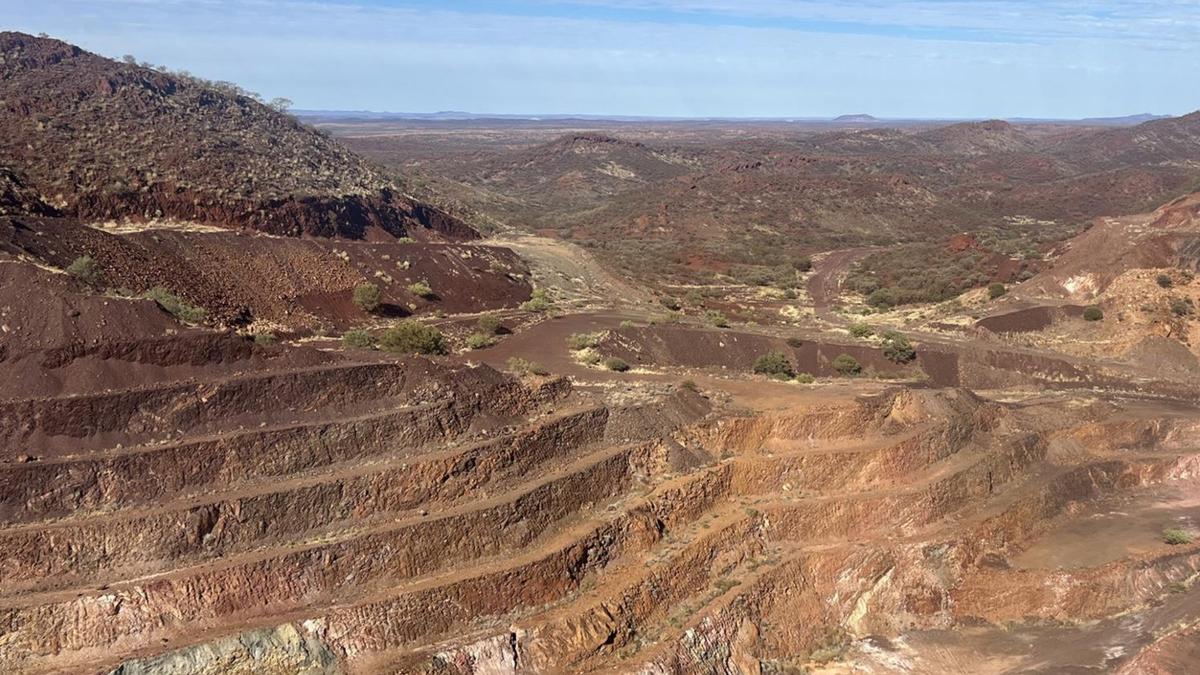
UPDATE: Kalamazoo Resources has just revealed groundbreaking findings from its Mt Olympus gold project in Western Australia’s Pilbara. The new scoping study indicates a potential to extract more than 524,000 ounces of gold over six years, with an astonishing $1.4 billion in free cash flow anticipated.
This urgent report highlights a rapidly growing opportunity in a market where gold prices are currently surging past $6000 an ounce. The study outlines a robust operation involving an 8.5-million-tonne open-pit mine and a flotation circuit capable of processing 1.5 million tonnes annually, producing a high-grade concentrate at an impressive 25 grams per tonne with an 86 percent recovery rate.
At a conservative gold price of $4500 an ounce—more than $1500 below current levels—the project still shows a pre-tax net present value (NPV) of $423 million and an internal rate of return (IRR) of 47 percent. However, these figures could skyrocket, with free cash flow potentially reaching $1.396 billion if gold prices remain elevated.
Kalamazoo’s Mt Olympus project is described as a “technically de-risked, high-grade system” that has returned to its original owners after years of scrutiny from major players like De Grey and Northern Star. The proposed development focuses on an integrated Mt Olympus–West Olympus open pit, with an average gold grade of 2.2 grams per tonne and a favorable nine-to-one strip ratio.
About 83 percent of the production target is bolstered by indicated resources, providing a solid foundation for the upcoming mine schedule. The average annual production is projected at 73,000 ounces, peaking at 110,000 ounces in the fifth year.
Additionally, the potential for underground mining was quantified last month, revealing a resource of 174,500 ounces at 3.76 grams per tonne. An exploration target beneath the open pit suggests an additional 129,000 to 387,000 ounces may be available. This positions Kalamazoo as a contender for a multi-deposit gold hub rather than a single-pit operation.
Kalamazoo’s recent acquisition of the Xanadu gold project has expanded its footprint to 380 square kilometres. Historical drilling at Xanadu has shown promising results, including intercepts of 11 metres at 5.32 grams per tonne and 5 metres at 8.71 grams per tonne, indicating similar mineralization to that at Mt Olympus.
The Pilbara region is gaining attention as a gold growth province. Infrastructure is already in place in towns like Paraburdoo, Tom Price, and Karratha, which are serviced by daily flights from Perth. Nearby projects, including Capricorn Metals’ 2.1-million-ounce Karlawinda project, further demonstrate the area’s potential.
Despite a modest $45 million market cap, Kalamazoo’s findings could attract significant investment, especially given the relatively low $208 million capital requirement to reach production. The company is currently in discussions to secure external partners, taking advantage of the project’s short payback period and substantial cash generation.
Management is now gearing up for pre-feasibility work, focusing on converting inferred material and exploring the Peake and Zeus deposits as potential satellite feeds. Early talks indicate there is “keen demand” for the company’s proposed gold-in-concentrate product, which could streamline financing.
With a projected half-million ounces at nearly $2200 an ounce margin and a two-year payback period, Kalamazoo’s Mt Olympus could very well anchor a new gold hub in Pilbara. The company aims to prove that this project is not just promising on paper but is capable of delivering real results in today’s favorable gold market.
As the pre-feasibility study is scheduled for release in 2024, all eyes will be on Kalamazoo Resources to see if Mt Olympus can fulfill its potential and transform the landscape of gold mining in Western Australia.
