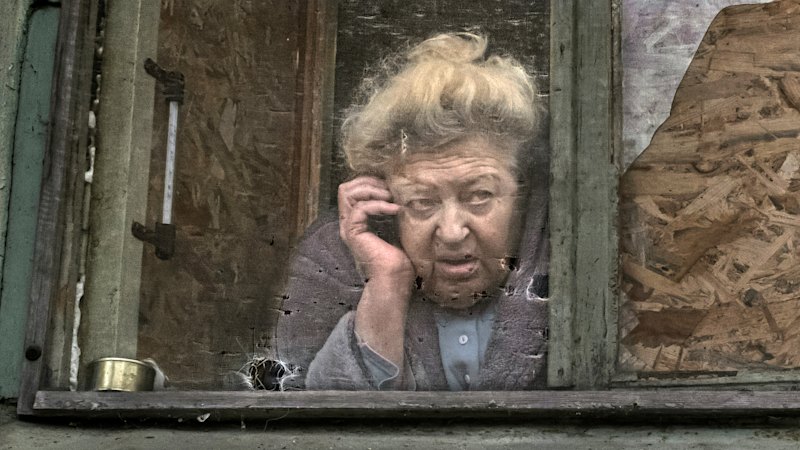
In the Ukrainian city of Kherson, residents navigate daily life under the looming threat of drone attacks. With a population that has dwindled to approximately 65,000, many families are on high alert, aware that every step outside their home could lead to fatal consequences from the skies.
As parents pick up their children from daycare, the routine is fraught with anxiety. Tanya Leshchenko, a mother of a five-year-old, checks an online chat group for alerts about incoming drone threats before leaving the building. The group provides crucial crowdsourced warnings in a city where the sound of a drone has become a harbinger of danger. Leshchenko describes the situation succinctly: “You cannot outrun a drone. It’s scary.”
Daily Life Amid Drone Threats
The picturesque streets of Kherson, lined with trees and historical architecture, mask an unsettling reality. Russian quadcopter drones, launched from occupied territories across the Dnieper River, have been used to target civilians indiscriminately. According to local authorities, around 200 civilians have been killed and 2,000 injured in drone strikes over the past year. The attacks, which residents have dubbed a “human safari,” have turned the city into a battleground where the enemy can strike from above.
The United Nations has condemned these assaults as war crimes, underscoring the severity of the situation. In response, the local government has moved essential services underground. Hospitals, schools, and government offices have relocated to basements to protect against aerial attacks. Children attend online classes, while underground activity rooms have replaced outdoor playgrounds.
Countermeasures and Community Resilience
In an effort to combat the drone menace, Kherson has implemented various defense measures, although no single solution has proven entirely effective. The military has established a wall of jamming antennas along the riverbank, and extensive nets have been installed over major thoroughfares to catch drones before they can detonate. Additionally, 250 concrete escape chambers have been constructed along footpaths to provide quick refuge.
Workers in the city utilize hand-held drone detectors to monitor the skies as they carry out repairs from previous bomb damage. These devices intercept the feeds from the drones’ cameras, allowing users to see real-time footage of the drone operator’s perspective. For the city’s military-civilian administrator, Yaroslav Shanko, the experience of being targeted by a drone is terrifying. He recalls a near-miss: “You need to reach maximum speed and manoeuvre,” he advises, emphasizing the urgency to evade detection.
Rights groups warn that Kherson may become a prototype for other cities grappling with similar threats. The accessibility of small quadcopter drones has revolutionized warfare, allowing for precision strikes that were previously reserved for high-cost military assets. Belkis Wille from Human Rights Watch notes, “Kherson is the clearest example of a campaign to target civilians with quadcopter drones, but this is really just the start of what we fear will become a reality for civilians in conflict areas around the world.”
Personal Stories of Survival
The human toll of these drone attacks is palpable. Oleh Pinchuk, a local surgeon, states that injuries from drone strikes have become so common that car accidents are now a secondary concern. Victims often find themselves watching videos of their own attacks online, a grim reminder of their vulnerability.
Residents like Mykola Hyadamaka, 67, share harrowing experiences. He recalls the moment he heard a drone pursuing his vehicle, only to be struck by shrapnel when he failed to reach safety in time. “There is no escape,” he reflects from his hospital bed. Similarly, Volodymyr Oleinichuk, a car park attendant, describes the chilling sensation of being hunted by a drone: “It circled overhead, waiting for me to crawl out.”
Despite the overwhelming dangers, many residents remain determined to stay in Kherson. Tanya Leshchenko expresses her unwillingness to leave, noting that her family has nowhere else to go. After picking up her daughter, she seeks shelter at the bus stop, checking the chat group for updates before hastening home.
As children adapt to life underground, they find solace in organized activities. Dance and art classes, along with movie screenings, provide brief respites from the constant threat of danger. One class, aptly named “United by Love,” serves as a reminder of the community’s resilience amid adversity.
In the face of ongoing conflict, the people of Kherson continue to navigate a life defined by uncertainty, relying on their ingenuity and solidarity to endure.