



































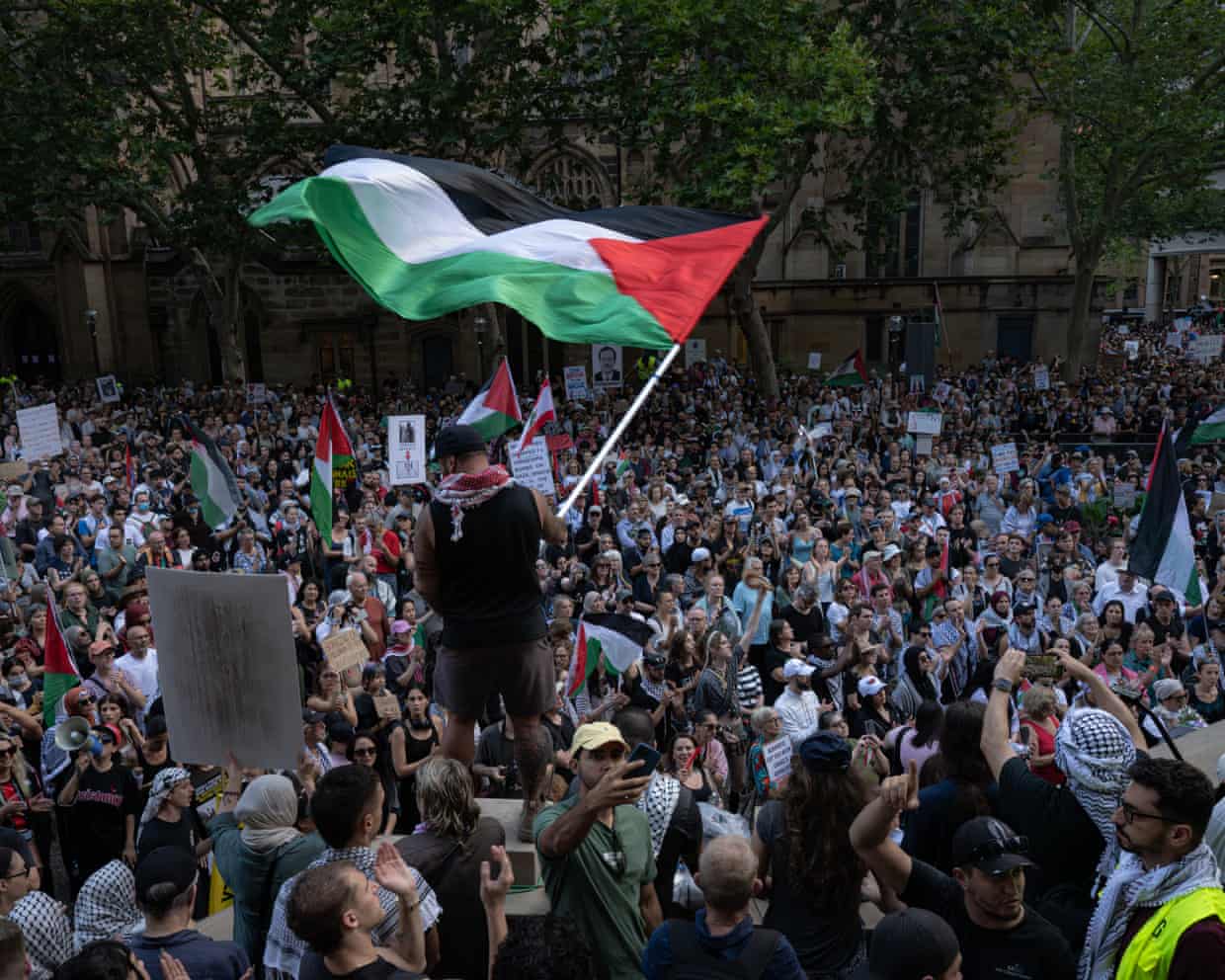
Lawyers representing three protest groups argued in the New South Wales (NSW) Court of Appeal that a law enacted by the Minns government, which effectively bans marches in Sydney’s Central Business District (CBD), has counteracted its own intention of fostering social cohesion. The court heard the challenge against the anti-protest law on Thursday, following its introduction after the Bondi terror attack.
The groups involved—Blak Caucus, Palestine Action Group (PAG), and Jews Against the Occupation ’48—filed their constitutional challenge in early January. They contend that the restrictions imposed by the law “impermissibly burden the implied constitutional freedom of communication on government and political matters.”
David Hume SC, representing the groups, questioned whether the specific limitation on protests aimed at enhancing social cohesion is constitutionally legitimate. The court required the state to present evidence supporting the rationale for broadly prohibiting all protests to achieve this goal and how the new law improves upon existing regulations.
Hume emphasized, “We think that it’s open to conclude that the new laws are worse,” highlighting that they undermine community protection and social cohesion objectives. The NSW police commissioner, Mal Lanyon, has extended the so-called public assembly restriction several times, which limits protesters’ ability to march without the risk of arrest in designated areas. While the law does not affect static protests, Lanyon cited ongoing community safety concerns, although no specific threats were identified as reasons for the extensions.
The restrictions were notably applied during a rally against Israeli President Isaac Herzog in early February, which escalated into violence and prompted a police oversight investigation. Lanyon lifted the restrictions last Tuesday, following Herzog’s departure from Australia.
Hume described the law’s prevention of the use of the Form 1 system—designed to help protest organizers avoid certain legal penalties—as counterproductive. The Form 1 system allows organizers to negotiate with police for immunity from charges like obstructing traffic. “It ensured that protesters have an opportunity to let off steam… [and] enhanced social cohesion,” Hume stated.
The history of the Form 1 system dates back to the first Mardi Gras in 1978, which saw police violence against protesters. The new law reportedly grants police broad powers to disperse protests, a situation Hume compared to “the fox guarding the henhouse,” suggesting that the executive branch can now decide the legitimacy of protests against itself.
Representing the state, Brendan Lim SC argued that the law is a “confined rolling back” of the protections usually offered by the Form 1 system. He asserted that the law was a necessary response to the aftermath of a terrorist attack and was not intended to dissuade public gatherings. However, Justice Stephen Free questioned this assertion, recalling statements from Michael Daley, the Attorney General, indicating that the law aimed to “signal to the community that assembling in public spaces in the designated area is discouraged.”
Lim maintained that the law seeks to protect the community and enhance social cohesion in the wake of the attack. He noted that public assemblies can potentially exacerbate tensions, especially following security concerns raised by the Australian Security Intelligence Organisation (ASIO).
Within the Labor Party, divisions over the law have emerged. While Penny Sharpe, the NSW Environment Minister, acknowledged that no cabinet members opposed the legislation, many Labor backbenchers expressed concerns that the law would escalate tensions rather than alleviate them. Several backbenchers participated in the protests against Herzog, and numerous Labor branches have called for the law’s repeal, with motions questioning police conduct during protests gaining traction.
As the court evaluates the implications of the anti-protest law, the ongoing debate reflects broader issues of civil liberties and public safety in Australia. The outcome of this constitutional challenge could set significant precedents for how protests are managed in the future.
