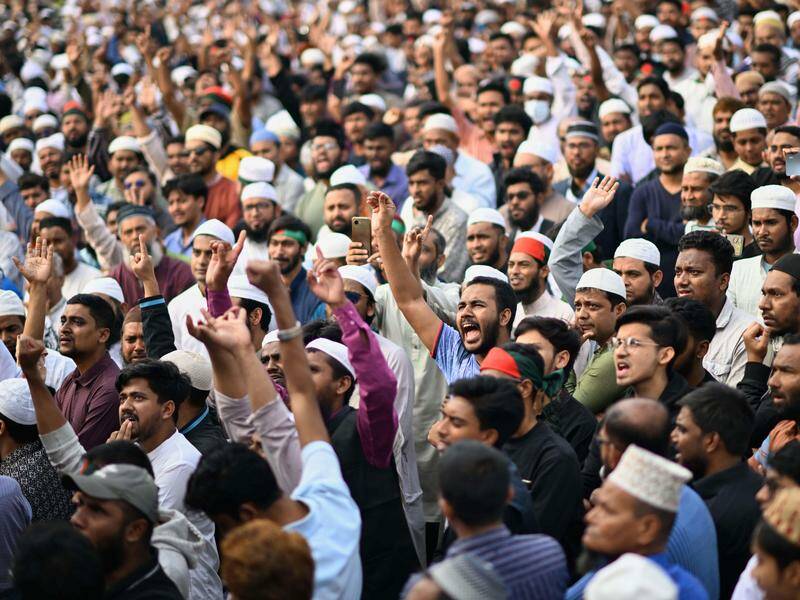
Hundreds of thousands gathered in Dhaka for the funeral of Sharif Osman Hadi, a prominent Bangladeshi activist who succumbed to gunshot wounds after an attack earlier this month. Hadi’s death on December 12, 2024, has intensified political tensions in Bangladesh, especially with national elections approaching in February 2025.
Hadi, a key figure in the political uprising that ended the 15-year rule of former Prime Minister Sheikh Hasina, passed away in a Singapore hospital on December 14. He had been shot in Dhaka while advocating for political reform. Police have identified suspects linked to the attack, and they believe the assailant may have fled to India. This incident has led to a diplomatic dispute between Bangladesh and India, prompting both countries to summon each other’s envoys for discussions.
Security was heavily enforced in Dhaka on the day of the funeral, which was held outside the national parliament complex. Hadi’s body was returned to Bangladesh on the evening of December 15, and the government declared a national day of mourning for December 16. Mourners, many carrying the national flag, expressed their grief by chanting slogans such as “We will not let Hadi’s blood go in vain.” Hadi’s burial is set to take place on the campus of Dhaka University, next to the grave of national poet Kazi Nazrul Islam.
The news of Hadi’s death provoked violent reactions, with protesters attacking the offices of two major national newspapers. In light of the unrest, Bangladesh’s interim leader, Nobel Peace Prize laureate Muhammad Yunus, has called for calm among the populace.
Hadi was known for his vocal opposition to both Hasina and the Indian government. Since fleeing Bangladesh in August 2024, Hasina has faced serious legal challenges, including a death sentence for crimes against humanity. The current political landscape is complex, with Yunus leading a transitional government aiming to restore democracy. The Awami League, Hasina’s party, remains one of the two dominant political forces, alongside the Bangladesh Nationalist Party led by former Prime Minister Khaleda Zia.
The Jamaat-e-Islami party, Bangladesh’s largest Islamist party, is also seeking greater political influence in the absence of Hasina’s leadership. The upcoming elections will be crucial for the future direction of the country, as various factions vie for power amid a backdrop of heightened tensions and public unrest.
As Bangladesh grapples with the aftermath of Hadi’s tragic death, the political stakes are high, and the need for stable governance is more pressing than ever. The nation stands at a crossroads, with the potential for both significant change and continued conflict.