



































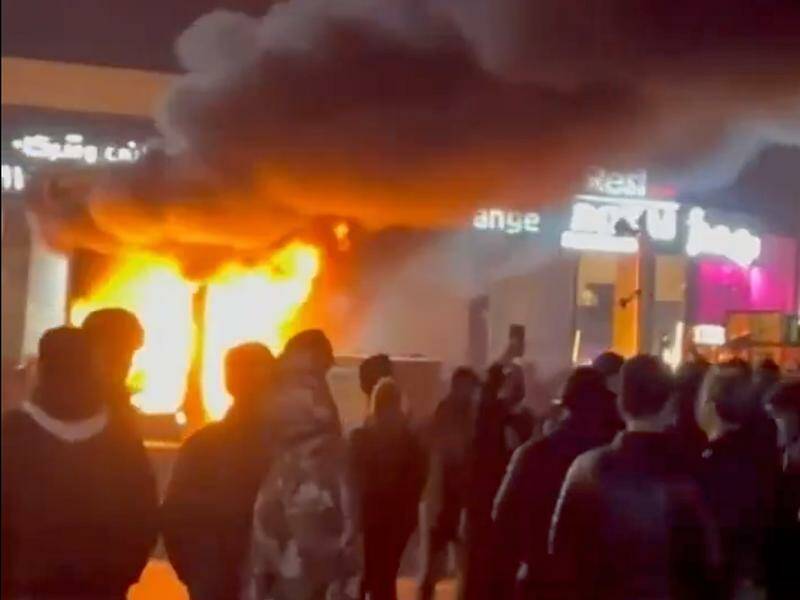
The Iranian Army has pledged to protect strategic infrastructure and public property amid escalating protests across the nation. This statement comes as authorities intensify efforts to suppress the largest demonstrations seen in years, which began in response to soaring inflation but have evolved into a broader call for political change. The military urged citizens to thwart “the enemy’s plots,” reflecting heightened tensions within the country.
The unrest continued overnight, particularly in Karaj, located west of Tehran, where state media reported a municipal building was set ablaze, attributing the act to “rioters.” In addition, state television aired funeral footage of security personnel allegedly killed during protests in cities such as Shiraz, Qom, and Hamedan. The Iranian authorities have also imposed an internet blackout, complicating communication and information dissemination.
Eyewitness accounts indicate that the Islamic Revolutionary Guard Corps (IRGC) has been deployed in various regions, reportedly opening fire on demonstrators. The IRGC operates separately from the Iranian Army, yet both are under the command of Supreme Leader Ayatollah Ali Khamenei. The military’s recent statement accused Israel and “hostile terrorist groups” of attempting to destabilize public security.
In a clear response to the unrest, the military emphasized its commitment to safeguarding national interests. “The army, under the command of the supreme commander-in-chief, together with other armed forces, will resolutely protect and safeguard national interests, the country’s strategic infrastructure, and public property,” the statement read.
The protests, which have expanded over the past two weeks, were triggered by economic grievances but quickly took on a political dimension, with demonstrators calling for an end to clerical rule. Iranian authorities have accused the United States and Israel of instigating the disturbances. Human rights organizations have reported at least 65 deaths, including 50 protesters and 15 security personnel, with more than 2,500 arrests recorded as of January 9.
Reza Pahlavi, the son of Iran’s last Shah, has emerged as a notable figure among the opposition, voicing support for the protesters from abroad. In a recent post on social media platform X, he stated, “Our goal is no longer merely to come into the streets; the goal is to prepare to seize city centres and hold them.” Pahlavi has also called on workers in key sectors, including transportation and energy, to initiate a nationwide strike.
Amidst this turmoil, former U.S. President Donald Trump reiterated his support for the Iranian people. Following a prior warning, he stated, “You better not start shooting because we’ll start shooting too,” expressing concern for the safety of the protesters.
As protests continue, many demonstrators have rallied around Pahlavi, although the majority of chants focus on ending clerical rule and addressing economic challenges exacerbated by international sanctions. In a recent address, Khamenei accused the protesters of acting in the interests of foreign adversaries, stating that Tehran would not tolerate “mercenaries for foreigners.”
The current situation presents a unique challenge for Iran’s clerical leadership, which appears increasingly vulnerable due to the ongoing economic crisis and recent conflicts. Past unrest, such as the protests of 1999, 2009, 2019, and the 2022 “Woman, Life, Freedom” movement, saw the regime withstand significant pressures. However, the combination of dire economic conditions and public discontent may pose a greater threat to the ruling establishment now than in previous years.
In response to the violence against protesters, countries such as Australia, Canada, and members of the European Union have issued statements condemning the killings and expressing solidarity with the Iranian populace. As the situation develops, international attention remains focused on Iran and the unfolding protests.
