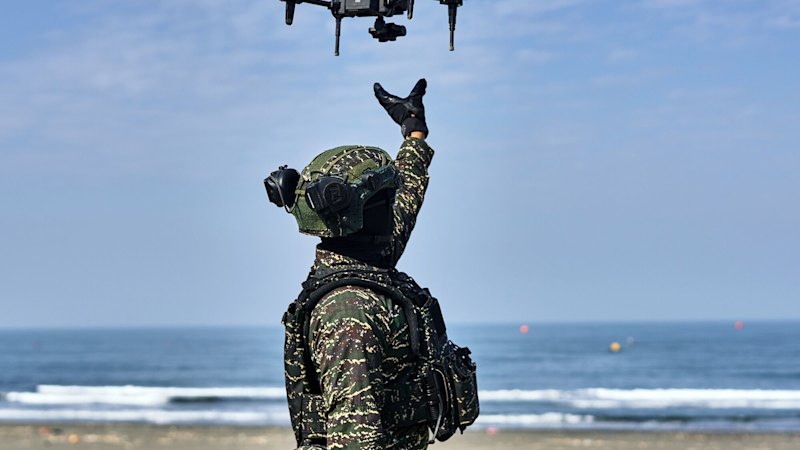
Elon Musk’s companies, SpaceX and xAI, are engaged in a confidential competition initiated by the Pentagon to develop advanced autonomous drone swarming technology. This contest, which offers a prize of $100 million, seeks to create drones capable of executing voice commands and operating in coordinated groups. The involvement of Musk’s firms marks a significant shift in his approach to artificial intelligence, as he has previously voiced concerns over the ethical implications of autonomous weapons.
The competition, launched in January 2024, is part of a broader effort by the Defence Innovation Unit and the Defence Autonomous Warfare Group to harness emerging technologies from the private sector. Participants, including only a select number of companies, are tasked with developing software that can manage multiple drones simultaneously, a feat that remains technically challenging. While multiple drones can currently be flown together, creating a swarm that can autonomously pursue targets is a more complex objective.
Progress in the contest will unfold in phases, contingent on the performance and engagement of participants. According to sources familiar with the initiative, the Pentagon aims to utilize these drones for offensive operations, emphasizing that human-machine interactions will influence the effectiveness of these systems.
As part of its preparation, xAI is actively recruiting software engineers with U.S. security clearance to work on projects related to military technology. Job postings indicate a focus on candidates with experience in collaborating with government agencies and Department of Defense contractors. This hiring effort follows xAI’s recent agreements to integrate its technology into military systems, including a significant $200 million contract with the Pentagon.
Historically, SpaceX has primarily concentrated on developing reusable rockets and satellite systems for various applications, including military communications and intelligence. The company has avoided delving into offensive weapon software but has established itself as a key player in the defense sector, alongside major contractors like Boeing and Lockheed Martin.
Despite Musk’s long-standing reservations about autonomous weapons that operate beyond human control, his current ventures seem to contradict his previous warnings. In 2015, he signed an open letter cautioning against the dangers posed by autonomous weaponry. His latest initiatives could provoke further debate regarding the ethical dimensions of AI in military applications.
Meanwhile, xAI, founded in 2023, has been positioned as a hub for Musk’s AI ambitions, encompassing various projects including a social media platform and chatbot technology. The company’s recent merger with SpaceX, valued at $1.25 trillion, aims to create a vertically integrated innovation engine that combines AI and aerospace capabilities. However, xAI faces challenges, including significant debt and competition from better-financed rivals, alongside scrutiny from regulators.
As this competition unfolds, the implications of Musk’s ventures into military technology may redefine the landscape of AI and defense. The results of the Pentagon’s challenge could shape the future of drone operations and raise critical questions about the role of technology in warfare.