



































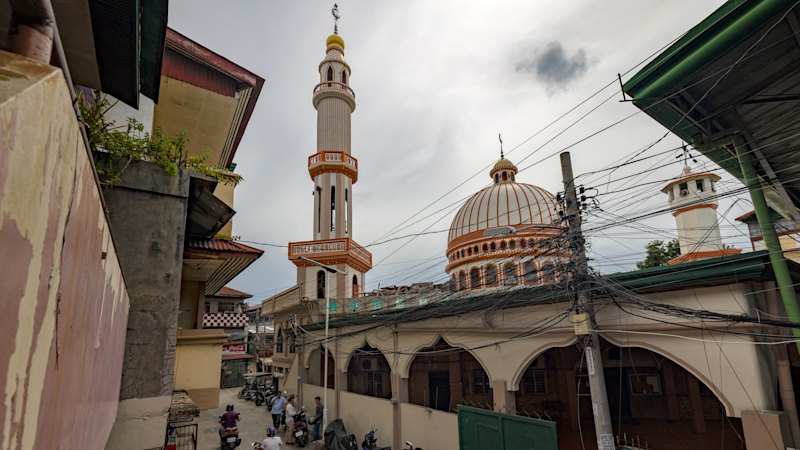
Pictures of the Bondi gunmen, Sajid and Naveed Akram, will be displayed at over 70 mosques in Davao City, Philippines, as local Muslim leaders aim to gather information about the pair’s activities during their month-long visit prior to a tragic shooting in Australia that claimed 15 lives. Sheikh Muhammad Yusop Pasigan, the region’s most senior Islamic cleric, emphasized the need for community vigilance, stating that the men were “no good – not good people.” He urged community members to contact police with any relevant information.
Sheikh Pasigan announced the initiative during a press briefing, revealing plans to display A4 printouts of the Akram duo’s images at mosque entrances. He stated, “We will post this above the doors of our mosques, front and back.” In an effort to enhance security, Sheikh Pasigan mentioned that newcomers at mosques would be asked for identification, and any suspicious behavior would be reported to local authorities by calling emergency services.
The investigation into the Akrams’ movements from November 1 to November 28 has revealed limited information, primarily obtained through a few surveillance camera images. The Philippines National Police confirmed that Sajid Akram, 50, visited a local gun shop during their stay. Additional footage captured the pair jogging and walking around their hotel area, while another video showed Naveed Akram, 24, out early in the morning near their accommodation.
Local authorities are exploring various leads, including a potential connection to two other men from Sydney who were in Davao during the same timeframe. Despite Davao being less frequented by tourists, Australian visitors often travel there for surfing trips to nearby Siargao Island. While Davao is predominantly Catholic, it is the largest city on Mindanao, an area historically associated with Islamist militant activity.
The Akrams were found to have homemade Islamic State flags in the car used during their December 14 attack at Bondi Beach. In response to negative media portrayals of Mindanao as a stronghold for violent extremism, the Philippine government asserted that Islamic State-affiliated groups have become fragmented and operationally weakened.
According to staff at the GV Hotel, where the Akrams resided for 27 days, the men reportedly only left their room for one to two hours each day. This suggests they may not have traveled far beyond Davao. When asked about extremist elements in the city, Sheikh Pasigan stated he had “no information” but is scheduled to meet with other senior Islamic leaders to discuss ways to gather intelligence about the Akrams.
Regional police director Leon Victor Rosete confirmed that investigations are ongoing, involving “backtracking operations” to identify individuals the Akrams may have interacted with and to assess any potential support networks. The collaborative effort aims to ensure community safety while addressing the tragic events that unfolded in Australia.
As the investigation continues, local leaders remain committed to fostering a safe environment and encouraging community cooperation in the face of such violence.
