



































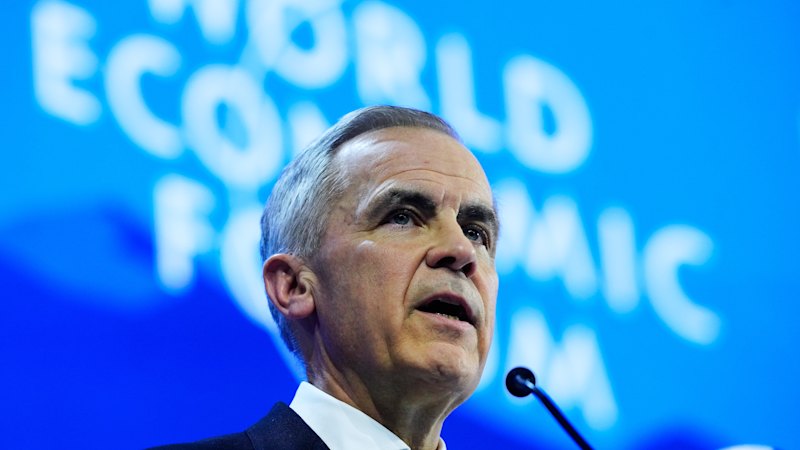
On January 27, 2026, US President Donald Trump announced via Truth Social that he has disinvited Mark Carney, the former Governor of the Bank of England, from an initiative he termed the “Board of Peace.” This public rebuke comes in the wake of Carney’s critical remarks delivered at the World Economic Forum in Davos, where he highlighted the shifting dynamics of global power and economic relationships.
Trump’s message to Carney was blunt. “Dear Prime Minister Carney,” he wrote, “please let this Letter serve to represent that The Board of Peace is withdrawing its invitation to you regarding Canada’s joining, what will be, the most prestigious Board of Leaders ever assembled.” This incident not only underscores the tensions between the United States and Canada but also reflects a broader struggle over international relations and the nature of leadership.
Carney’s speech at Davos addressed the concept of hegemon, a term he used repeatedly to describe the current state of American influence. He positioned the United States not as a partner in global prosperity but as a dominating force, indicating a shift in how nations perceive American power. During his address, Carney referenced Vaclav Havel‘s work, specifically his essay “The Power of the Powerless,” to illustrate how systems of oppression can perpetuate themselves through a façade of compliance.
Carney argued that economic integration is increasingly weaponized by major powers, suggesting that nations could no longer afford to pretend that mutual benefits exist when such integration often leads to subordination. His remarks coincided with Trump’s threats of tariffs against Europe if Greenland was not ceded to the United States, showcasing a transactional approach to diplomacy that starkly contrasts with Carney’s vision of cooperative international relations.
In response, Trump issued a pointed warning during his own speech, stating, “I watched your prime minister yesterday. He wasn’t so grateful. They should be grateful to us, Canada. Canada lives because of the United States.” This declaration encapsulates Trump’s view that American leverage should be unapologetically asserted, reinforcing the transactional nature of his foreign policy.
The philosophical divide between Carney and Trump is evident in their respective approaches to power and governance. Carney’s call for a more principled, respectful international order stands in stark contrast to Trump’s emphasis on leverage and dominance. In Trump’s perspective, as articulated in his book “The Art of the Deal,” the key to successful negotiations lies in leveraging power, often with little regard for longstanding partnerships.
While Carney’s speech sought to challenge the norm, it also demonstrated a willingness to confront power dynamics by advocating for a return to principles over transactionalism. His call for nations to reconsider their relationships with the United States resonates with concerns that allies may be increasingly looking to diversify their partnerships in light of perceived American overreach.
This divergence in ideology raises critical questions about the future of international alliances. Carney warned that as the United States attempts to monetize its relationships, allies will seek alternatives to hedge against uncertainty. This sentiment is already reflected in Canada’s growing ties with countries such as China and Qatar, indicating a shift in the global landscape as nations prioritize sovereignty and reciprocity over dependence.
In essence, the recent exchanges between Trump and Carney reveal a deepening rift in how global leaders envision their roles in an interconnected world. As Carney exemplifies, there remains a persistent hope that relationships can transcend mere leverage, fostering an international community grounded in mutual respect and shared values.
This ongoing dialogue highlights the complex nature of leadership in today’s world and suggests that the concept of power is as much about respect and cooperation as it is about strength and leverage. Only time will reveal the long-term implications of these contrasting philosophies on global diplomacy and governance.
