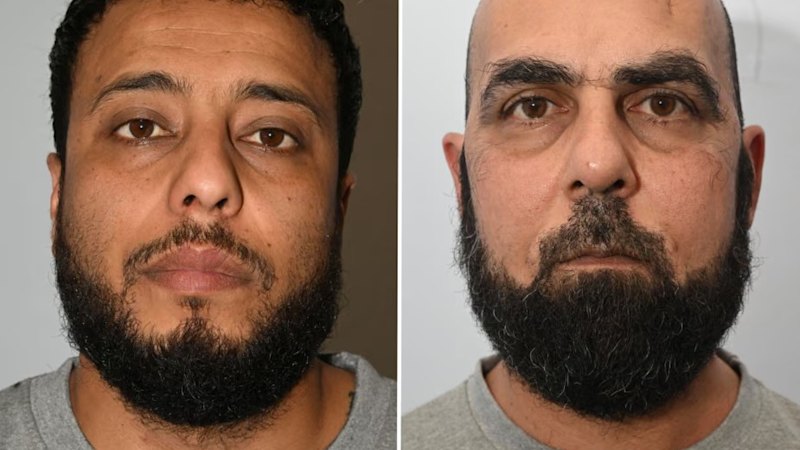
Two men were convicted on Tuesday, October 10, 2024, for plotting a terrorist attack against the Jewish community in the United Kingdom. The planned assault, inspired by Islamic State ideology, aimed to inflict mass casualties using automatic firearms. According to police and prosecutors, the convictions of Walid Saadaoui, 38, and Amar Hussein, 52, highlight a troubling resurgence of threats posed by militant groups.
The thwarted attack was described by Assistant Chief Constable Robert Potts, who oversees counter-terrorism efforts in northwest England, as potentially “one of, if not the, deadliest terrorist attacks in UK history.” This conviction follows a recent mass shooting in Australia that left 15 people dead, with Islamic State lauding the incident as a source of pride, increasing concerns over rising Islamist extremism.
While the current threat level is not as severe as it was during the peak of Islamic State’s power in Iraq and Syria, European security officials warn that the group and its affiliates are once again exporting violence and radicalizing individuals online. British Foreign Secretary Yvette Cooper noted a concerning escalation of terrorist threats across Europe.
Plot Details and Arrests
Prosecutors revealed that Saadaoui and Hussein had fully embraced Islamic State’s extremist views and were prepared to die as martyrs for their cause. Saadaoui had made arrangements to smuggle two assault rifles, an automatic pistol, and nearly 200 rounds of ammunition into the UK through the port of Dover. He was arrested in May 2024 before his plans could be executed.
The investigation revealed that Saadaoui sought to acquire additional weapons, including two more rifles and at least 900 rounds of ammunition. Unbeknownst to him, the man he was negotiating with, known as “Farouk,” was an undercover operative, thwarting his intentions before they could be realized.
Prosecutor Harpreet Sandhu stated that the firearms Saadaoui aimed to procure were similar to those used in the 2015 Bataclan attack in Paris, which resulted in 130 fatalities. Saadaoui had expressed admiration for Abdelhamid Abaaoud, the mastermind behind that attack, in communications with “Farouk.” He referred to the Paris incident as “the biggest operation after that of Osama (bin Laden),” alluding to the September 11, 2001, attacks in the United States.
Potts emphasized that Saadaoui’s communications indicated his belief that a less lethal attack would not suffice. He was determined to kill as many Jewish individuals as possible, dismissing the idea of using less lethal means, such as knives or vehicles.
Trial and Sentencing
Both Saadaoui and Hussein pleaded not guilty to the charges, with Saadaoui claiming he only participated in the plot due to fears for his safety. Hussein, who attended the trial sporadically, made headlines during the first day by shouting “how many babies?” in reference to the ongoing conflict in Gaza.
The jury at Preston Crown Court convicted the men of a single charge of preparing terrorist acts. Saadaoui’s brother, Bilel Saadaoui, 36, was also found guilty of failing to disclose information about acts of terrorism, although prosecutors indicated he was reluctant to participate in the attack.
This foiled plot represents a broader trend in the UK and Europe, as Islamic State has sought to inspire violence since its emergence in Iraq and Syria a decade ago. Although the group has lost significant territory, it continues to propagate its ideology and encourage attacks worldwide.
According to the SITE Intelligence Group, following the recent Bondi Beach attack in Australia, Islamic State has intensified its calls for action, particularly targeting Belgium. A European intelligence official, speaking on condition of anonymity, noted that the group has been flooding social media with propaganda, leading to an uptick in terrorism investigations compared to previous years.
In a statement from Ken McCallum, head of Britain’s domestic intelligence agency MI5, he revealed that since the start of 2020, the agency has thwarted 19 late-stage attack plots and intervened in numerous other threats. McCallum stated, “Terrorism breeds in squalid corners of the internet where poisonous ideologies, of whatever sort, meet volatile, often chaotic individual lives.”
The convictions of Saadaoui and Hussein serve as a stark reminder of the ongoing threat posed by extremist ideologies and the necessity for vigilance in counter-terrorism efforts across the region.