



































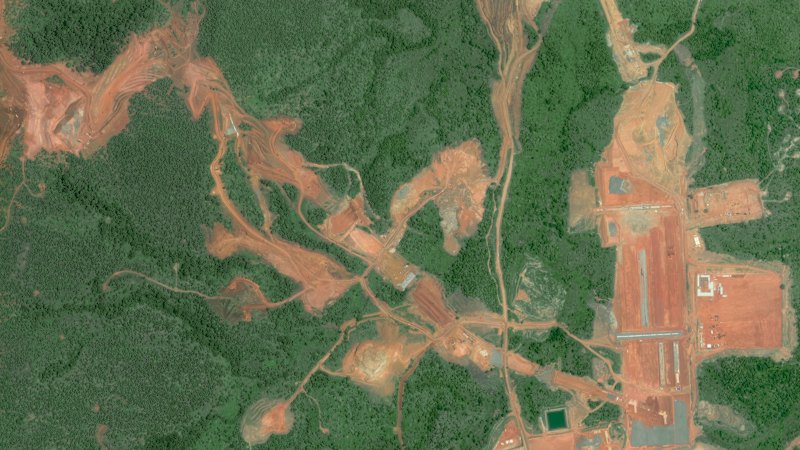
The battle for iron ore supremacy in Guinea intensifies as Ivanhoe Atlantic, a US-based mining company, positions itself against the $23 billion Rio Tinto Simandou project. Located approximately 160 kilometres from Simandou, Ivanhoe’s Kon Kweni deposit boasts iron ore with a remarkable purity of 66.5 percent, making it one of the highest quality reserves globally.
Founded by American-Canadian entrepreneur Robert Friedland, Ivanhoe Atlantic aims to establish its project as a significant alternative to the China-led iron ore supply chain. The company has branded its initiative the “Liberty Corridor,” which is designed to deliver high-grade iron ore to Western markets. Bronwyn Barnes, president and chief executive of Ivanhoe Atlantic, emphasized that the $1.8 billion project is aimed at “countering China’s tightening grip over critical minerals.”
Transporting ore through neighboring Liberia, Ivanhoe seeks to bypass the 600-kilometre railway constructed by China, which connects Simandou to Chinese mills via a Guinean port. “Every tonne we produce is reserved exclusively for US and allied supply chains,” Barnes asserted, noting that none of the ore will be destined for China.
Despite its ambitions, Ivanhoe Atlantic faces hurdles linked to geopolitical dynamics and local governance. Recent developments indicate that some Guinean officials are hesitant about an agreement made by a previous administration, which permitted Ivanhoe to export ore through Liberia. A senior mining official in Guinea stated that the new government wishes to maximize its own resource revenues, casting doubt on Ivanhoe’s ability to export through Liberian railways.
The importance of US support is underscored by the complex relationships between American firms and African nations. Although the Liberty Corridor project has received tacit support from former President Donald Trump, doubts remain regarding his direct involvement. A senior Liberian official, speaking anonymously, noted that during a meeting in July with Liberian President Joseph Boakai, Trump appeared unfamiliar with the project.
In response to concerns about the US-China rivalry, Peter Pham, Ivanhoe’s chair and Trump’s former special envoy, suggested that the former president supports the overarching goals of the Liberty Corridor without being fully informed of its specific details. A senior official from the Trump administration reiterated that the administration has prioritized securing critical minerals supply chains through American companies.
While the support of the Guinean government is crucial, Ivanhoe Atlantic must also navigate the realities of sharing infrastructure with existing investors. ArcelorMittal, the largest investor in Liberia, has expressed concerns about the implications of sharing its railway, which transports its own iron ore. Paul Weigh, head of communications at ArcelorMittal, clarified that the railway is open for use by others, provided they invest in developing additional capacity.
Recent political scrutiny in the US complicates matters further. John Moolenaar, a Republican congressman and chair of the House China Committee, has raised alarms about Ivanhoe Atlantic’s potential ties to Chinese interests. In a letter to US Secretary of State Marco Rubio, Moolenaar claimed that Ivanhoe Atlantic is serving Chinese interests due to its links with companies like China Citic and Zijin Mining through Ivanhoe Mines, which he referred to as a “sister company” to Ivanhoe Atlantic.
Ivanhoe responded to these accusations, asserting that Moolenaar had conflated Ivanhoe Atlantic with Ivanhoe Mines, emphasizing that they are separate entities with distinct assets and management. The majority shareholder of Ivanhoe Atlantic is I-Pulse, a privately held company founded by Friedland, with Ivanhoe Mines holding a small stake in I-Pulse.
Political analyst Peter Mallin-Jones noted that long-term mining projects like Ivanhoe’s are susceptible to the shifting political landscape in Washington. He remarked that the US is lagging behind China, which has significantly invested in African mines and infrastructure over the past decade. While Washington has increased funding for mining-related infrastructure projects in Africa, its strategy has lacked the consistency seen in Chinese investments.
As Ivanhoe Atlantic prepares for a potential shipment of ore in the first half of 2027, it has received preliminary approval to list on the Australian Securities Exchange. This move could materialize once Liberia ratifies the railway agreement. Barnes expressed confidence that Guinea would adhere to the 2019 agreement, which Ivanhoe describes as legally binding.
As the competition for mineral resources heightens, the challenges faced by Ivanhoe Atlantic illustrate the intricate interplay of international interests and local governance in Africa’s mining sector. The outcome of this venture may significantly influence not only the regional economy but also the broader dynamics between the US and China in the critical minerals market.
