Recent research published in Nature challenges long-held beliefs about ocean conditions during the last ice age. The study reveals that the North Atlantic Deep Water (NADW) was only about 1.8°C colder than today, contradicting previous assumptions of near-freezing temperatures. This finding suggests that despite the severe climate of the Last Glacial Maximum (LGM), which occurred around 19,000 to 23,000 years ago, the ocean’s circulation system remained active.
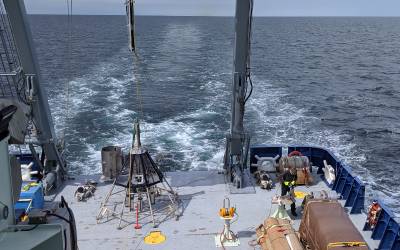
The researchers conducted a detailed analysis of microfossils found in sediment from various depths in the North Atlantic, specifically off the coasts of the Bahamas, Bermuda, South Carolina, and Iceland. These tiny fossil shells, known as foraminifera, provide insights into the temperature and salinity of the seawater at the time they existed. By examining samples collected from depths between 1.5 and 5 kilometres, the team could reconstruct deep ocean conditions and found that NADW maintained a depth range similar to today.
Implications for Climate Models and Future Predictions
According to lead author Dr Jack Wharton from UCL Geography, the research highlights that the deep Atlantic remained relatively warm and salty during one of Earth’s coldest periods. He stated, “Taken together, our data tell us the ocean’s circulation system kept running even under extreme conditions, which is crucial for understanding how our climate engine works.” This research supports climate model projections that suggest the NADW’s unique conditions allowed for continued heat transport during the ice age.
The findings also raise alarm about the potential future of the Atlantic Meridional Overturning Circulation (AMOC), a critical component of Earth’s climate system. As surface waters in the North Atlantic warm, they become less dense and are less able to sink, which could weaken the AMOC. This weakening could lead to significant cooling in regions such as Europe and North Africa, affecting weather patterns and agricultural productivity.
Co-author Professor David Thornalley confirmed the research’s implications, stating, “The microfossils recovered from the ocean floor show that deep waters in the North Atlantic were far from freezing during the last ice age.” The study illustrates that warm, salty surface waters continued to sink, forming NADW at depths comparable to those seen today.
Potential Consequences of AMOC Weakening
Climate models indicate that if the AMOC were to collapse, there could be severe consequences for the climate in Europe and beyond. Estimates suggest average annual temperatures in the UK could decrease by as much as 7°C by the end of the century, with winter temperatures plummeting by up to 15°C. Such changes could lead to frozen sea ice reaching the shores of Scotland and significantly reduce arable land across the UK and continental Europe.
Co-author Professor Mark Maslin emphasized the urgency of understanding these mechanisms, stating, “This research helps us better understand the mechanisms that drive ocean circulation and improves our ability to predict future climate change.” The study underscores the importance of continued research in climate science, particularly as it relates to the vulnerabilities of ocean currents under changing global temperatures.
This research was supported by the Natural Environment Research Council (NERC), the Leverhulme Trust, the European Union’s Horizon Europe research and innovation programme, and the National Science Foundation (NSF). Collaboration included contributions from Utrecht University, the University of Colorado Boulder, and the Woods Hole Oceanographic Institution.