



































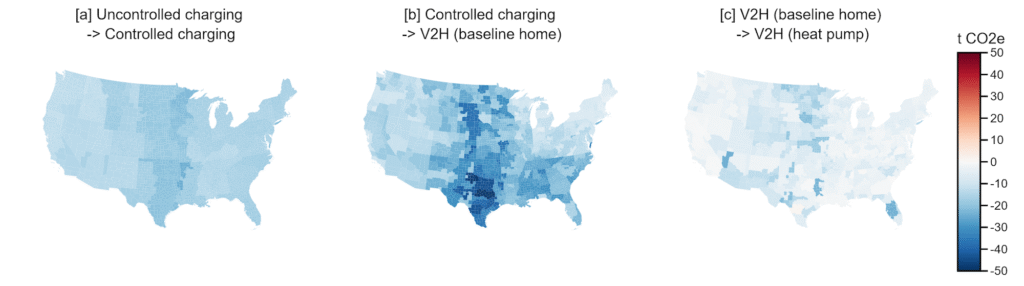
Research conducted by the University of Michigan and Ford Motor Company suggests that using electric vehicle (EV) batteries for home energy needs could lead to significant savings and a drastic reduction in greenhouse gas emissions. The study, published in the journal Nature Energy, highlights the potential of vehicle-to-home (V2H) charging, a technology that allows EV owners to draw power from their vehicle’s battery to supply electricity to their homes.
According to the findings, V2H can save owners between $2,400 and $5,600 over the lifetime of their vehicle by reducing charging costs by 40% to 90%. Additionally, households utilizing this technology could cut their lifecycle greenhouse gas emissions from electricity use by an impressive 70% to 250%, equivalent to eliminating between 24 and 57 tons of carbon dioxide emissions. This reduction could be likened to the emissions produced by driving a small gas-powered SUV for up to 190,000 miles or taking up to 190 one-way flights between New York and Los Angeles.
Understanding the Benefits of V2H Technology
Parth Vaishnav, an assistant professor at the University of Michigan’s School for Environment and Sustainability (SEAS), explained the fundamental mechanics behind V2H technology. “Putting vehicle batteries between the electricity grid and homes makes it possible for homes to buy electricity for all household uses when it is cheap and clean—for example, in the afternoon, when there is a lot of solar power,” he stated. This innovation enables EVs to function as mobile energy storage units, allowing homeowners to store energy when it is most affordable and environmentally friendly.
The study analyzed a representative mid-sized SUV and considered various factors such as grid energy costs, emissions, and local climate influences to assess the potential benefits of V2H across the contiguous United States. The researchers divided the country into 432 regions based on shared grid conditions and climate characteristics.
Jiahui Chen, the lead author of the study and a doctoral student at SEAS, noted that while the benefits of V2H may vary by location, the technology can effectively reduce greenhouse gas emissions in areas accounting for 60% of the U.S. population. In states like Texas and California, the cost savings achieved through V2H can surpass those of traditional charging methods, potentially offsetting the electricity needed for driving.
Challenges and Future Prospects
Despite the promising findings, the research team emphasized that challenges remain before V2H technology becomes widely implemented. While the concept is not new, the practical application of V2H in U.S. homes requires further development. Hyung Chul Kim, a research scientist at Ford and co-author of the study, pointed out that existing technology for controlling charging and optimizing V2H is not yet fully operational across the country. “This capability is promising but still in its early stages,” he remarked.
The study also aims to inform decision-makers about the feasibility of implementing V2H systems in homes. Solutions are currently being tested in collaboration with local utilities to refine the technology and maximize battery longevity. Kim highlighted the goal of creating a seamless experience for EV owners: “Drivers won’t have to change anything—they would park and plug in their EVs as normal, while technology running in the background finds the best charging and discharging times.”
As EV infrastructure continues to evolve, the research team hopes to reshape public perception of energy usage in relation to vehicles. Robb De Kleine, a life cycle research analyst at Ford, emphasized the potential for EVs to serve as critical energy storage solutions. “We know that vehicles are parked the vast majority of the time, and as this infrastructure develops, there’s a great opportunity here,” he said.
The study’s findings underline the substantial economic and environmental benefits of V2H technology while advocating for further exploration and investment in this innovative approach to energy management.