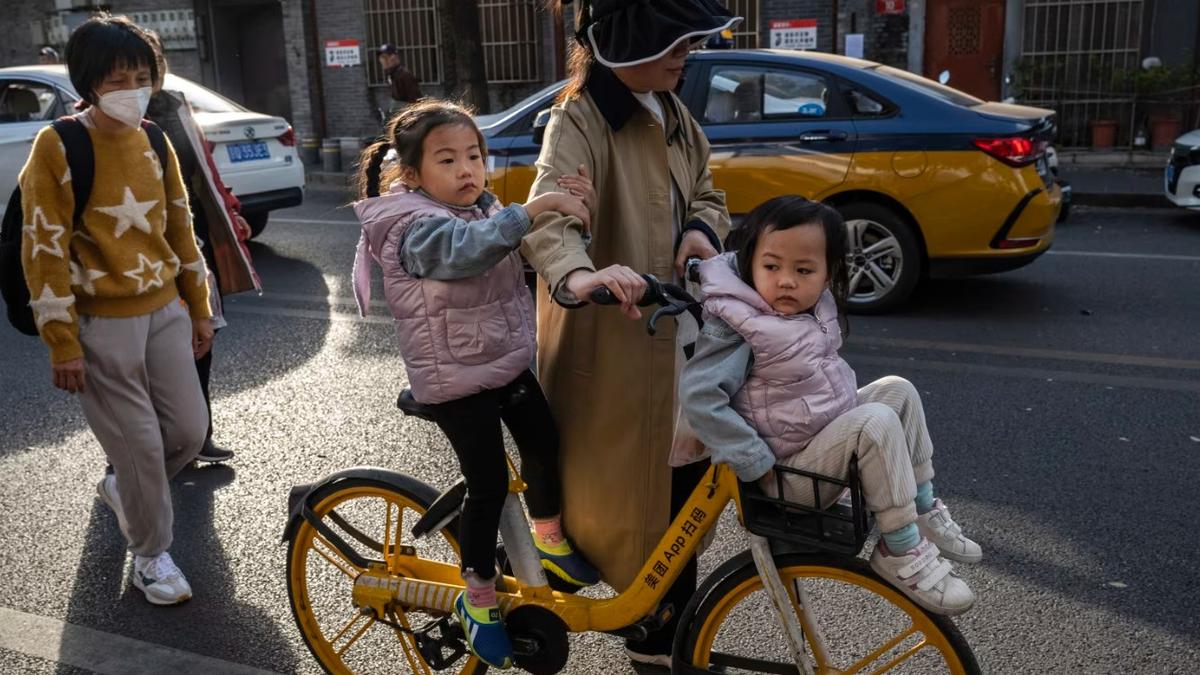
China is grappling with a declining birth rate, prompting the government to shift its approach from imposing fines for having too many children to offering financial incentives for families to have more. This dramatic change in policy reflects a growing concern about an aging population and a shrinking workforce.
Zane Li, now 25, recalls the impact of China’s former one-child policy on his family. When his baby sister was born, his parents were fined 100,000 yuan (approximately $A21,440), which was nearly three times their annual income from selling fish. The financial burden forced Li to take on household responsibilities at a young age, shaping his outlook on family life. Today, he has no plans to have children, a sentiment shared by many in his generation, which raises alarms for the government.
In a bid to counteract the declining birth rates, the Chinese government recently announced a new annual subsidy of 3,600 yuan (around $A772) for each child until the age of three, retroactive to January 1, 2024. Yet, for many young adults like Li, this amount does not adequately address the high costs associated with child-rearing. According to research from the Beijing-based YuWa Population Research Institute, raising a child to age 18 costs an average of 538,000 yuan (about $A115,345), significantly more than six times China’s GDP per capita.
In cities like Shanghai and Beijing, the costs can exceed 1 million yuan and 936,000 yuan respectively. Li expressed skepticism about the new subsidy, stating, “The cost of raising a child is enormous, and 3,600 yuan a year is a mere drop in the bucket.” His concerns are echoed by many in an increasingly competitive job market, particularly among those facing high housing prices and job insecurities.
The shift from punitive measures to supportive ones represents a significant policy change. For decades, local authorities enforced the one-child policy through fines, forced abortions, and sterilizations. Now, the central government is standardizing a nationwide program with an allocation of 90 billion yuan (approximately $A19.2 billion) aimed at benefiting 20 million families this year. According to Emma Zang, a demographer and sociology professor at Yale University, “It’s a signal that the government sees the birth rate crisis as urgent and national.”
While the announcement of the new subsidy has been generally welcomed, experts warn it may not significantly impact birth rates. Similar initiatives in other East Asian countries, such as Japan and South Korea, have not successfully reversed declining fertility trends. Many young Chinese continue to face hurdles that extend beyond financial considerations.
Gao, a 27-year-old woman from Guizhou, highlights the emotional toll of child-rearing. She was sent to live with her grandmother to allow her parents to have more children while avoiding penalties from family planning officials. Now, Gao has no interest in marriage or motherhood, stating, “Knowing that I can’t provide a child with a good environment for education and life, choosing not to have one is also an act of kindness.”
The sentiment among many young adults today is one of disillusionment. As property prices soar and job security diminishes, a growing number are opting out of traditional milestones such as marriage and parenthood. This sense of futility is captured in the popular term “involution,” which describes the excessive competition leading to diminishing returns in life.
June Zhao, 29, who grew up in Beijing, shared her experience of relentless academic pressure. After completing her education abroad, she returned to work in investor relations but struggles to envision raising a child given her busy lifestyle. “The cost is simply too high and the returns too low,” she remarked, reflecting the pervasive anxiety about the future among her peers.
Moreover, the existing gender imbalance in caregiving remains a significant factor. Women often bear a heavier burden in balancing work and family life. Zhao observed her mother’s struggles to manage both responsibilities and noted, “I know for a fact that women bear a much heavier burden and cost than men when it comes to raising a family.”
In light of declining fertility rates, the Chinese government has emphasized traditional roles for women as part of family values. Yet, Zang argues that expecting women to return to these roles without addressing the underlying challenges is unrealistic. “Today’s young women are highly educated, career-oriented, and want more equality,” she stated.
For the government to effectively encourage higher birth rates, comprehensive support systems must be established, such as paternity leave, workplace protections, and flexible job opportunities. Until these structural changes are made, many young adults may continue to view parenting as an unattainable goal, regardless of financial incentives. As Zhao concluded, “You only feel the urge to have children when you believe the days to come will be good.”