



































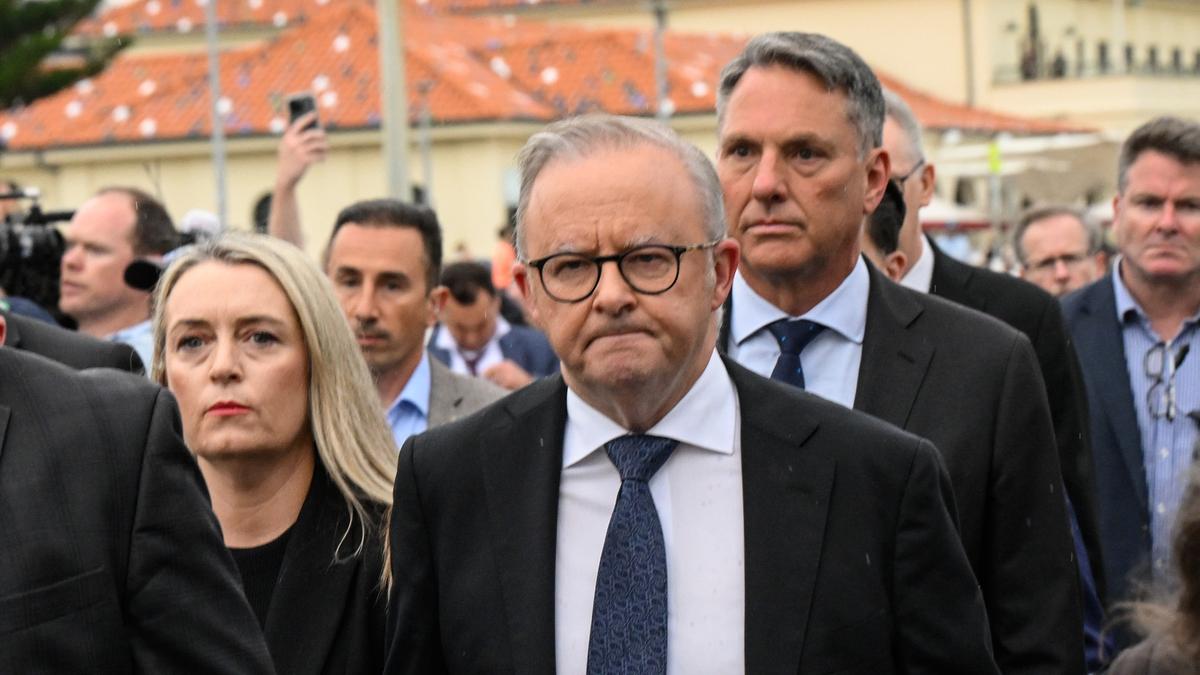
The recent National Day of Reflection Service in Bondi Beach became a focal point for growing tensions surrounding Prime Minister Anthony Albanese‘s handling of antisemitism in Australia. Attendees expressed their frustration with Albanese as he was met with boos and jeers, a stark contrast to the warm reception given to New South Wales Premier Chris Minns and state Liberal Leader Kellie Sloane, who received standing ovations for their responses to the recent violence against the Jewish community.
The service was organized in the wake of a tragic incident where two gunmen, Sajid and Naveed Akram, killed 15 individuals, including a Holocaust survivor and a ten-year-old girl, during a Hanukkah celebration. Premier Minns has since committed to strengthening laws against hate speech and has called for a state Royal Commission to investigate the circumstances surrounding the attack. His decisive actions have resonated with the community, earning him praise for his leadership during this difficult time.
Community Response to Leadership
At the memorial, Minns emphasized the dangers of antisemitism, highlighting its evolution from harmful rhetoric to violent acts. His remarks struck a chord with the audience, including Sloane, who was a first responder at the scene of the shooting. She recounted her harrowing experience of providing first aid amidst chaos, which further solidified her standing in the community.
In contrast, Albanese’s presence at the event was met with hostility. The Prime Minister has faced criticism for what many perceive as a slow and inadequate response to the rising tide of antisemitism in Australia. His initial proposals to reform gun laws drew skepticism, with former Prime Minister John Howard publicly denouncing the approach as insufficient. Following this backlash, Albanese pivoted to announce measures targeting antisemitism, but many view these efforts as too little, too late.
Calls for a Royal Commission
Contentions grew further when Albanese announced a review of Australia’s intelligence agencies instead of pursuing a full Commonwealth Royal Commission. ASIO Director-General Mike Burgess welcomed the review, acknowledging the limitations of intelligence capabilities in preventing the attack. He stated, “Tragically, in this case we did not know about the attack before it happened,” which he described as a source of grave regret.
Critics, including David Ossip from the New South Wales Board of Deputies, have called for a more comprehensive inquiry at the federal level. “It cannot be disputed that we need a royal commission which goes beyond New South Wales to get to the bottom of how this catastrophe took place,” Ossip remarked at the Reflection Day ceremony. He contrasted Minns’ active engagement with the Jewish community with Albanese’s absence from key memorial events.
The Prime Minister’s reluctance to embrace a thorough inquiry has raised doubts about his commitment to addressing antisemitism effectively. While he vowed to “eradicate antisemitism,” the community is waiting for tangible actions that match the severity of the situation. Observers note that the Prime Minister’s cautious approach may hinder his ability to restore trust with the Jewish community, which is seeking decisive leadership in the face of recent tragedies.
As the fallout from the Bondi attack continues, it is clear that Albanese’s political future may hinge on his response to these mounting challenges. The contrast between his leadership style and that of Minns is evident, with the latter demonstrating a proactive stance that resonates with the public. Should Albanese fail to take decisive action, he risks being seen as reactive rather than a leader capable of guiding the nation through its most pressing issues.
